

Sourcing reliable, dimensionally precise aluminum parts remains one of the biggest hurdles for many manufacturers. Substandard components often result in project delays, cost overruns, and even long-term damage to a company’s reputation. By leveraging aluminum casting technology, businesses can access proven processes, optimized materials, and rigorous quality control standards. This guide equips you with the essential knowledge to make confident decisions, ensuring that every component you procure is both high-performing and dependable for your specific applications.
1. Intro to aluminum casting technology
The process transforms aluminum into complex shapes by melting the metal and pouring it into a mold. Quality control at each step is paramount for producing durable and precise parts. This ensures the final product meets your exact specifications.
The fundamental casting process
What’s the bottom line? The basic process involves creating a mold, melting the aluminum, and pouring it to create the final part. To guarantee success, you must focus on:
- Mold design accuracy
- Consistent melt temperature
- Controlled pouring speed
Melting and pouring procedures
Here’s the deal: Proper melting is vital to maintain the aluminum’s integrity before it is poured into the mold. Your team should monitor key factors including:
- Furnace temperature controls
- Metal purity and cleanliness
- Pouring technique to avoid defects
Solidification and cooling stages
What does this mean for you? The cooling phase determines the final grain structure and mechanical properties of your casting. Controlled cooling helps prevent:
- Internal stress fractures
- Porosity issues
- Dimensional warping
| Stage | Objective | Critical Factor |
|---|---|---|
| Melting | Achieve liquid state | Consistent Temperature |
| Pouring | Fill the mold cavity | Flow Rate Control |
| Cooling | Solidify the part | Cooling Rate |
This process flow demonstrates that each stage builds upon the last, making control essential throughout. Key Takeaway: Mastering the fundamental stages of melting, pouring, and cooling is non-negotiable for achieving high-quality results with aluminum casting technology.
2. Core aluminum casting technology types
Different casting methods offer unique advantages depending on your project’s volume, complexity, and budget. Permanent mold casting is ideal for high-volume, repeatable production. Investment casting excels at creating intricate, detailed parts.
What is permanent mold casting?
You might be wondering: How does it work? Permanent mold casting uses reusable steel dies to form parts, offering excellent dimensional accuracy and surface finishes. This method is perfect if you need:
- High production volumes
- Consistent part quality
- Superior mechanical properties
The investment casting method
The real question is, when should you use it? Investment casting creates highly detailed components by forming a ceramic shell around a wax pattern. It is the preferred choice for:
- Extremely complex geometries
- Parts requiring a fine surface finish
- Low-to-medium volume production
Comparing tilt vs. semi-perm mold
But what’s the difference? Tilt-pour casting gently fills the mold to reduce turbulence, while semi-permanent mold uses sand cores for complex internal shapes. Your choice depends on:
- The part’s internal complexity
- Required fill speed and quality
- Desired surface finish standards
| Method | Best For | Key Advantage |
|---|---|---|
| Permanent Mold | High Volume | Repeatability, Strength |
| Investment | High Complexity | Fine Detail, Finish |
| Tilt Pour | Delicate Fills | Reduced Turbulence |
This comparison shows a clear trade-off between production volume and the ability to produce complex part geometries. Key Takeaway: Select the aluminum casting technology that best aligns with your part’s complexity and required production volume.
3. Materials in aluminum casting technology
The selection of aluminum alloys and molding materials directly impacts the final product’s strength, weight, and durability. Using the right materials is as important as the casting process itself. This ensures your components perform correctly in their intended application.
Selecting the right aluminum alloys
Here’s the deal: The alloy you choose determines the casting’s final characteristics. Consider what properties are most important for your application, such as:
- High strength-to-weight ratio
- Corrosion resistance
- Thermal conductivity
The function of molding materials
Why does this matter? The mold material, typically steel for permanent molds, must withstand extreme temperatures while retaining intricate design details. Key attributes for mold materials are:
- High thermal durability
- Resistance to wear and tear
- Ability to produce a fine surface
How material choice affects quality
The bottom line is simple: Your material choices directly influence the quality and performance of the final cast aluminum product. Poor material selection can lead to:
- Reduced component lifespan
- Structural failures under stress
- Inconsistent product quality
| Material | Role | Impact on Quality |
|---|---|---|
| Aluminum Alloy | Base Component | Defines strength, weight |
| Mold Steel | Forms the Part | Determines finish, accuracy |
| Sand Core | Creates Voids | Enables complex internals |
This illustrates how different materials work together to create a final product with specific, engineered properties. Key Takeaway: Strategic selection of both aluminum alloys and mold materials is foundational to successful aluminum casting technology.
4. Mold design & aluminum casting technology
A well-designed mold is the cornerstone of a successful casting process, ensuring dimensional accuracy and part quality. Permanent molds are favored for their durability and consistency in high-volume production. Proper design prevents defects and optimizes manufacturing efficiency.
Why permanent molds are superior
You might be asking, what makes them better? Permanent molds, made from steel, can be used for thousands of cycles, offering unmatched consistency. You benefit from:
- Excellent dimensional repeatability
- Superior surface finish
- Lower cost-per-part on large runs
Key factors in mold selection
What should you consider? Choosing the right mold requires balancing several factors to meet your production goals. Key decision points include:
- The complexity of the part design
- Expected production volume
- Desired final material properties
Avoiding common mold-related defects
Here’s how you can prevent issues: Proactive mold design helps you avoid common defects like shrinkage or hot tears. Focus on designing for:
- Proper gating and runner systems
- Effective heat extraction
- Strategic part ejection
| Design Factor | Purpose | Benefit |
|---|---|---|
| Gating System | Controls metal flow | Prevents turbulence |
| Cooling Channels | Manages heat | Ensures uniform solidification |
| Draft Angles | Eases part removal | Avoids surface damage |
This analysis shows that intelligent mold design is a proactive measure to ensure part quality and process efficiency. Key Takeaway: Investing in superior mold design is crucial for leveraging the full potential of aluminum casting technology.
5. Key aluminum casting technology equipment
High-quality equipment is essential for transforming raw aluminum into precise components. Furnaces melt the metal, while die casting machines inject it into molds under pressure. The right tools ensure a repeatable and efficient casting process from start to finish.
The central role of furnaces
Here’s the deal: Furnaces are responsible for melting aluminum to the precise temperature required for casting without compromising its integrity. Key furnace features for you include:
- Accurate temperature control
- Energy efficiency
- Consistent heating patterns
Understanding die casting machines
What does this mean for you? Die casting machines press molten aluminum into molds with high pressure, ensuring complete cavity fill and part density. Look for machines that provide:
- Consistent injection pressure
- Reliable cycle times
- Advanced process monitoring
Essential tools for the foundry
The bottom line is this: Beyond major machinery, a foundry relies on critical tools to support the casting process. These essential items help you maintain quality and include:
- Durable crucibles for metal transport
- Pyrometers for temperature verification
- Dies and molds for shaping parts
| Equipment | Function | Desired Outcome |
|---|---|---|
| Furnace | Melts aluminum | Purity, correct temperature |
| Die Cast Machine | Injects metal | Density, accuracy |
| Crucible | Transports molten metal | Safety, minimal heat loss |
The synergy between this equipment is what enables a modern foundry to produce high-quality parts efficiently. Key Takeaway: Investing in quality equipment is a direct investment in the quality of your final aluminum castings.
6. Precision aluminum casting technology
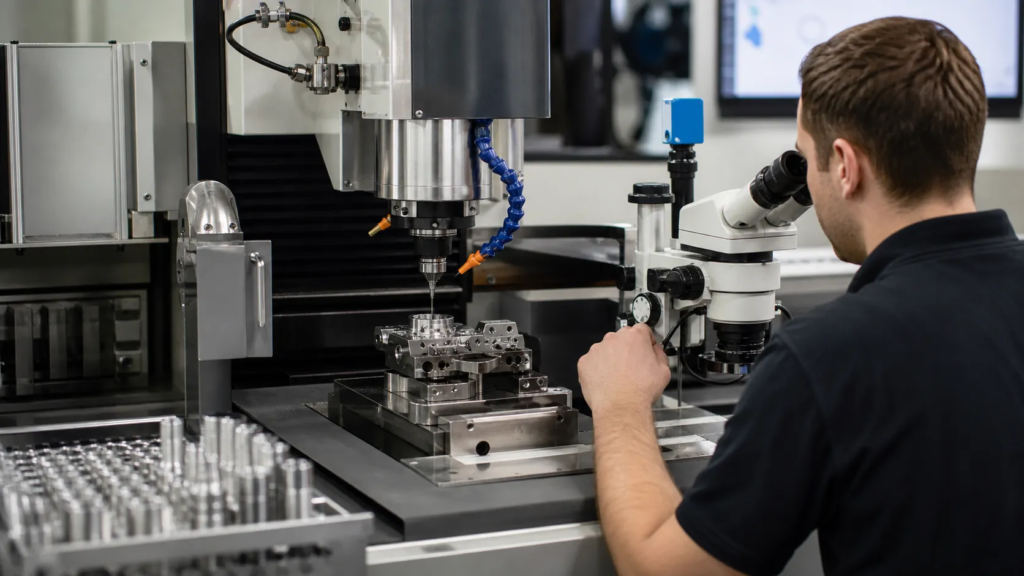
Using precisely machined dies is the only way to guarantee consistent and accurate aluminum castings. Dies serve as reusable steel molds that define the final shape and tolerances of your parts. This method is fundamental to achieving uniformity in large production runs.
How dies ensure casting accuracy
You might be wondering: how does it work? A well-crafted die is a mirror image of your final part, and its precision directly translates to the casting. To ensure accuracy, your die must have:
- Tight manufacturing tolerances
- A high-quality surface finish
- Robust and durable construction
Designing dies for complex parts
What’s the catch? Designing dies for complex geometries requires careful planning to manage metal flow and cooling. You need to incorporate features like:
- Lifters or slides for undercuts
- Multiple gates for uniform filling
- Venting to allow trapped air to escape
Maintaining dies for longevity
Here’s the bottom line: Proper maintenance is critical for extending the life of your dies and ensuring consistent part quality over time. Your maintenance plan should include:
- Regular cleaning and inspection
- Lubrication of moving components
- Timely repair of any wear or damage
| Action | Purpose | Benefit |
|---|---|---|
| Precision Machining | Create an accurate die | Part-to-part consistency |
| Complex Design | Accommodate features | Enables intricate shapes |
| Regular Maintenance | Preserve die condition | Extends tool life, saves cost |
This breakdown clarifies that a die’s lifecycle—from design to maintenance—is critical for precision manufacturing. Key Takeaway: The quality of your die dictates the precision of your final part in aluminum casting technology.
7. QA for aluminum casting technology
Quality assurance is not an afterthought; it is integrated throughout the casting process to guarantee part integrity. This includes pressure testing for leaks and applying finishing processes for final validation. Every step ensures your components meet stringent performance standards.
What is pressure & helium leak testing?
Here’s the deal: Pressure and helium testing are used to verify the integrity of castings that must be leak-proof. This is critical for you if your parts will be used in:
- Hydraulic systems
- Pneumatic applications
- Fluid or gas containment
Finishing processes for castings
The real question is, what happens after casting? Finishing processes are applied to meet your final specifications for appearance and function. Common finishing steps include:
- Trimming excess material (flash)
- Shot blasting for a uniform finish
- Machining critical features
Final inspection and validation
What’s the final step? A thorough final inspection validates that every casting meets all dimensional and quality specifications before shipment. This process involves using:
- Coordinate Measuring Machines (CMM)
- Visual inspection standards
- Gauges to check key features
| QA Method | Purpose | Application |
|---|---|---|
| Pressure Test | Verify seal integrity | Fluid/gas systems |
| Finishing | Meet final specs | Aesthetics, function |
| CMM Inspection | Confirm dimensions | All precision parts |
This highlights that a multi-stage QA approach is necessary to validate every aspect of the casting. Key Takeaway: Rigorous QA and testing are essential to transform a raw casting into a reliable, finished component.
8. Applied aluminum casting technology
Aluminum casting is a versatile process used across numerous industries due to its ability to produce lightweight yet strong components. The automotive and aerospace sectors heavily rely on this technology. Its applications continue to expand into various other industrial fields.
Automotive industry use cases
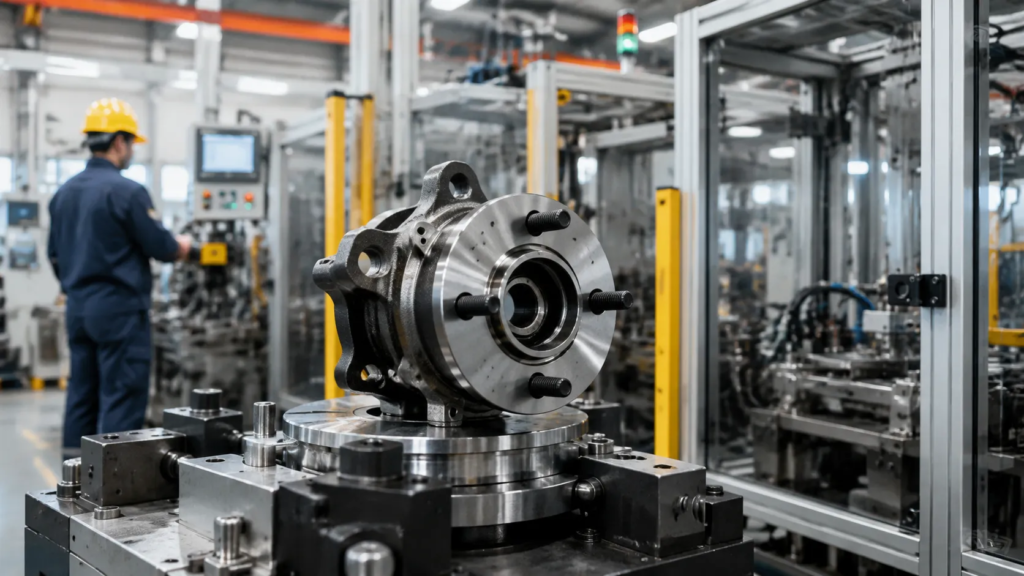
You might be wondering, where is it used? In the automotive industry, aluminum casting is vital for producing components that reduce vehicle weight and improve fuel efficiency. You will find castings used for:
- Engine blocks and cylinder heads
- Transmission housings
- Suspension components
Aerospace component manufacturing
But what about aerospace? Here, the strength-to-weight ratio is paramount, making aluminum casting ideal for manufacturing reliable, lightweight parts. Common aerospace applications include:
- Structural brackets and fittings
- Avionics enclosures
- Fluid system components
Other industrial applications
The bottom line is this: The benefits of aluminum casting extend to many other industrial sectors. You can find cast aluminum parts in:
- Medical equipment and devices
- Telecommunications hardware
- Consumer electronics enclosures
| Industry | Key Application | Benefit |
|---|---|---|
| Automotive | Powertrain Components | Weight Reduction |
| Aerospace | Structural Fittings | High Strength-to-Weight |
| Industrial | Housings & Enclosures | Design Flexibility |
This demonstrates the wide-ranging adaptability of aluminum casting to meet diverse industry demands. Key Takeaway: Aluminum casting technology is a cornerstone of modern manufacturing in performance-critical industries.
9. Gains of aluminum casting technology
Aluminum casting offers significant advantages, making it a preferred manufacturing method for many applications. Its primary benefits include a superior strength-to-weight ratio and cost-effectiveness. The technology also provides remarkable flexibility for creating complex designs.
Strength-to-weight ratio benefits
Here’s the deal: Aluminum provides the strength needed for structural applications at a fraction of the weight of steel. This gives you parts that are:
- Easier to handle and assemble
- More fuel-efficient in mobile uses
- Strong enough for demanding loads
Cost-effectiveness in production
What does this mean for you? For high-volume runs, the permanent mold process becomes highly cost-effective due to reusable tooling and fast cycle times. You gain advantages through:
- Lower per-part production costs
- Reduced material waste (net shape)
- High-speed, automated production
Design flexibility and complexity
The real question is, what can you create? Aluminum casting allows you to produce complex, single-piece parts that would otherwise require multiple components and assembly steps. This enables you to design:
- Parts with intricate internal passages
- Components with thin walls
- Integrated, multi-functional designs
| Advantage | Description | Your Benefit |
|---|---|---|
| Strength/Weight | Strong but lightweight | Improved performance |
| Cost-Effective | Low per-part cost in volume | Better project ROI |
| Design Flexibility | Complex shapes possible | Part consolidation, innovation |
This summary confirms that the technology offers a powerful combination of physical, financial, and design benefits. Key Takeaway: The unique gains of aluminum casting technology provide a competitive edge in performance, cost, and design.
10. Future aluminum casting technology
The future of aluminum casting is being shaped by automation, advanced materials, and sustainable practices. These innovations are poised to make the casting process more efficient, precise, and environmentally friendly. Staying ahead of these trends is key to future success.
Automation in the foundry
You might be wondering, what’s changing? Automation and robotics are taking over repetitive and dangerous tasks in the foundry, leading to greater consistency and safety. You can expect to see more:
- Automated pouring systems
- Robotic part extraction and handling
- AI-powered quality inspection
Innovations in alloy development
Here’s the bottom line: New aluminum alloys are being developed to offer enhanced properties for specialized applications. This opens up possibilities for components with:
- Higher temperature resistance
- Increased strength and durability
- Improved electrical conductivity
Sustainable casting practices
What does this mean for you? Sustainability is becoming a major focus, with an emphasis on reducing waste and energy consumption. Future foundries will prioritize:
- Increased use of recycled aluminum
- Energy-efficient melting furnaces
- Closed-loop recycling of materials
| Trend | Focus | Future Impact |
|---|---|---|
| Automation | Efficiency and Safety | Higher consistency, lower cost |
| New Alloys | Enhanced Properties | Expanded applications |
| Sustainability | Environmental Responsibility | Reduced footprint, lower costs |
This outlook shows a clear path toward a smarter, stronger, and more sustainable manufacturing future. Key Takeaway: The evolution of aluminum casting technology promises greater efficiency, capability, and sustainability.
Conclusion
Understanding the nuances of material selection, mold design, and process control is the key to overcoming manufacturing challenges. At Premier Aluminum, we are not just a manufacturer; we are an expert partner dedicated to advancing casting innovation and quality. Leverage our expertise to ensure your next project achieves the highest standards of precision and performance by contacting our team today to discuss your specific needs.
FAQ Section
1. What’s the best casting method for high-volume production runs? Permanent mold casting is the ideal choice for high-volume runs. Its reusable steel molds allow for fast cycle times and excellent part-to-part consistency, making it highly cost-effective at scale.
2. How can I determine the right aluminum alloy for my component’s application? To select the right alloy, you must identify the most critical properties for your application, such as strength, corrosion resistance, or thermal conductivity. Our engineering team can help you analyze these requirements and recommend the optimal alloy.
3. Can complex internal geometries be achieved with aluminum casting? Yes, complex internal geometries can be created using semi-permanent mold casting. This process uses disposable sand cores to form intricate internal passages and features that are not possible with a solid steel mold alone.
4. What are the typical lead times for tooling and first article inspection? Tooling lead times can vary depending on mold complexity but typically range from a few weeks to several months. Following tool completion, a first article inspection (FAI) is performed to validate the process, which adds a short amount of time before full production begins.
5. What kind of post-casting finishing services are available? A variety of finishing services are available to meet your final specifications. These include trimming, shot blasting for a uniform surface texture, precision CNC machining for tight-tolerance features, and pressure testing to ensure integrity.

 German
  English