

Plasma vs laser cutting guide compares speed cost accuracy thickness and material limits to help you choose the right process
What Is Plasma Cutting?
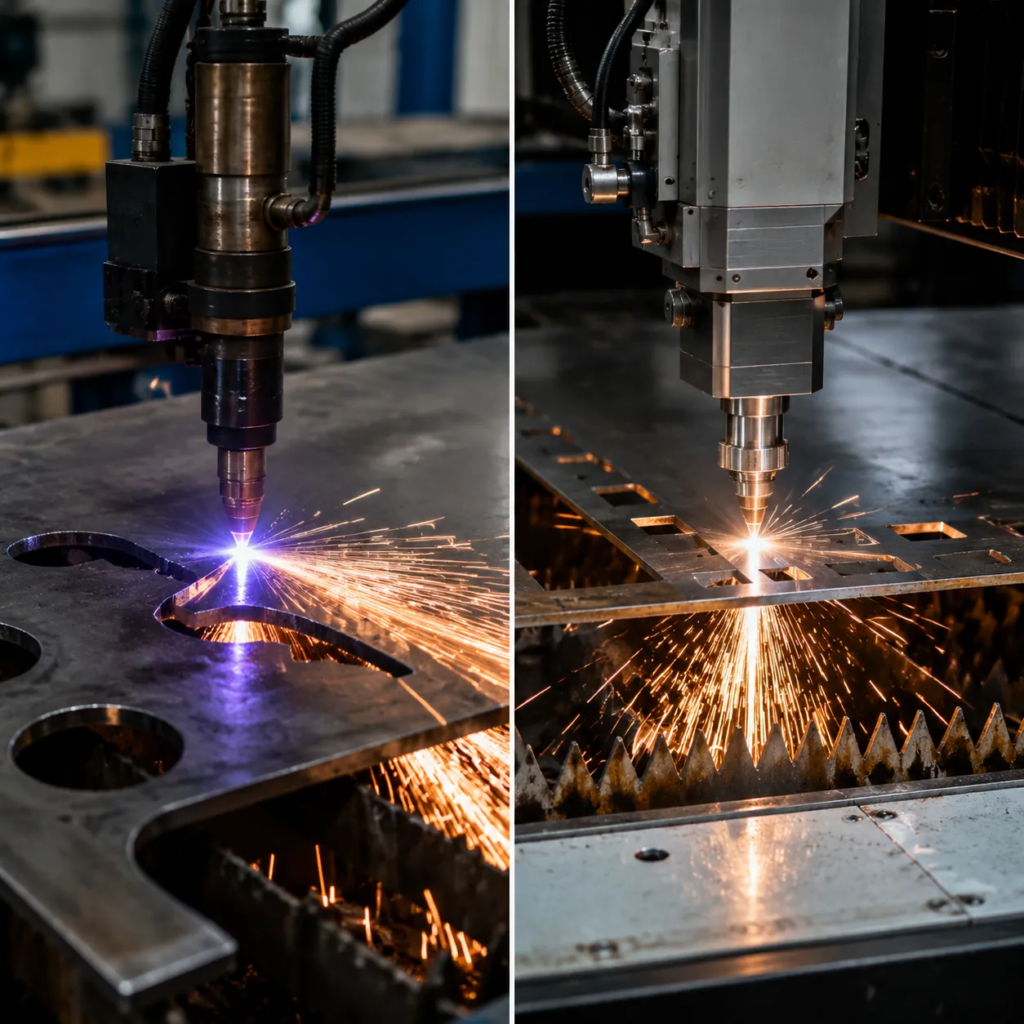
When we look at modern metal fabrication solutions, plasma cutting stands out as a highly reliable, high-velocity thermal cutting process. It is specifically designed to slice through electrically conductive materials by utilizing an accelerated jet of hot plasma. On our shop floor, we rely on this method when we need to cut heavy, robust metals quickly and cost-effectively.
How CNC Plasma Cutting Works
The science behind CNC plasma cutting comes down to harnessing superheated, electrically ionized gas. Here is how the process unfolds on a technical level:
- Gas Ionization: An inert gas (or compressed air) is blown at high speed through a focused nozzle while an electrical arc is introduced.
- Plasma Creation: This electrical interaction ionizes the gas particles, turning the stream into the fourth state of matter: plasma.
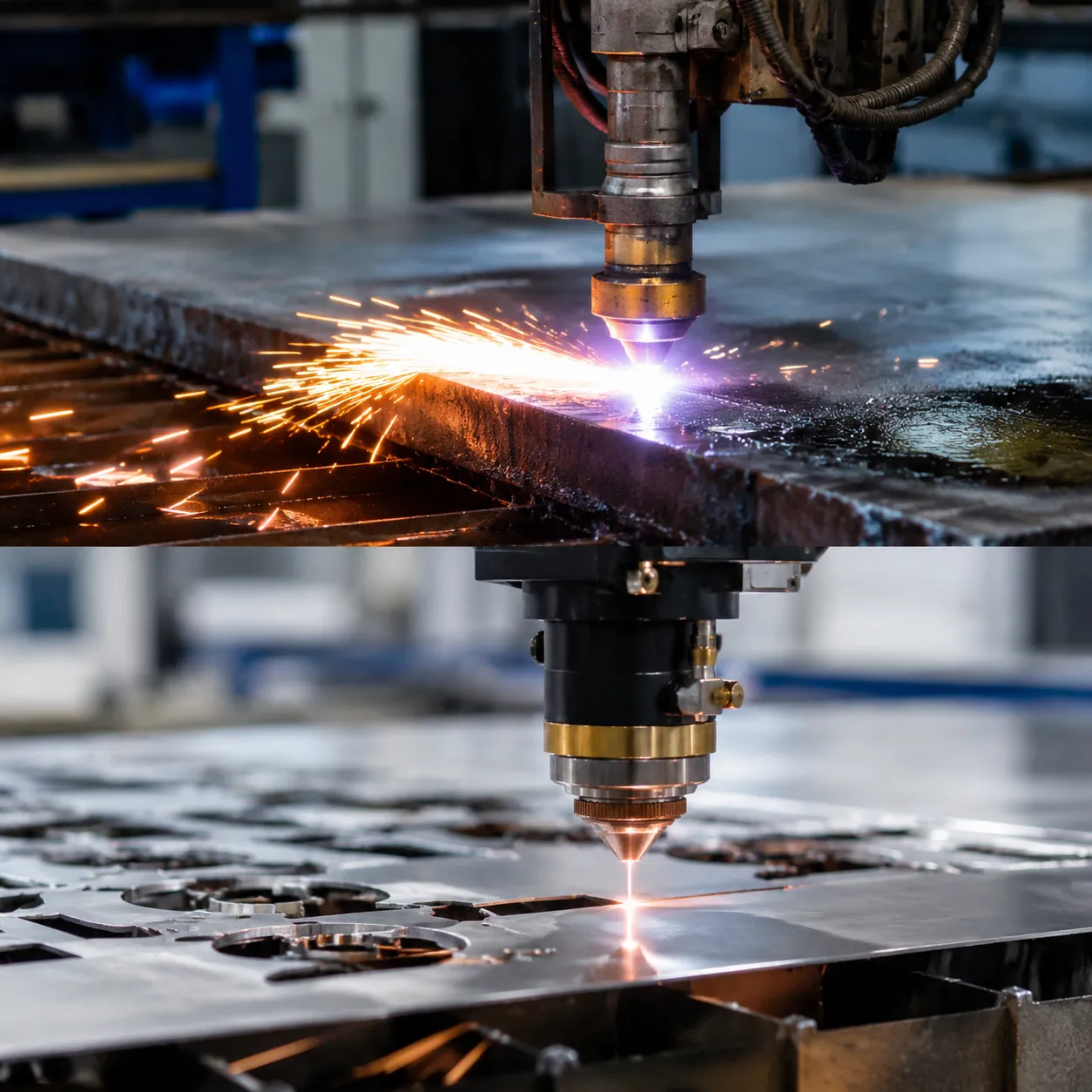
- The Melt and Blow: The plasma torch delivers extreme temperatures—often reaching up to 30,000°F—which instantly melts the target metal. Simultaneously, the high-velocity gas blows the molten material away, leaving a clean kerf.
Main Strengths of CNC Plasma Cutting
For heavy industrial applications, choosing a plasma cutter for steel and other conductive alloys offers distinct competitive advantages.
- Exceptional Thick Metal Cutting: Unlike alternative methods, plasma handles thick plates (often up to 1.5 inches or more) with ease.
- High Speed on Thick Stock: It delivers blistering cutting speeds on carbon steel and medium-to-thick plates, keeping production lines moving.
- Lower Initial Investment: The machinery and setup costs for industrial plasma systems are significantly lower than high-power laser installations.
- Material Versatility: It successfully cuts any conductive metal, including structural steel, stainless steel, cast iron, and aluminum.
Main Limitations in Thermal Cutting
While plasma is an absolute workhorse, this thermal cutting method does have inherent limitations when compared to ultra-precision technologies.
- Wider Kerf and Taper: The plasma arc naturally flares slightly, resulting in a wider cut path and a slight bevel or taper on the cut edge.
- Larger Heat-Affected Zone (HAZ): The intense heat inputs create a larger HAZ, which can alter the mechanical properties of the metal near the cut.
- Lower Precision on Intricate Details: It struggles with fine, micro-scale geometries, tight tolerances, or very small holes where a laser cutter excels.
- Dross Accumulation: Operators often need to account for post-processing time to clean up dross (slag) attached to the bottom edges of the part.
What Is Laser Cutting?
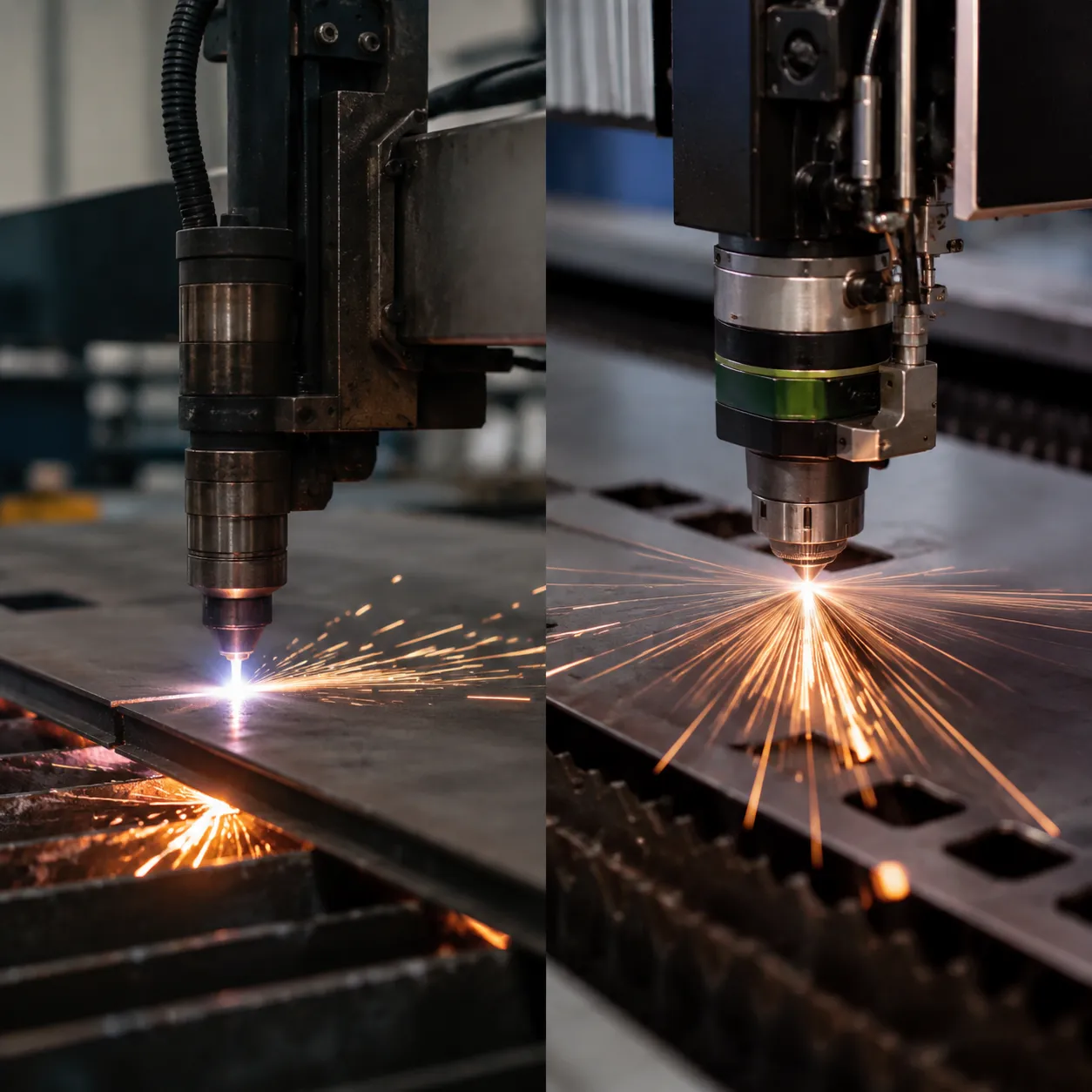
When we look at the peak of precision in modern manufacturing, an industrial laser cutter stands in a class of its own. It uses a highly concentrated beam of light to melt, burn, or vaporize material along a pre-programmed path, delivering unmatched accuracy on the shop floor.
How Fiber Laser Cutting Works
Our fiber laser cutting systems utilize solid-state laser banks to generate a high-powered beam. This beam is transmitted through a flexible fiber optic cable directly to the cutting head.
- The Beam: A microscopic, intense light focus melts the metal instantly.
- The Assist Gas: High-pressure nitrogen or oxygen blows away the molten metal.
- The Result: A clean, narrow kerf achieved with extreme speed and zero mechanical contact.
Main Strengths of an Industrial Laser Cutter
- Microscopic Tolerances: Easily holds accuracies within +/- 0.003 inches, making it the go-to choice for intricate geometry.
- Minimal Heat-Affected Zone (HAZ): The heat is localized so tightly that the surrounding sheet metal suffers virtually no thermal distortion.
- Zero Secondary Processing: The edge finish is so clean that parts can typically skip the grinding station and go straight to welding or painting.
- High-Speed Thin Sheet Processing: For gauge-thickness materials, nothing matches the throughput of a fiber laser.
Main Limitations in Sheet Metal Cutting
- Thick Plate Constraints: While it dominates thin to medium materials, efficiency drops off drastically as plate thickness approaches or exceeds 1 inch.
- Massive Initial Investment: The upfront capital expenditure for a high-wattage laser system is significantly higher than alternative thermal cutting methods.
- Reflective Material Hazards: Standard configurations can struggle with copper and brass due to back-reflection risks, though modern fiber tech has mitigated this somewhat.
Plasma vs Laser Cutting at a Glance
When we evaluate a metal cutting process for our shop floor, we look directly at how the technology impacts our production timeline and bottom line. Choosing between plasma vs laser cutting comes down to balancing raw speed on thick plate against extreme precision on thin sheet metal.
To help you quickly compare these thermal cutting methods, we have broken down the core performance metrics we track daily in precision metal cutting operations.
| Performance Metric | CNC Plasma Cutting | Fiber Laser Cutting |
|---|---|---|
| Precision & Tolerances | ±0.015″ to ±0.030″ (Higher deviation) | ±0.001″ to ±0.005″ (Ultra-tight) |
| Cutting Speed (Thin Sheet) | Fast, but prone to distortion | Extremely fast; high efficiency |
| Cutting Speed (Thick Plate) | Faster and more efficient over 0.5″ | Slower; requires massive power |
| Max Material Thickness | Up to 2″ or more (Heavy industrial) | Typically optimized up to 1″ |
| Edge Quality & Burrs | Noticeable bevel, heavier dross/burrs | Clean, square edges; minimal post-processing |
| Heat-Affected Zone (HAZ) | Large footprint; higher risk of warping | Narrow, concentrated footprint |
| Material Compatibility | Conductive metals only (Steel, Al, Cu) | Metals, plus select non-metals |
| Operating Cost per Hour | Low ($15 – $30/hr average) | Moderate ($20 – $40/hr average) |
| Equipment Investment Scale | Low to Moderate ($50k – $200k+) | High to Very High ($250k – $1M+) |
| Maintenance & Consumables | High frequency (Nozzles, electrodes) | Low frequency (High optics reliability) |
Key Takeaways for Your Shop Floor
- The Precision Gap: If your components require strict tolerance control and minimal edge deviation, an industrial laser cutter is the clear winner. For structural parts where a slight bevel is acceptable, plasma gets the job done.
- Thickness Limits: Our laser cutting service options shine in the thin-to-medium sheet metal cutting range. Once we cross into thick metal cutting over 0.75 inches, a plasma cutter for steel becomes much more cost-effective.
- The Real Cost Impact: While fiber laser cutting carries a massive upfront equipment investment scale, its minimal maintenance and elimination of secondary grinding often yield a faster ROI for high-volume precision metal cutting.
Detailed Comparison by Buying Criteria
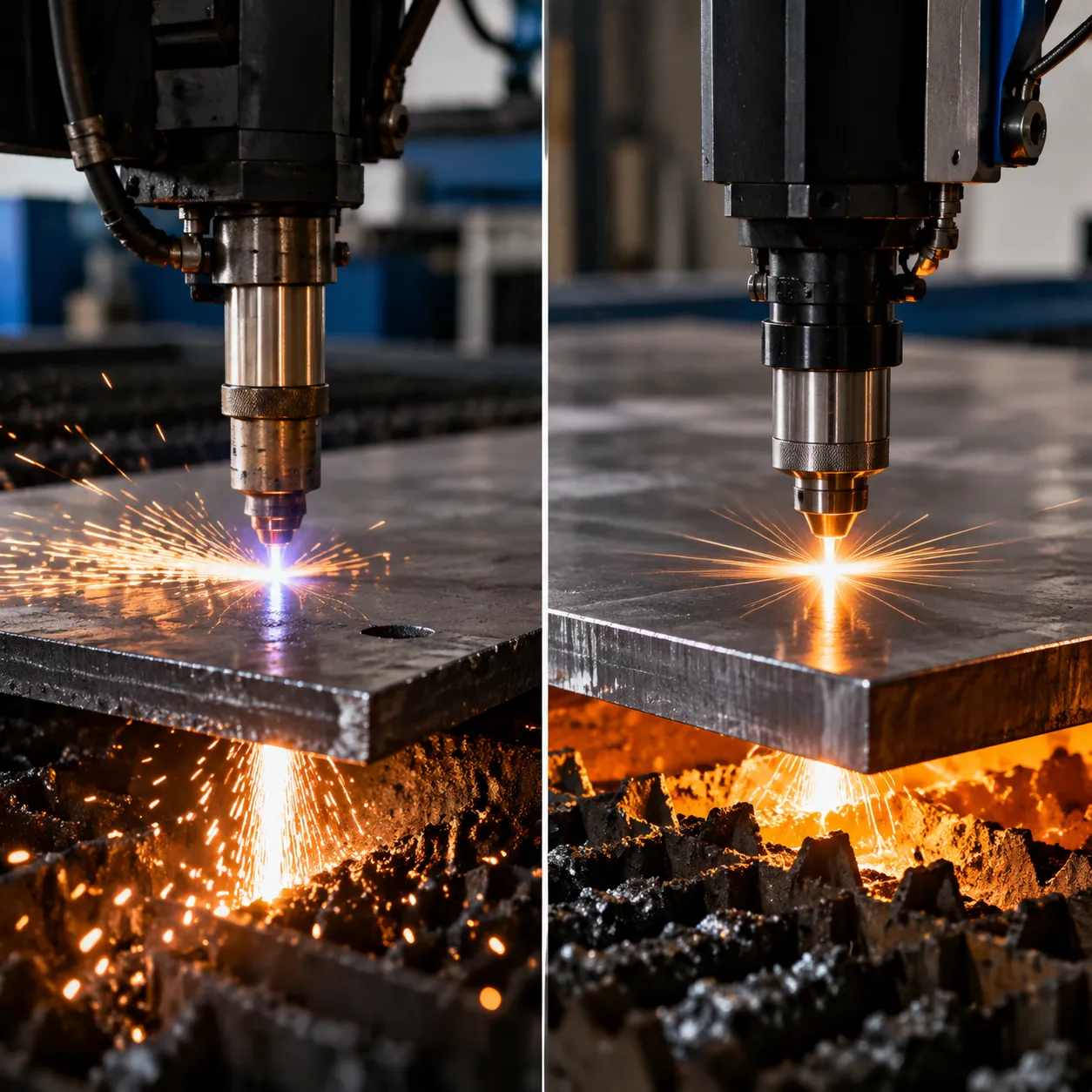
When choosing between plasma vs laser cutting for our metal fabrication solutions, we evaluate how each machine performs against core shop-floor benchmarks. Here is a direct breakdown of how CNC plasma cutting and fiber laser cutting stack up across critical buying criteria.
Accuracy and Repeatability in Precision Metal Cutting
For projects requiring tight tolerances, fiber laser systems lead the industry. Laser cutting achieves an exceptional accuracy of ±0.005 inches, making it the standard for precision metal cutting. CNC plasma systems generally hold tolerances around ±0.020 to ±0.030 inches, which is ideal for structural parts but less suited for intricate, interlocking components.
Cut Edge Finish Quality
Lasers deliver a clean, squared edge with a minimal heat-affected zone (HAZ) and virtually zero dross. Plasma cutters introduce a slight edge bevel (typically 1 to 3 degrees) due to the shape of the plasma arc, along with some dross on the bottom edge that requires cleaning.
Performance Benchmarks: Thin-Sheet vs. Maximum Thickness
Our operational data highlights a clear dividing line based on material gauge: Thin-Sheet Benchmarks: Fiber lasers dominate thin gauge sheet metal, cutting at hyper-speeds with pristine edge quality. Maximum Thickness Performance: High-definition plasma cutters handle massive plates up to 2 inches thick with ease, outperforming lasers in cost-efficiency once materials exceed 1 inch.
Shop Floor Production Metrics
| Buying Criterion | Fiber Laser Cutting | CNC Plasma Cutting |
|---|---|---|
| Precision & Tolerances | Ultra-tight (±0.005″) | Standard (±0.020″ – ±0.030″) |
| Thin Sheet Speed | Extremely High | Moderate |
| Thick Plate Speed (1″+) | Slow / High Power Needed | Fast and Efficient |
| Post-Processing Required | None to Minimal | Dross removal and bevel grinding |
| Setup Flexibility | Fast software transitions | Quick torch/gas adjustments |
Setup Flexibility and Post-Processing Requirements
Fiber lasers offer rapid job-to-job setup via CNC software adjustments, allowing us to switch nested parts instantly. However, plasma machines win on structural floor flexibility for oversized or uneven plates.
Because plasma leaves a minor bevel and dross, it demands more post-processing labor (grinding and deburring) before parts move to welding or painting. Laser-cut parts typically go straight from the cutting bed to assembly.
Environmental and Safety Considerations
Both processes require robust safety protocols. Industrial laser cutters require fully enclosed housings to protect operators from invisible beam reflections, alongside dedicated fume extraction. Plasma cutting generates high-volume particulate smoke and intense UV light, requiring either a water table setup or high-capacity downdraft ventilation to keep the shop floor clean and compliant.
Material Compatibility Breakdown
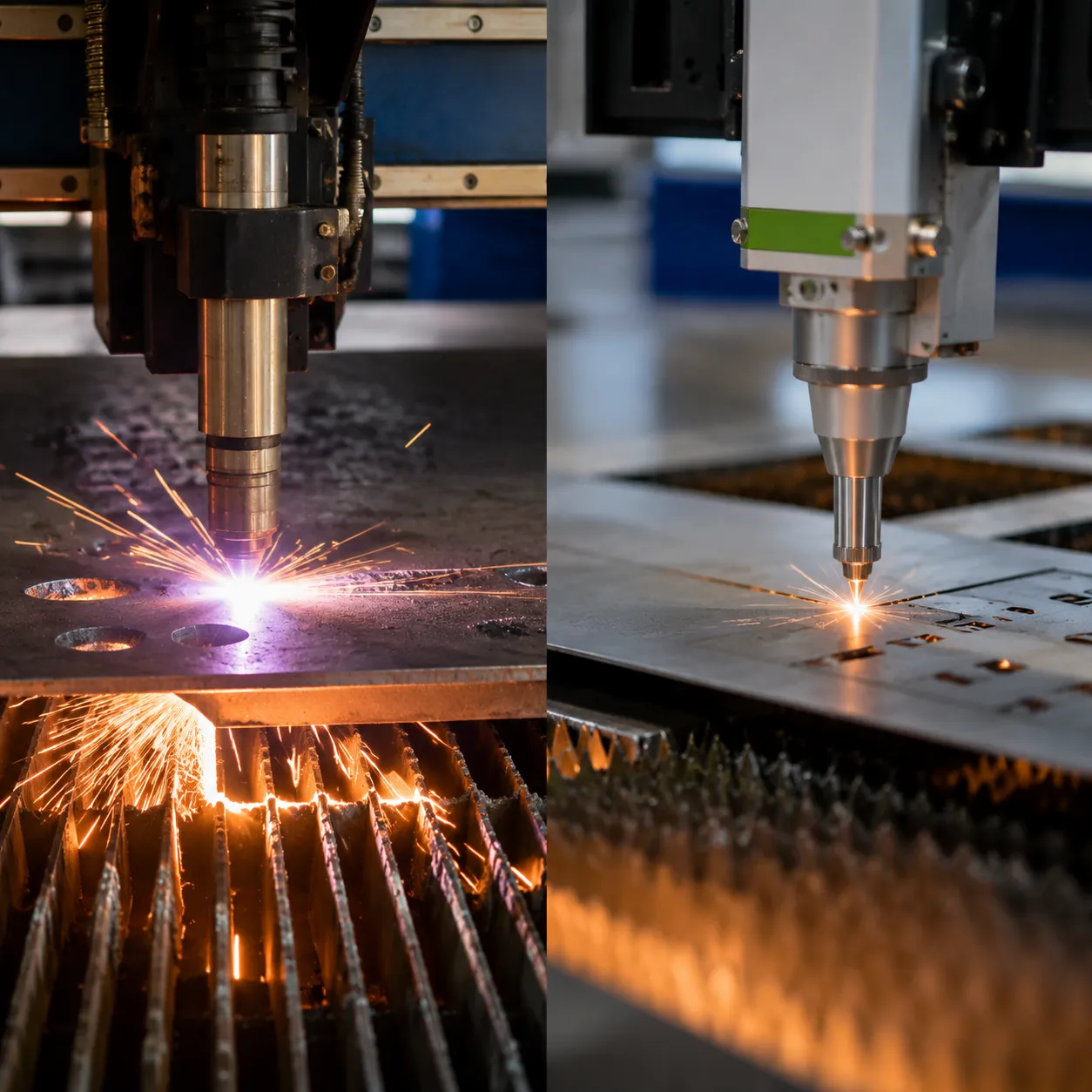
When evaluating plasma vs laser cutting capabilities for your shop floor, understanding how different metals react to each thermal cutting process is critical. While both methods excel at precision metal cutting, their efficiency, edge quality, and material limitations vary significantly based on the metallurgy of the workpiece.
Metal Cutting Process Compatibility Matrix
| Material Type | Fiber Laser Cutting Performance | CNC Plasma Cutting Performance |
|---|---|---|
| Carbon Steel | High efficiency; ultra-smooth edges on thin to medium sheets. | Excellent speed on thick plate; rougher edge profile. |
| Stainless Steel | Clean, oxide-free edges using nitrogen assist gas. | High speed, but leaves a heavier heat-affected zone. |
| Aluminum | Excellent with modern fiber optics; avoids dross. | High speed, but produces rougher edges and more burrs. |
| Copper & Brass | Requires specialized fiber lasers; handles reflectivity well. | Easily cuts reflective metals without machine damage. |
| Non-Metals | Cuts plastics, wood, and organics (CO2 systems only). | Completely incompatible; requires conductive materials. |
Carbon Steel Cutting Efficiency
For carbon steel, fiber laser cutting offers unmatched precision on gauges up to 1 inch, delivering minimal kerf and sharp detail. When processing thick metal plate over 1 inch, a CNC plasma cutting system becomes the more efficient powerhouse, tearing through heavy steel with high travel speeds and lower gas costs.
Stainless Steel Cutting Options
Achieving high-quality stainless steel cutting depends heavily on your post-processing tolerances. Laser cutting with nitrogen produces pristine, corrosion-resistant edges ready for immediate welding. Plasma cutters can slice stainless steel rapidly, but the intense thermal cutting action alters the material characteristics along the edge, often requiring mechanical grinding to remove the oxidized layer.
Aluminum Cutting Challenges
Aluminum conducts heat rapidly and melts at a low temperature, making dross control a common challenge. Industrial laser cutter systems utilize high-frequency pulses and precise assist gas pressure to deliver clean cuts on aluminum sheets. Plasma cutting handles aluminum well at high speeds, but users must expect a larger heat-affected zone and more significant burr formation on the bottom edge.
Copper and Reflective Metals Handling
Reflective alloys like copper and brass back-reflect beam energy, which historically damaged older lasers. Modern fiber laser cutting machines utilize advanced optical isolation to safely slice through thin reflective sheets with high accuracy. CNC plasma cutting remains a highly reliable alternative for heavy copper fabrication because the electric arc process is entirely unaffected by material reflectivity.
Other Conductive Metals Behaviors
For specialty metals like titanium, nickel alloys, and armored plate, plasma cutters offer a brute-force solution that ensures consistent separation. Lasers provide superior tight-tolerance geometries on these exotic alloys but require precise tuning of the assist gas mix to prevent micro-cracking along the cut path.
Non-Metal Material Limitations in Thermal Cutting
A strict boundary exists between these two technologies when it comes to non-conductive materials. Because a plasma cutter for steel relies on a completed electrical circuit between the torch and the workpiece, it cannot cut non-metals. Fiber lasers are also optimized strictly for sheet metal cutting; processing wood, acrylic, or rubber requires specialized CO2 laser wavelengths or completely different mechanical cutting methods.
Cost Comparison and ROI Factors
When we look at plasma vs laser cutting from a financial perspective, the upfront investment and long-term operating costs present two entirely different business strategies. We break down the real numbers to help you calculate your return on investment.
Machine Purchase Cost Differences
The initial capital expenditure shows the widest gap between these two technologies. A high-quality CNC plasma cutting system is highly accessible, making it a favorite for regional fabrication shops. In contrast, an industrial fiber laser cutting machine requires a substantial upfront investment due to its complex optics and linear drive systems.
| Equipment Type | Entry-Level Cost (USD) | High-End / Production Cost (USD) |
|---|---|---|
| CNC Plasma Cutting | $20,000 – $50,000 | $100,000 – $300,000 |
| Fiber Laser Cutting | $100,000 – $250,000 | $500,000 – $1,000,000+ |
Operating Cost per Part Variations
While laser machines cost more upfront, their operating cost per part drops dramatically during high-volume runs. Fiber laser cutting moves faster on thin sheet metal, using less energy per inch of cut. Plasma cutters consume more power and gas per inch, making them less efficient for thin parts but highly economical when cutting thick structural steel plates.
Consumables and Maintenance Expenses
Our shop data shows that plasma systems demand frequent, low-cost maintenance. You will swap out nozzles and electrodes regularly. Laser systems require virtually no consumable parts under normal operation, but when a laser optic or cutting head components need replacement, the bill is significantly higher.
- Plasma Consumables: High frequency, low individual cost (nozzles, shields, electrodes).
- Laser Consumables: Low frequency, high individual cost (focusing lenses, protective windows, nozzles).
Labor and Post-Processing Cost Impact
A hidden factor in the metal cutting process is secondary labor. Plasma cutting often leaves dross and a larger heat-affected zone, requiring your team to spend hours grinding edges. Because precision metal cutting via fiber laser delivers clean, ready-to-weld edges, it eliminates secondary labor costs and speeds up your total shop throughput.
ROI Considerations for Small Shops vs. High-Volume Production
For small job shops handling diverse, low-volume thick plate projects, a plasma cutter for steel offers the fastest path to profitability. The machine pays for itself even if it runs just a few hours a day. However, for high-volume contract manufacturers working with sheet metal cutting, the extreme speed and automated material handling of a fiber laser deliver a much higher ROI over a two-to-three-year period.
Thickness Guide for Metal Fabrication
Material thickness is the ultimate deciding factor when choosing between laser cutting vs plasma cutting. We use a simple rule of thumb on our shop floor: laser dominates the thin-to-medium range, while plasma takes over when the material gets heavy.
Best Thickness Range for Plasma Cutting vs Laser Cutting
- Fiber Laser Cutting: Our sweet spot for high-precision sheet metal cutting is 0.020 inches to 0.50 inches. While high-power industrial laser cutters can handle up to 1 inch, the efficiency drops as the plate gets thicker.
- CNC Plasma Cutting: This thermal cutting powerhouse thrives on heavy plate. We recommend a plasma cutter for steel starting at 0.25 inches up to 2 inches (and beyond for specialized gas mixes).
| Material Thickness | Preferred Metal Cutting Process | Edge Quality Expectation |
|---|---|---|
| Thin Sheet (< 0.125″) | Fiber Laser Cutting | Pristine, Burr-Free |
| Medium Plate (0.125″ – 0.50″) | Laser or Plasma (Application Dependent) | Clean (Laser) / Slight Taper (Plasma) |
| Heavy Plate (> 0.50″) | CNC Plasma Cutting | Acceptable Taper, Economical |
What Happens When Sheet Thickness Increases
As the metal gets thicker, the physics of precision metal cutting change dramatically. With laser systems, the beam must maintain focus through a deeper cut, which slows down travel speeds and increases gas consumption.
With a plasma cutter for steel, the arc naturally flares out at the bottom of a thick plate. This creates a slight angular deviation (bevel) on the cut edge. However, plasma maintains its high cutting speed on thick metal far better than a laser does.
How Thickness Affects Cost and Quality Balance
Balancing your budget means understanding how thickness impacts your final part cost.
- Thin Materials: Laser cutting provides unbeatable speed and a clean edge finish quality that eliminates post-processing. The cost per part is incredibly low because we skip the grinding step.
- Thick Materials: Laser operating costs skyrocket on thick plate due to high power demand and assist gas consumption. Plasma cutting becomes the more cost-effective choice here. Even though you might face minor dross cleanup, the sheer speed and lower machine cost of plasma deliver a better overall ROI on heavy fabrications.
Application Scenarios for Industrial Parts
Choosing between plasma vs laser cutting comes down to the specific parts we need to build on the shop floor. Both processes excel in different fabrication environments, depending on the required tolerances and material thicknesses.
Sheet Metal Fabrication Routines
For standard sheet metal cutting under 0.25 inches, fiber laser cutting is our primary choice. It delivers the speed and clean edges needed for rapid-turnaround enclosures, panels, and HVAC components without requiring secondary finishing.
Structural Steel Parts Manufacturing
When we fabricate base plates, gussets, and heavy trusses from thick carbon steel, CNC plasma cutting dominates. A plasma cutter for steel handles rough, scaled structural plates with ease, delivering high-speed cuts through thick materials where extreme precision is secondary to throughput.
Precision Components Production
For industrial parts requiring strict dimensional accuracy and tight tolerances (within ±0.005 inches), an industrial laser cutter is non-negotiable. We rely on laser cutting vs plasma cutting here to eliminate taper and ensure perfectly round holes for mechanical assemblies.
Custom Brackets and Enclosures Creation
Custom brackets with intricate tab-and-slot designs require the tight beam diameter of a fiber laser. Laser cutting allows us to nest parts tightly to minimize material waste while keeping bend lines precise for subsequent sheet metal fabrication steps.
Heavy-Duty Industrial Parts Projects
For shipbuilding, heavy machinery, and agricultural equipment components, we deploy heavy-duty plasma cutting systems. These machines cut through thick metal plates up to 2 inches thick efficiently, keeping operational costs low on massive structural components.
Prototypes and Low-Volume Production Strategies
For quick-turn prototypes, our laser cutting service offers the fastest setup flexibility on the shop floor. Because laser systems require no specialized physical tooling and minimal setup time, we can transition from a CAD drawing to a finished premium part in minutes, making low-volume runs highly economical.
Which Process Is Better for Your Industry?
Choosing between plasma vs laser cutting comes down to your industry’s specific standards, production volumes, and tolerance requirements. We analyze how these thermal cutting technologies perform across key US industrial sectors.
Aerospace Components Accuracy
The aerospace sector demands extreme precision and minimal heat deformation. Fiber laser cutting is the standard here, delivering tight tolerances for intricate aluminum and titanium brackets without altering the material’s structural integrity.
Automotive Production Volumes
High-speed throughput drives the automotive sector. For thin sheet metal cutting and stamped component trimming, industrial laser cutters offer the rapid cycle times and clean edges needed to keep automated assembly lines moving efficiently.
Machinery Parts Resilience
Heavy machinery manufacturing relies on thick structural steel plates. CNC plasma cutting dominates this space, easily slicing through thick carbon steel frames and brackets where raw cutting power matters more than microscopic precision.
Marine Hardware Endurance
Marine fabrication requires heavy-duty, corrosion-resistant materials like thick stainless steel and aluminum. Plasma cutters handle these thick, non-ferrous plates cost-effectively, providing the rugged endurance required for shipyards and dock infrastructure.
Valves and Fittings Tolerances
Precision metal cutting is critical for sealing surfaces in valves and high-pressure fittings. Laser cutting service standards ensure the ultra-tight tolerances and smooth edge finishes required to prevent leaks under extreme operational pressure.
Metal Cabinets and Enclosures Scaling
For rapid scaling in electronics and HVAC housing, laser cutting vs plasma cutting is a clear win for lasers. It allows for lightning-fast perforation, complex tab-and-slot designs, and clean bends directly from the cutting table with zero post-processing.
How to Choose Between Plasma and Laser Cutting
Making the right call between these two powerful thermal cutting methods comes down to your specific application requirements, material thickness, and budget limits. We break down exactly when to deploy each technology on your shop floor to maximize ROI.
When to Choose a Laser Cutting Service for High Precision
Opt for a fiber laser cutting service when your project demands tight tolerances and pristine edge quality. Laser cutting vs plasma cutting comparisons consistently show that lasers excel at intricate geometries and thin sheet metal cutting.
- Tolerances: Holds strict tolerances within ±0.005 inches.
- Material Thickness: Best for carbon steel, stainless steel, and aluminum under 0.25 inches.
- Secondary Operations: Minimal to no dross means you skip the grinding station completely.
- Complex Details: Perfect for small holes, narrow slots, and complex tabs.
When to Choose a Plasma Cutter for Steel and Thick Plate
A CNC plasma cutter for steel is the undisputed champion when you need to slice through heavy plate quickly and cost-effectively. When precision metal cutting takes a backseat to raw speed and material thickness, plasma wins.
- Thick Metal Cutting: Effortlessly handles carbon steel and industrial plates from 0.5 inches up to 2 inches or more.
- Speed Advantage: Outpaces fiber lasers once material thickness exceeds 0.75 inches.
- Conductive Metals: Ideal for heavy-duty structural steel parts and marine hardware fabrication.
- Lower Initial Setup: Offers a significantly lower equipment investment scale for heavy fabrication shops.
Choosing Based on Part Function Over Machine Price
Never choose your metal cutting process based solely on the upfront machine price. A cheaper cutting process that requires hours of manual post-processing will destroy your shop’s profitability. Base your decision on how the finished part functions in its final application.
| Selection Metric | Choose Fiber Laser Cutting | Choose CNC Plasma Cutting |
|---|---|---|
| Primary Focus | Extreme precision, part aesthetics, no dross | High speed on thick plate, lowest cost per foot |
| Material Thickness | Best under 0.50″ | Best over 0.50″ |
| Edge Profile | Perfectly square, clean edges | Slight bevel angle (1 to 3 degrees) |
| Post-Processing | Ready for assembly or welding | Requires slag/dross removal and grinding |
| Best Fit Applications | Aerospace, automotive brackets, enclosures | Structural steel, heavy machinery, thick flanges |
Common Buyer Questions (FAQs)
When choosing between a plasma vs laser cutting system for our shops, we get a lot of the same questions from fabricators trying to balance precision and budget. Here are the direct answers from the shop floor.
Is laser cutting more accurate than plasma cutting?
Yes, fiber laser cutting is significantly more accurate. Lasers achieve tight tolerances of around ±0.005 inches, whereas a standard CNC plasma cutting system typically holds tolerances between ±0.015 and ±0.030 inches. If you are fabricating intricate parts or tight-tolerance brackets, laser is the clear winner.
Is plasma cutting cheaper than laser cutting?
Upfront, yes. A high-quality plasma cutter for steel and heavy plate requires a much lower initial equipment investment compared to an industrial laser cutter. However, when looking at the operating cost per part on thin-sheet metal, fiber lasers often win out due to their blistering speeds and minimal post-processing needs.
Which is faster for thick metal cutting?
Once you get past 0.25-inch or 0.5-inch plate, a high-definition CNC plasma cutting machine dominates on speed. While fiber lasers can cut thick metal, their speeds drop drastically as thickness increases, making plasma the more productive choice for heavy metal fabrication solutions.
Which has less dross and cleanup?
Laser cutting leaves a virtually pristine, burr-free edge that is ready for welding or painting right off the bed. Plasma cutting inherently produces more dross (slag) and a larger heat-affected zone, meaning your team will spend more time with a grinder doing post-processing cleanup.
Which process is better for stainless steel cutting?
For high-quality stainless steel cutting, fiber laser is superior for thin to medium gauges because it prevents edge discoloration and maintains tight tolerances. However, if you are cutting stainless plate thicker than 0.75 inches on a budget, high-definition plasma becomes the more cost-effective thermal cutting alternative.
Can plasma cut aluminum effectively?
Yes, modern CNC plasma systems can cut aluminum, but it presents challenges like rougher edge quality and dross buildup. If cosmetic appearance and edge precision matter for your aluminum parts, a fiber laser cutter handles the reflective nature of the material much better and delivers a cleaner finish.


 German
  English