


Discover centrifugal casting equipment systems specs and applications with Precisionvast for high density cylindrical metal parts.
How Centrifugal Casting Machinery Works: Engineering Flawless Parts
Are your cylindrical components failing under high pressure due to internal voids or porosity? If you require absolute structural integrity, standard pouring methods fall short. At Precisionvast, our ISO9001 certified, 19,000+ m² facility relies on industrial-grade centrifugal casting equipment to engineer flawless parts at scale and speed. Here is a breakdown of the core mechanics.
High-G Centrifugal Pouring
The centrifugal casting process relies entirely on rotational physics. We introduce molten metal into a rapidly spinning mold. This rotation generates extreme centrifugal forces—frequently exceeding 100 Gs. This immense pressure evenly distributes the molten material against the mold walls, dictating the outer dimensions while establishing unparalleled centrifugal force metal density.
Centrifugal Casting Defects Elimination
This machinery doesn’t just shape metal; it actively purifies it. Because non-metallic impurities are lighter than the base alloy, physics takes over during the spin.
- Targeted Impurity Migration: The rotation forces lighter defects like slag, trapped gas, and oxides away from the mold wall, driving them directly to the center of the spin (the inner bore).
- Porosity-Free Exterior: The critical outer mechanical structure solidifies rapidly under constant G-force, ensuring a highly dense, completely porosity-free grain structure.
- Precision Extraction: During the final machining phase, we simply bore out the inner diameter. This removes all the gathered impurities in one pass, leaving behind a structurally flawless cylinder, tube, or ring.
Core Types of Centrifugal Casting Equipment
When we configure our industrial foundry setups, we categorize our centrifugal casting equipment into three primary builds. The right choice depends entirely on the geometry of the part and your production volume.
Horizontal Centrifugal Casting Machines
These systems rotate the mold on a horizontal axis and are the industry standard for long, continuous shapes.
- Ideal Applications: Pipes, large tubes, and components requiring dedicated cylinder liner casting equipment.
- Crucial Specifications: Bed length and maximum outer diameter (O.D.) dictate your capacity.
- Design Choices: We utilize cantilevered designs for rapid, lighter jobs, while dual-support builds are necessary to stabilize long, heavy-duty castings during high-speed rotation.
Vertical Rotary Casting Machinery
Operating on a vertical axis, these machines are built for parts where the diameter is greater than the length.
- Ideal Applications: Symmetrical metal component production, specifically short-axis parts.
- Common Output: Heavy-duty rings, flanges, and gear blanks.
Automated Multi-Station Casters
To meet strict US manufacturing deadlines and high-volume demands, we deploy fully automatic carousel systems. These setups handle the entire centrifugal casting process in a continuous loop.
- Seamless Integration: The carousel automatically indexes through melting, high-G centrifugal pouring, and mechanical extraction.
- Maximum Efficiency: By implementing advanced technologies revolutionizing metal casting, these multi-station systems eliminate manual handling bottlenecks, delivering consistent density and precision at scale.
Key Specs for Centrifugal Casting Equipment
When we evaluate new centrifugal casting equipment for the shop floor, we don’t just glance at the standard spec sheet. We look closely at how the machine manages the actual physics of the pour. If you want a dense, reliable run every time, you need to nail down three core technical specifications.
Drive Systems and RPM Control
Your drive system dictates the structural integrity of your parts. We always prioritize setups with Variable Frequency Drives (VFD) that offer stepless speed adjustments. You need absolute control over your rotational speed RPM casting parameters. Dialing in the exact RPM on variable speed spinning molds is what generates the optimal centrifugal force metal density, forcing lighter impurities to the inner bore while keeping the critical outer structure dense and flawless.
Mold Capacity and Machining Tolerances
You have to match the machine’s physical boundaries to your actual production goals. Whether we are running heavy-duty industrial foundry casting machinery for massive bimetallic pipes or scaling down for top low-volume casting prototyping solutions for your needs, the weight limits and dimensional ranges (specifically maximum Outer Diameter and bed length) are make-or-break. Tight axis tolerances on the machine mean less vibration during the spin, which translates directly to less post-machining work on your end.
Thermal Management and Cooling Jackets
How you cool the mold is just as critical as how fast you spin it. Top-tier centrifugal casting equipment utilizes integrated water-cooling or air-cooling jackets to aggressively manage heat transfer. This thermal management dictates the solidification rate of the molten metal. Carefully managing that temperature drop is exactly how we lock in a uniform grain structure and prevent thermal tearing.
Quick Reference: Core Spec Evaluation
| Critical Specification | What to Look For | Production Impact |
|---|---|---|
| Rotational Drive | VFD with stepless speed adjustment | Complete control over variable speed spinning molds for optimal density. |
| Capacity Limits | Strict O.D., length, and weight ranges | Ensures the machine can handle the payload without axis wobble or distortion. |
| Cooling Setup | Integrated water or air-cooling jackets | Controls solidification rates for a superior, defect-free grain structure. |
Material Compatibility for Centrifugal Casting Equipment
Our centrifugal casting equipment is engineered to handle a massive range of industrial metals. Whether you are pouring heavy-duty iron or specialized aerospace alloys, having reliable industrial foundry casting machinery makes all the difference for your production lines here in the US.
Here is a quick breakdown of the materials our systems regularly process:
Ferrous Metals
- Carbon & Alloy Steel: Built for tough, high-stress environments requiring exceptional structural integrity.
- Stainless Steel: The standard for corrosion resistance. If you are weighing your production options, understanding the benefits of stainless steel casting over forging makes it clear why centrifugal methods dominate for seamless cylindrical parts.
- Ductile Iron: Delivers excellent machinability and rugged durability for heavy machinery components.
Non-Ferrous & Superalloys
- Aluminum & Copper Alloys: The go-to choices for lightweight and highly conductive components.
- Titanium Alloys: Essential for high-performance, low-weight aerospace, marine, and defense applications.
- High-Temperature Superalloys: We fully support specialized non-ferrous centrifugal casting operations. When pushing extreme thermal limits, choosing the exact right material is critical—much like evaluating the performance of nickel alloys against standard stainless steel for high-stress environments.
The Centrifugal Casting Process Flow at Precisionvast
When running our centrifugal casting equipment, we follow a strict five-phase process to guarantee flawless, high-density parts. Every step is dialed in to eliminate defects and maximize structural integrity for our US industrial clients.
Here is exactly how our centrifugal casting process works on the foundry floor:
- Phase 1: Preparation: We start by pre-heating the die. Once at the target temperature, we apply a specialized refractory wash or coating. This protects the mold and ensures a clean, smooth release.
- Phase 2: Pouring & Spinning: We introduce the molten metal into the mold while it rotates at precisely calculated RPMs. This high-G centrifugal pouring uses extreme force to push the heavy, dense metal to the outside wall while trapping lighter impurities in the center.
- Phase 3: Solidification: We actively manage the cooling rate rather than letting it drop naturally. Controlled solidification dictates the final grain structure, which is highly critical when mastering stainless steel casting to lock in maximum corrosion resistance and mechanical strength.
- Phase 4: Extraction & Machining: Once the part is solid, we extract the rough casting. Because the centrifugal force pushed all the slag, gas, and oxides to the inner bore, we simply machine that inner layer away to reveal pure, defect-free metal.
- Phase 5: Quality Assurance: We verify every specification. Before any component leaves our facility, it undergoes rigorous X-Ray testing, magnetic particle inspection, and CMM verification to guarantee it hits your exact dimensional tolerances.
Investment Casting vs. Centrifugal Casting
When setting up your foundry line, choosing the right production method dictates the final part quality. Knowing exactly when to deploy your centrifugal casting equipment saves both time and material.
- Investment Casting: This method is best suited for complex, asymmetrical geometries and intricate internal cavities. If your project requires rapid prototyping or highly detailed, irregular shapes, leveraging the investment casting process is the smartest play.
- Centrifugal Casting: This process is unmatched for manufacturing pure cylindrical and tubular parts. The high-speed rotation generates extreme centrifugal force, ensuring maximum metal density and structural integrity while forcing lighter impurities to the inner bore for easy machining.
While investment casting easily handles intricate and irregular designs, our centrifugal casting machinery remains the industrial powerhouse for producing the dense, defect-free, symmetrical metal components demanded by heavy-duty applications across the United States.
High-Performance Industry Applications for Centrifugal Casting Equipment
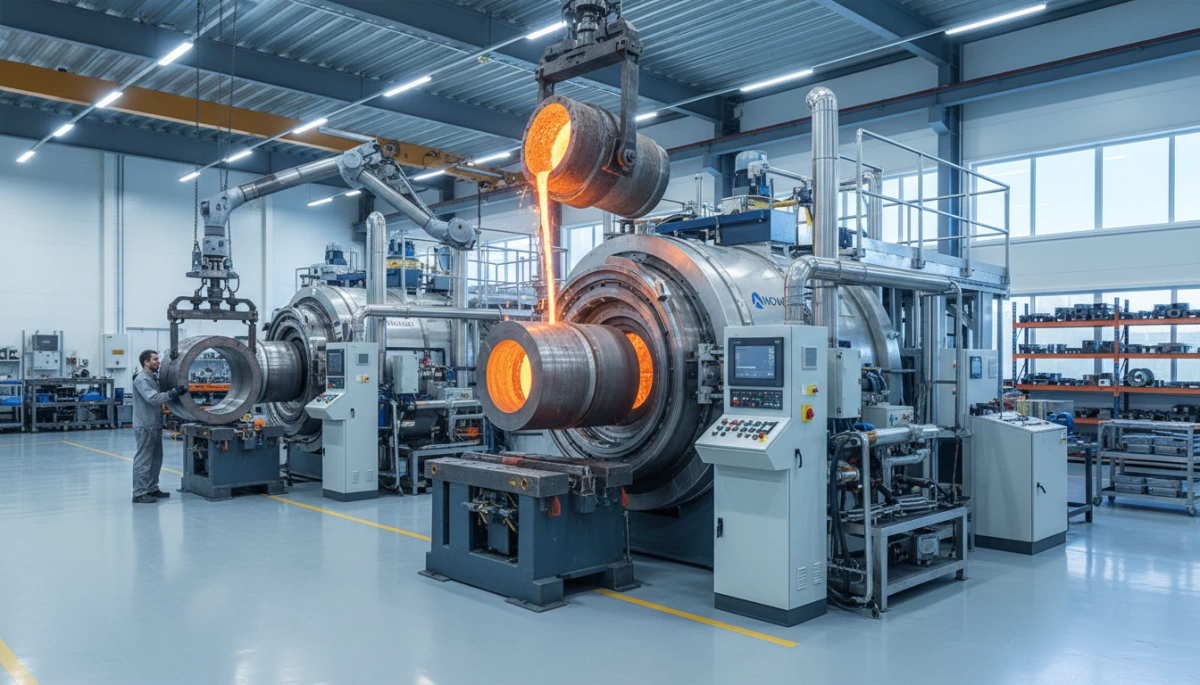
When we build and deploy centrifugal casting equipment at Precisionvast, we target industries that cannot afford a single point of failure. The unmatched metal density and structural integrity achieved through high-G centrifugal pouring make it the go-to solution for the toughest manufacturing sectors in the United States.
Here is exactly where our industrial foundry casting machinery goes to work:
Pumps & Valves
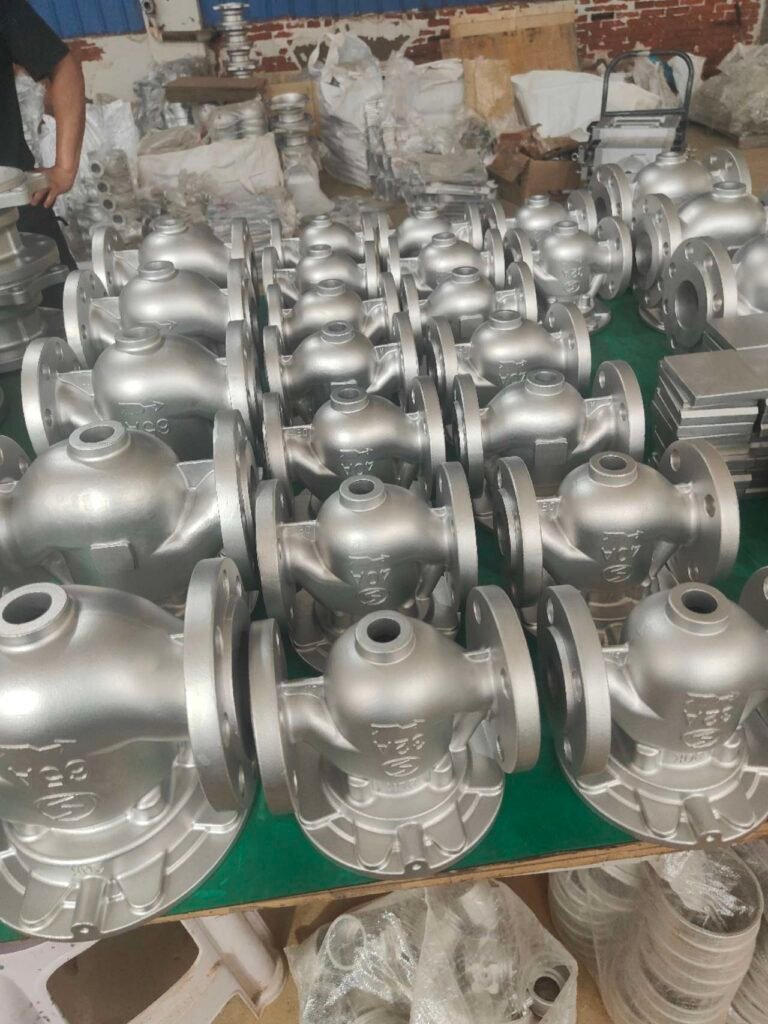
Fluid control systems deal with massive PSI levels on a daily basis. Our equipment spins out flaw-free, high-pressure casings and heavy-duty valve bodies. When manufacturers leverage the benefits of carbon steel casting in our rotary setups, the resulting components easily handle extreme pressure without cracking, porosity, or leaking.
Marine Hardware
Saltwater and high torque tear standard metal apart. Shipyards rely on the centrifugal casting process to produce incredibly dense, corrosion-resistant cylindrical housings and heavy propeller shafts. If you look at who uses high-temperature alloys in industries alongside severe-duty marine metals, the naval and commercial shipping sectors are always at the top of the list, demanding zero internal defects.
Automotive & Heavy Machinery
From diesel truck engines to heavy earth-moving rigs, internal engine components take a severe beating.
- Cylinder Liners: Our dedicated cylinder liner casting equipment produces perfectly symmetrical, wear-resistant sleeves designed for high-mileage abuse.
- Heavy-Duty Bearings: The rotational speed and G-force ensure a flawless, tightly packed grain structure for critical load-bearing parts.
- Babbitted Components: By utilizing a specialized babbitting machine setup, operations can achieve perfectly bonded bimetallic wear surfaces that keep heavy machinery engines running smoothly under extreme friction.
Centrifugal Casting Equipment FAQs
What standard dimensional tolerances do centrifugal casting machines achieve?
Our industrial foundry casting machinery typically achieves outside diameter (OD) tolerances of +/- 0.1 to 0.25 inches right out of the mold, depending on the overall size and weight of the part. Because the centrifugal casting process naturally forces lighter impurities to the inner bore, we always machine the inside diameter (ID) as a final step. This guarantees we hit your precise, final dimensional tolerances on the finished component.
How does rotational speed dictate the final wall thickness?
The wall thickness itself is determined by the exact volume of molten metal we pour into the machine. However, the rotational speed RPM is what makes that thickness uniform. We rely on variable speed spinning molds to dial in the exact G-force required for each specific part. This precise control ensures the centrifugal force metal density is perfectly even, pushing the material firmly against the die wall to lock in a consistent thickness as the metal solidifies.
Can centrifugal casting equipment handle dual-metal (bimetallic) applications?
Absolutely. Utilizing our centrifugal casting equipment for bimetallic centrifugal casting is one of our core capabilities. We can pour a rugged, cost-effective outer shell—like carbon steel—and immediately follow it with a highly specialized inner layer. This dual-pour method is ideal when you need to combine heavy structural integrity with advanced wear resistance, such as when manufacturing heavy-duty parts capable of resisting the heat in high-temperature applications by adding an inner nickel alloy layer.
 German
  English