

Are you struggling to find the right balance between part strength, surface finish, and tooling costs? When engineering blueprints demand high-performance components, permanent mold aluminum casting delivers exactly what you need.
Unlike traditional sand casting that destroys the mold after a single pour, this process relies on highly durable, reusable steel or iron molds. We pour molten aluminum directly into these precision-machined cavities, allowing for highly repeatable and efficient manufacturing.
The true advantage of this method lies in the metallurgy. Because metal molds conduct heat quickly, they drastically change how the aluminum solidifies.
Core Benefits of the Process
- Rapid Cooling Rates: The steel or iron mold cools the molten aluminum much faster than expendable sand molds.
- Finer Grain Structure: Accelerated solidification prevents large, porous crystals from forming, creating a highly dense internal structure.
- Superior Mechanical Properties: The tight grain structure gives the final aluminum component significantly higher tensile strength and durability, making it perfect for high-stress applications.
How the Permanent Mold Aluminum Casting Process Works
When we handle a project, the process relies on precise, repeatable steps to guarantee consistent, durable parts. Here is how we take a project from molten metal to a solid, reliable component:
- Mold Preparation: We preheat the reusable steel or iron mold and spray a specialized refractory coating inside the cavity. This acts as a thermal barrier to control the cooling rate and ensures a clean release.
- Core Placement: For complex internal hollows or intricate geometries, we place expendable sand cores or reusable metal cores inside the mold before it closes.
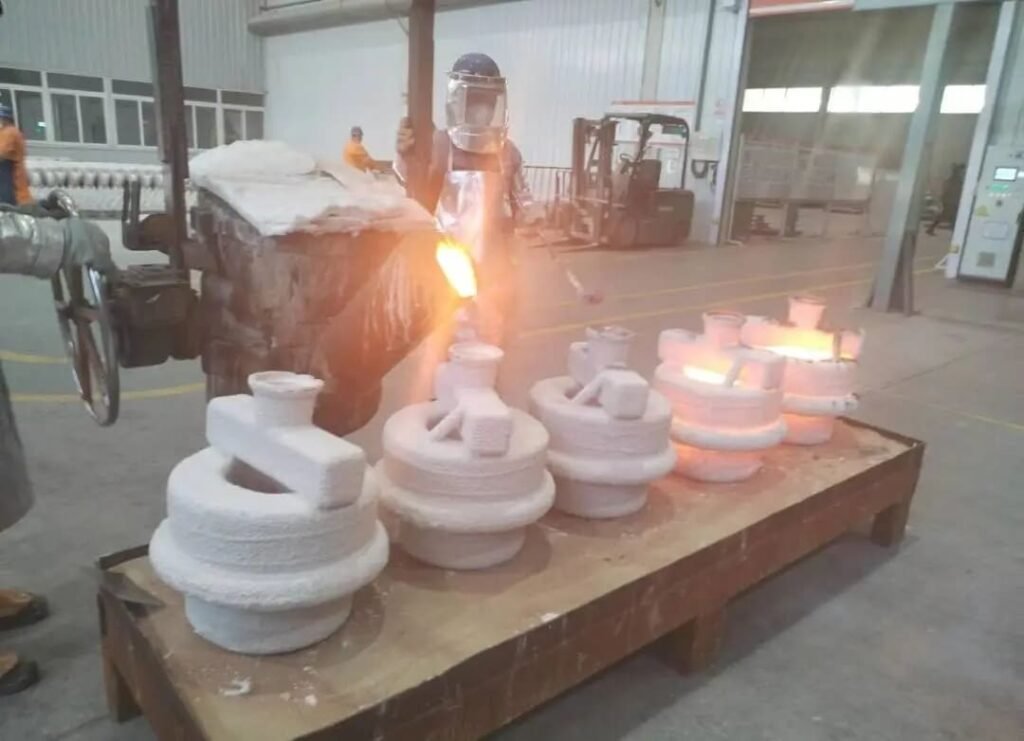
- Pouring: We generally rely on two approaches depending on the required structural integrity:
- Gravity Pouring: Liquid aluminum is poured from the top, allowing gravity to naturally fill the mold cavity.
- Low Pressure Permanent Mold (LPPM): Liquid metal is pushed slowly upward into the mold under low pressure. This drastically cuts down on turbulence and prevents trapped air, reducing aluminum casting porosity.
- Solidification & Ejection: Direct contact with the steel mold rapid-chills the aluminum, locking in a denser grain structure. Once solid, the mold opens, and automated pins safely eject the hot part.
- Finishing: We cut off the attached gates and risers (the hardened flow pathways), recycle the scrap, and leave a clean casting ready for heat treatment or final CNC machining.
Key Advantages for Engineering Applications
Selecting the right manufacturing method is as critical as the design itself. Permanent mold aluminum casting offers a specific set of benefits that make it the preferred choice for engineers.
Superior Mechanical Strength
Unlike sand casting, the reusable steel mold acts as a heat sink. This fast solidification creates a finer, denser grain structure. In practical terms, we typically see a 15% or greater increase in tensile strength compared to sand-cast parts.
Lower Porosity and Denser Castings
Gas pockets and voids are the enemies of structural integrity. Because the pouring process (gravity or LPPM) is highly controlled, we minimize turbulence. This results in the low porosity required for pressure-tight applications like pumps or valves.
Tighter Tolerances & Surface Finish
A precision-machined steel mold yields a smooth, clean surface finish right out of the gate (unlike the granular texture of sand casting). A better “as-cast” finish means less excess material to remove, significantly reducing heavy post-casting CNC machining operations.
Economies of Scale: The “Sweet Spot”
For medium-to-high volume production runs where quality cannot be compromised but die casting volumes aren’t quite there, this method offers the best return on investment.
Permanent Mold vs. Sand Casting vs. Die Casting
When planning your production run, picking the right method comes down to volume, budget, and performance. Here is how the three main casting processes stack up:
| Feature | Sand Casting | Permanent Mold Casting | Die Casting |
| Tooling Cost | Low | Medium | Very High |
| Piece Price (Med-High Vol) | High | Medium | Low |
| Mechanical Strength | Fair | Excellent | Good |
| Surface Finish | Rough | Smooth | Very Smooth |
- Sand Casting: Best for low-volume runs, massive parts, or rapid prototypes to avoid high upfront tooling investments.
- Permanent Mold Aluminum Casting: The industry standard for medium to high-volume production requiring maximum mechanical strength and lower porosity (e.g., automotive engine components, heavy-duty brackets).
- Die Casting: Strictly engineered for ultra-high-volume production (100,000+ parts) needing very thin walls, but requires massive initial tooling costs.
Essential Design for Manufacturability (DFM) Guidelines
Getting your part design right from the start saves time and money. Sticking to these core design rules ensures a flawless production run:
- Uniform Wall Thickness: Consistent thickness promotes even cooling, minimizes internal stresses, and drastically reduces porosity. If thickness must change, transitions should be gradual.
- Proper Draft Angles: Adding a 2 to 3-degree taper to vertical walls allows the solid part to release smoothly from the steel mold, preventing surface scraping and holding tight tolerances.
- Generous Radii and Fillets: Sharp internal corners create dangerous stress concentrations that lead to cracking. Radii and fillets smooth the flow of molten metal and significantly strengthen the final component.
Common Aluminum Alloys Used
Selecting the right material is critical for the final part’s performance.
A356 Aluminum Alloy: The Industry Standard
A356 is the undisputed workhorse in our foundry, offering an incredible balance of strength, castability, and durability.
- Exceptional Castability: Flows smoothly into complex cavities, ensuring high-fidelity details.
- Corrosion Resistance: Stands up well to harsh environments (automotive, marine, structural).
- T6 Heat Treatment: When subjected to T6 heat treatment, its yield strength and overall durability skyrocket.
Alternative Casting Alloys
- A319: Known for excellent machinability and pressure tightness. Recommended for engine components and oil pans.
- A355: Offers superior strength at elevated temperatures. Ideal for sustained high-heat environments.
Why Choose PrecisionVast for Your Aluminum Castings?
You need more than just a foundry; you need a manufacturing partner who understands the science behind the metal. At PrecisionVast, we combine over 20 years of experience with cutting-edge technology.
- Advanced CAE Simulation: We predict molten metal flow and solidification patterns digitally before cutting steel. This optimizes tooling design and eliminates defects early.
- True Turnkey Manufacturing: We handle the entire lifecycle under one roof—from SLA rapid prototyping and casting to in-house CNC machining and final T6 heat treatment.
- Certified Quality Control: Operating under strict ISO9001 certification, we provide comprehensive NDT (X-Ray, MPI), CMM dimensional verification, and Spectrometer material analysis for every batch.
- Scale and Reliability: With an 18,000 sqm foundry and 200+ skilled employees, we ensure consistent lead times and reliable output for global industries.
 German
  English