

Why We Swear by Aluminum for Precision Casting
Understanding the hype behind lightweight metal casting and complex geometries
At Precision Vast, we don’t just cast metal; we engineer performance. The reason castable aluminum alloys dominate our production floor—from high-pressure die casting to gravity casting—is their unmatched ability to balance structural integrity with weight reduction. In industries like automotive and telecommunications, shedding pounds without sacrificing durability isn’t just a preference; it’s a requirement.
We rely on aluminum because it allows us to achieve near-net-shape aluminum parts right out of the mold. Unlike steel, which often requires extensive machining to achieve intricate details, aluminum flows effortlessly into complex mold designs. This fluidity lets us create thin-walled components and elaborate geometries that would be cost-prohibitive with other materials.
Why our clients choose aluminum casting:
- High Strength-to-Weight Ratio: Essential for modern EVs and industrial machinery where mass reduction improves efficiency.
- Superior Thermal Conductivity: Perfect for LED lighting housings and heat sinks that require rapid heat dissipation.
- Corrosion Resistance: naturally forms a protective oxide layer, extending the lifespan of parts exposed to harsh environments.
- Cost-Effective Scalability: Whether it’s a prototype or a high-volume run, aluminum minimizes machining time and tool wear.
By leveraging lightweight metal casting, we deliver precision aluminum components that meet strict dimensional tolerances while keeping production lean and efficient.
Breaking Down the Alloy Series
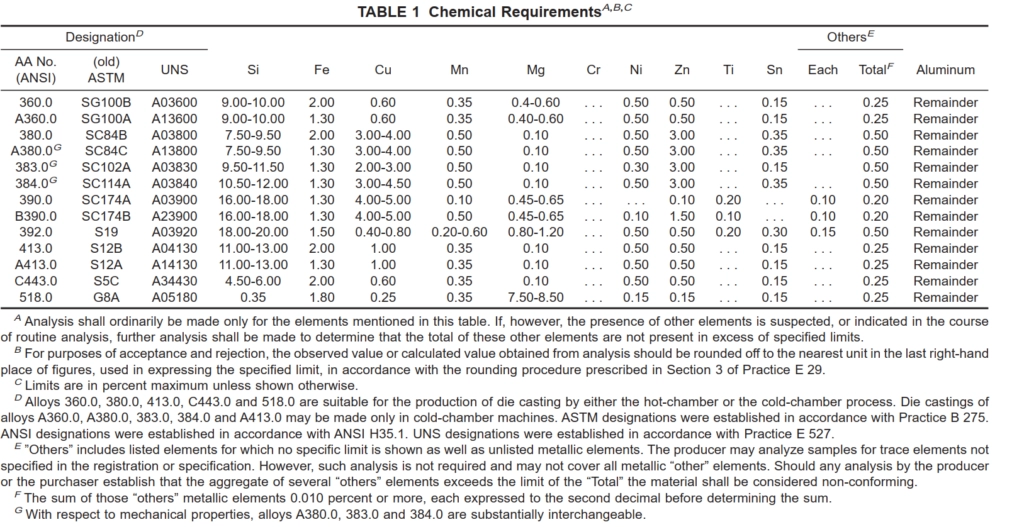
The naming convention for castable aluminum alloys is distinct from the 4-digit system used for wrought sheets or plates. We rely on the ANSI 3-digit designation system (xxx.x) to identify the major alloying elements, which directly dictates how the metal behaves in the mold. The first digit identifies the primary ingredient added to the aluminum base, while the decimal indicates whether the alloy is a casting (.0) or an ingot (.1).
Here is a quick guide to the series we encounter most often in manufacturing:
- 1xx.x Series: At least 99% pure aluminum. It offers high electrical conductivity but relatively low strength.
- 2xx.x Series: Copper is the main addition. These provide high strength and hardness but can be prone to hot cracking during solidification.
- 3xx.x Series: The industry standard for Al-Si-Mg alloys (Silicon plus Copper/Magnesium). These offer the best balance of fluidity, strength, and response to heat treatment.
- 4xx.x Series: Silicon-based. Known for excellent corrosion resistance and flow, often used for intricate parts that don’t require heat treatment.
- 5xx.x Series: Magnesium-based. These offer superior corrosion resistance and machinability but are more challenging to cast.
- 7xx.x Series: Zinc-based. These alloys are valued for their ability to age naturally and maintain dimensional stability.
For most precision aluminum components, the 3xx series aluminum is the sweet spot. It allows us to produce complex geometries using processes like lost wax casting or high-pressure die casting without sacrificing mechanical integrity.
Our Go-To Castable Aluminum Alloys
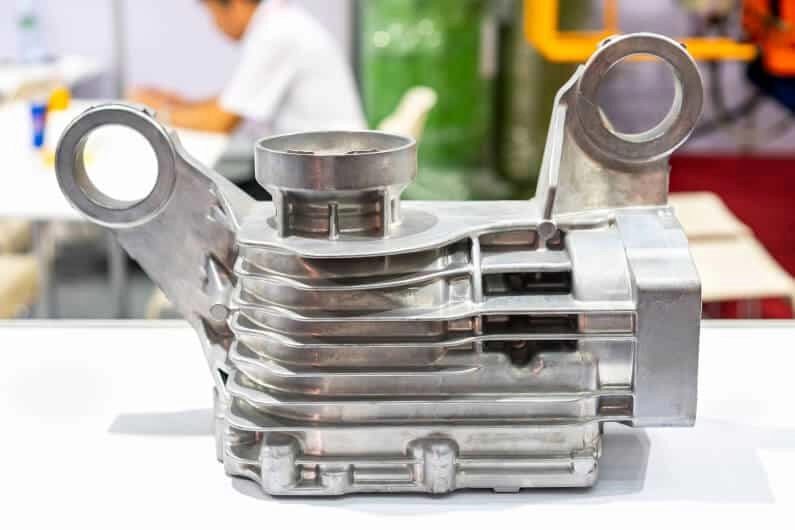
Selecting the right material is never a guessing game; it is a calculated decision based on the specific mechanical requirements and the production method used. We rely on a specific range of castable aluminum alloys that offer the best balance of fluidity in casting, mechanical strength, and post-process machinability. Since the material behavior changes drastically depending on how it is poured or injected, understanding the different types of casting processes is critical to matching the alloy to the application.
For our High-Pressure Die Casting (HPDC) projects, we primarily utilize alloys known for excellent flow characteristics and short cycle times:
- ADC12 (A383 Equivalent): This is a staple for complex, thin-walled parts. Its high silicon content ensures it fills intricate molds completely before solidifying, making it perfect for precision aluminum components in electronics and automotive housings.
- A380: The most common die-casting alloy in the U.S. market. It provides a solid trade-off between thermal properties and mechanical strength, offering reliable performance for general industrial applications.
- AlSi10Mg & AlSi12: These are chosen when corrosion resistance and thermal conductivity are prioritized, often used in LED lighting heat sinks.
For Gravity and Sand Casting, where structural integrity and pressure tightness are paramount, we switch to Al-Si-Mg alloys:
- A356 / ZL101: This is the industry standard for structural parts requiring high strength and ductility. It responds exceptionally well to Heat Treatment T6, significantly boosting its hardness and load-bearing capacity.
- ZL104: Used for parts requiring higher strength, often in heavy machinery contexts.
By sticking to these proven materials, we ensure that every lightweight metal casting we produce meets strict dimensional tolerances and surface finish requirements, whether it is a raw cast or a fully machined component.
A356 and A356.0: The Industry Workhorse
When we discuss castable aluminum alloys that dominate the market, A356 sits at the top of the list. This Al-Si-Mg alloy (Aluminum-Silicon-Magnesium) strikes the perfect balance between manufacturing ease and mechanical performance. We rely on it heavily because it offers exceptional fluidity, allowing us to pour complex, thin-walled geometries without defects.
The real value of A356 lies in its versatility for lightweight metal casting applications. It provides excellent pressure tightness, making it the standard choice for hydraulic cylinders, pump housings, and valves where fluid leakage is not an option. Additionally, this alloy boasts superior weldability, which is critical when components require assembly or repair using standard TIG or MIG welding processes.
Why We Choose A356:
- Castability: The high silicon content (around 7%) ensures molten metal fills intricate mold details.
- Heat Treatable: We typically process this to A356-T6 Aluminum condition to significantly boost yield strength and hardness.
- Corrosion Resistance: It holds up well against environmental factors, making it ideal for outdoor automotive and marine parts.
While A356 is the general designation, A356.0 specifically refers to the chemical composition limits of the final casting. Whether for aerospace structural nodes or automotive wheels, this series delivers the reliable mechanical properties and dimensional stability our clients expect.
A357: When You Need Higher Strength
When the mechanical requirements of a project exceed the capabilities of standard A356, we upgrade to A357. Among high-performance castable aluminum alloys, this material stands out because it incorporates a precise amount of beryllium. This addition is a game-changer; it modifies the iron intermetallics within the metal, allowing us to achieve significantly higher tensile strength and ductility after heat treatment. It is essentially the heavy lifter of the Al-Si-Mg alloys family.
We typically recommend A357 for critical structural components in the aerospace and defense sectors where weight reduction cannot come at the expense of durability. The beryllium content also improves fluidity in casting, helping us fill complex molds for thin-wall aluminum casting with fewer defects.
- Enhanced Mechanical Properties: Delivers superior yield strength compared to standard commercial alloys.
- Corrosion Resistance: Offers excellent performance in harsh operating environments.
- Heat Treatment Response: Reacts exceptionally well to T6 cycles for maximum hardness and stability.
C355: Handling the Heat
When applications demand performance in high-temperature environments, standard castable aluminum alloys often fall short. C355 is our answer for components that need to maintain structural integrity near engines or exhaust systems. As a member of the 3xx Series Aluminum group, this alloy incorporates copper to boost its high-temperature strength without sacrificing too much castability.
While aluminum die casting is ideal for low-volume production of general brackets, we specifically deploy C355 in gravity or sand casting for parts requiring excellent pressure tightness and the ability to withstand sustained heat. To maximize its potential, we typically process this alloy using Heat Treatment T6, which significantly enhances its mechanical properties.
Key C355 Characteristics:
- High-Temperature Stability: Retains Tensile Strength better than A356 at elevated temperatures (up to 350°F).
- Leak Resistance: Excellent pressure tightness makes it ideal for housings and manifolds.
- Response to Aging: Reacts exceptionally well to heat treatment for increased hardness.
Alloy 40E (713.0): The Self-Aging Solution
When a project demands high strength without the risk of distortion from thermal processing, Alloy 40E (ANSI 713.0) is our top recommendation. Among the various castable aluminum alloys, this Aluminum-Zinc-Magnesium formulation is unique because it is “self-aging.” It naturally achieves full mechanical properties after sitting at room temperature for approximately 21 days, completely eliminating the need for a standard T6 heat treatment cycle.
By skipping the solution heat treatment and quench phases, we avoid the internal stresses that typically lead to warping. This makes 713.0 exceptional for parts requiring tight dimensional stability and complex geometries where maintaining tolerance is critical.
Why We Choose 713.0 for Precision Parts
- Superior Machinability: It cuts cleanly and polishes to a brilliant silver-white finish, often outperforming standard Al-Si-Mg alloys in surface quality.
- Cost Efficiency: Removing the heat treatment step reduces lead times and manufacturing costs.
- Environmental Durability: The alloy offers excellent corrosion resistance compared to other metals, making it suitable for brackets, levers, and instrument cases exposed to the elements.
- Anodizing Quality: It responds very well to anodizing, producing a consistent and attractive protective layer.
If you need precision aluminum components that hold their shape perfectly right out of the mold while offering the strength of heat-treated parts, Alloy 40E is the practical solution.
The Numbers: Mechanical Properties & Specs
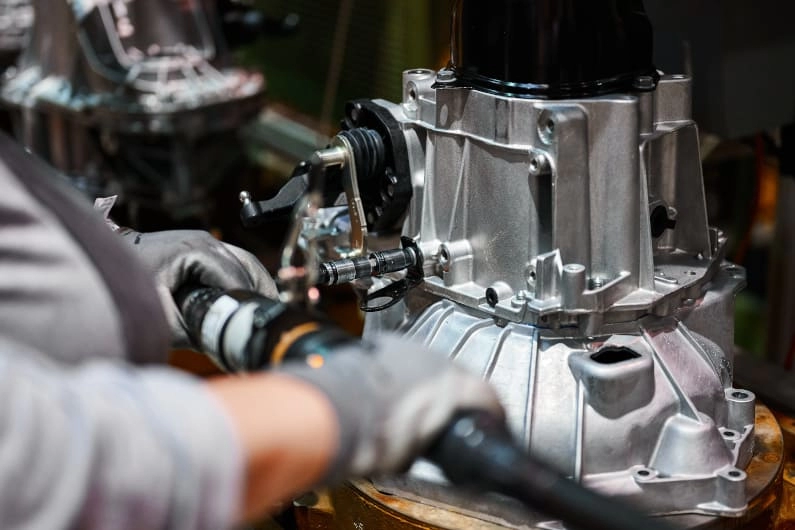
Selecting the right material for your project isn’t about guessing; it is about hard data. We rely on specific mechanical benchmarks to ensure every part we manufacture can withstand the real-world stresses of its application. Whether you are looking at high-pressure die casting options or gravity-fed molds, understanding the trade-offs between tensile strength, yield, and elongation is critical.
Below is a comparison of the typical mechanical properties for the most common castable aluminum alloys we process. These figures represent standard performance, though specific heat treatments like A356-T6 can significantly enhance these values.
| Alloy Designation | Casting Method | Tensile Strength (MPa) | Yield Strength (MPa) | Elongation (%) | Hardness (HB) |
|---|---|---|---|---|---|
| A356.0-T6 | Gravity / Sand | 230 – 260 | 165 – 185 | 3.5 – 5.0 | 70 – 75 |
| A380 (ADC10) | Die Casting | 317 | 159 | 3.5 | 80 |
| ADC12 | Die Casting | 310 | 154 | 2.5 | 75 |
| AlSi10Mg | Die / Sand | 220 – 240 | 140 – 160 | 2.0 – 4.0 | 60 – 70 |
Key Takeaways for Selection:
- A356-T6 Aluminum: The gold standard for structural integrity. It offers an excellent balance of strength and ductility, making it ideal for safety-critical automotive and aerospace parts.
- A380 & ADC12: These are the workhorses for advantages and disadvantages of high-pressure die casting. They provide superior fluidity for complex thin-wall geometries but generally have lower elongation compared to heat-treated gravity alloys.
- Hardness: If machining is required post-casting, hardness values (Brinell) will dictate the tooling and feed rates we use to maintain precision.
How We Ensure Integrity in Every Pour
Achieving structural reliability in castable aluminum alloys requires more than just high-quality metal; it demands strict process control from the design phase to the final finish. As a provider of comprehensive Aluminum Foundry Services, we treat every step as critical to the part’s performance.
Precision Mold Design and Simulation
We eliminate guesswork before the first ingot is melted. Using advanced flow simulation software, we optimize the gating and runner systems to ensure smooth metal flow. This reduces turbulence and prevents common Aluminum Casting Defects like air entrapment or cold shuts. By controlling how the metal enters the mold, we secure the internal structure of the component.
Melt Quality and Degassing
Molten aluminum is sensitive to hydrogen absorption, which causes porosity. We implement rigorous degassing protocols to purify the melt before casting.
- Rotary Degassing: Actively removes dissolved hydrogen to ensure density.
- Fluxing: Cleans oxides and impurities from the melt surface.
- Spectrometry: Verifies the chemical composition matches exact specs for alloys like A356 or ADC12.
Enhancing Strength with Heat Treatment
For parts requiring superior mechanical properties, we utilize Heat Treatment T6. This process involves solution heat treatment followed by artificial aging. It significantly boosts the yield strength and hardness of the alloy, making it suitable for high-stress applications in automotive and industrial machinery. This step transforms a standard casting into a high-performance component ready for assembly.
Quality Checks: No Defects Allowed
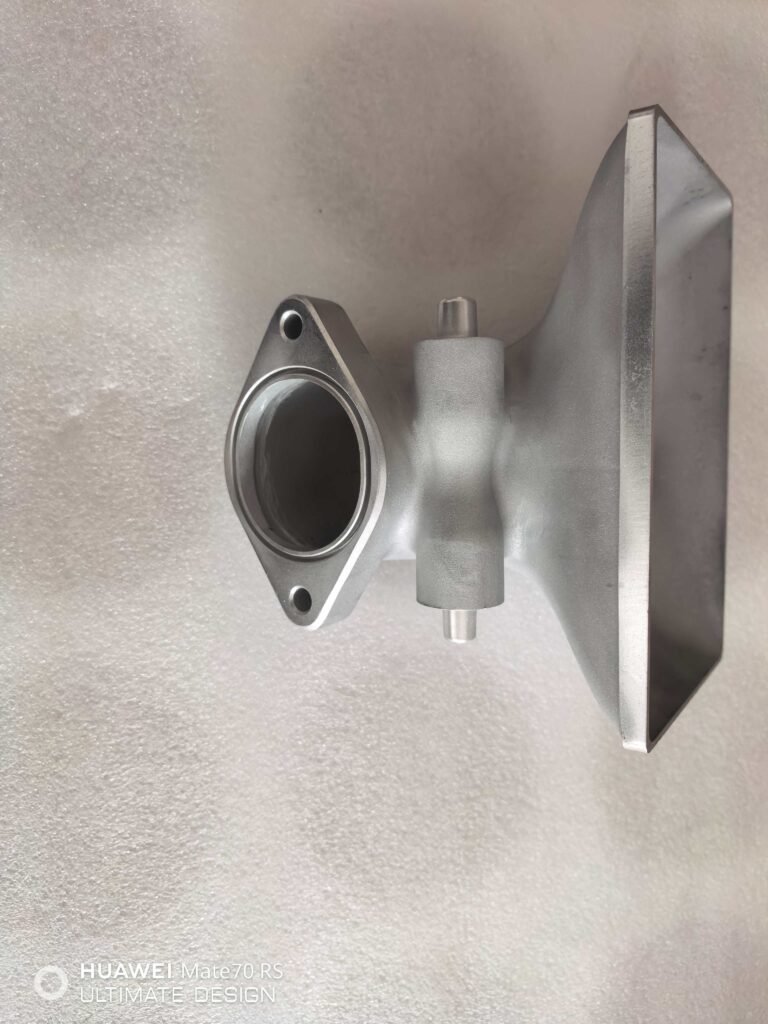
When we cast parts, “good enough” doesn’t cut it. Working with castable aluminum alloys requires rigorous validation to ensure that lightweight performance doesn’t come at the cost of structural weakness. We employ a strict zero-defect policy backed by advanced metrology and testing equipment to catch issues before they ever reach your assembly line.
To guarantee every component meets your exact specifications, we rely on a multi-stage inspection process:
- X-Ray Verification: We look deep inside the metal to detect hidden Aluminum Casting Defects like porosity, gas pockets, or shrinkage that aren’t visible to the naked eye.
- Dimensional Inspection: Using CMM (Coordinate Measuring Machines), we verify tolerances down to the micron, ensuring the physical geometry matches your CAD data perfectly.
- Material Analysis: Optical emission spectrometry confirms the chemical composition of the alloy, ensuring the purity and grade of the aluminum meet international standards.
- NDT (Non-Destructive Testing): Techniques like dye penetrant inspection help us spot surface hairline cracks and inconsistencies without damaging the part.
We don’t just pour metal; we engineer reliability. By strictly controlling the process from the melt to the final check, we deliver precision aluminum components that you can trust for critical applications.
Where You Will Find Our Cast Aluminum Parts
Real-World Applications in Automotive, Medical, and Industrial Sectors
We don’t just pour metal; we engineer solutions for industries where failure is not an option. Our castable aluminum alloys are the material of choice for sectors that demand a rigorous balance of high strength, low weight, and superior thermal properties. By strictly controlling the alloy composition and utilizing the best molds for aluminum casting, we deliver components that meet the exact standards of the US market.
Here is where our precision aluminum components make an impact:
- Automotive & EV: In the race for better fuel economy and extended battery range, lightweight metal casting is non-negotiable. We manufacture critical engine components, heat sinks, and structural brackets using alloys like A380 and ADC12. These materials offer the corrosion resistance and thermal conductivity needed for modern electric vehicle architectures.
- Medical Devices: Reliability is paramount in healthcare. Our foundry produces intricate, high-tolerance parts for diagnostic equipment and surgical tools. The clean surface finish and dimensional stability of our castings ensure they meet strict medical hygiene and operational standards.
- Industrial Machinery & Telecommunications: From rugged housings for 5G infrastructure to heavy-duty brackets for automation equipment, our parts withstand harsh operating environments. We utilize high-pressure die casting to produce durable enclosures that protect sensitive electronics while effectively managing heat dissipation.
- LED Lighting: We support the lighting industry with complex heat sink designs that maximize surface area for cooling, ensuring long-term performance for high-output LED systems.
Frequently Asked Questions About Aluminum Casting
We encounter the same technical questions from engineers and procurement teams every day. Navigating the nuances of castable aluminum alloys can be tricky, so we have compiled straight answers to the most common inquiries regarding design constraints and finishing options.
What is the minimum wall thickness for cast aluminum parts?
Achieving thin-wall aluminum casting depends heavily on the process and the alloy’s fluidity.
- High-Pressure Die Casting: We can typically achieve walls as thin as 0.060 inches (1.5 mm), and sometimes down to 0.040 inches (1.0 mm) for smaller components using high-fluidity alloys like ADC12 or A380.
- Gravity & Sand Casting: These processes require thicker walls to ensure proper metal flow before solidification. We generally recommend a minimum of 0.125 inches (3 mm) to 0.187 inches (5 mm).
Can die-cast aluminum alloys be anodized?
Yes, but with caveats. Most die-casting alloys, such as A380 and ADC12, contain high levels of silicon to improve fluidity. This silicon does not dissolve during the anodizing process, often resulting in a dark, gray, or blotchy appearance.
- Protective Finish: If you need anodizing strictly for corrosion resistance or wear protection (Hard Anodizing), standard die-cast alloys work fine.
- Cosmetic Finish: If you need a vibrant, consistent color (like an Apple product), die casting is difficult. We often recommend powder coating or painting for high-aesthetic requirements on these alloys.
How does A380 compare to A356?
A380 is the most common choice for high-pressure die casting because it is cost-effective and flows easily into complex molds. However, it is generally not heat-treated. In contrast, A356 is the standard for gravity and sand casting where structural integrity is paramount. If you are looking for high strength and ductility, you should read everything you need to know about 356 alloy, as it responds exceptionally well to T6 heat treatment for critical applications.

 English
  German