

Sand casting iron is a highly efficient, cost-effective manufacturing process ideal for large, heavy-duty components where structural integrity outweighs the need for tight initial tolerances.
- The process involves four main steps: Pattern Creation, Mold Preparation (typically Green Sand or Resin-Bonded Sand), Melting/Pouring (typically at temperatures between 1,300°C and 1,500°C), and Cooling/Shakeout.
- Raw sand-cast iron yields a rough surface (typically 250–1000 µin Ra) requiring secondary operations like fettling, shot blasting, and CNC machining.
- For complex geometries, thin walls, and tighter tolerances, investment casting (lost-wax casting) is the preferred alternative, minimizing post-machining costs.
What is the Sand Casting Process for Iron?
When evaluating manufacturing strategies for heavy-duty components, engineers often need to understand exactly how to sand cast iron. At its core, this foundational metal casting method involves pouring molten iron into an expendable cavity formed out of compacted, bonded sand.
Depending on the specific requirements for the mold’s rigidity, thermal threshold, and the desired production speed, foundries typically construct these molds using one of two primary sand mixtures:
- Green Sand: A highly cost-effective, moist aggregate consisting of silica sand (75-85%), bentonite clay (5-11%), water (2-4%), and carbonaceous materials. It is the backbone of standard iron foundry casting methods due to its recyclability.
- Resin-Bonded (No-Bake) Sand: A chemically cured mixture that provides enhanced structural stability and a slightly smoother finish. It is reserved for heavier pours, oversized castings, and more demanding geometric cores.
Typical Applications for Sand-Cast Iron
We specify the sand casting process for applications where sheer size, weight, vibration dampening, and structural integrity outrank the need for extremely tight dimensional tolerances. Common grades cast include Grey Iron (e.g., ASTM A48) and Ductile Iron (e.g., ASTM A536).
- Heavy machinery bases and industrial equipment frames (excellent vibration absorption).
- Engine blocks, large automotive manifolds, and gearboxes.
- Industrial valves, pipes, and heavy-duty municipal water fittings.
- Large agricultural and architectural components requiring immense load-bearing capacity.
How to Sand Cast Iron: Step-by-Step
When we look at how to sand cast iron, the method breaks down into four core engineering phases. Here are the essential sand casting process steps followed on the foundry floor to turn raw metal into solid, functional parts.
1. Pattern Creation and Engineering
Before pouring any metal, a physical replica (pattern) of the final part is machined from wood, plastic, or metal. We design this pattern slightly larger than the final product to explicitly account for shrinkage allowance (typically 1% to 2% for cast iron) as the metal cools from a liquid to a solid state. Draft angles (usually 1° to 3°) are also added to allow the pattern to be removed without breaking the sand.
2. Mold Preparation (The Flask)
The mold is built inside a two-part rigid frame called a flask.
- Packing the Sand: We pack bonded sand tightly around the pattern in the top half (the cope) and the bottom half (the drag). Cores are inserted if the part requires hollow internal cavities.
- The Gating System: We carefully carve out a sprue, runners, and gates. This network acts as a plumbing system, controlling the velocity and flow of the liquid metal smoothly into the main cavity to prevent sand erosion and turbulence.
3. Melting and Pouring
We melt the iron in an industrial induction or cupola furnace. Hitting the exact pouring temperature—usually between 1,300°C and 1,500°C (2,370°F – 2,730°F) depending on the alloy—is critical for a smooth, defect-free flow. Once the iron is fully molten and metallurgically verified, it is poured directly into the sand mold cavity.
4. Cooling and Shakeout
The casting sits until the iron completely solidifies and cools to a safe handling temperature. Once cool, the sand mold is aggressively broken away—a step known as the shakeout—to reveal the raw iron part. The sand is then reclaimed and recycled for future molds.
Surface Finish: Do You Need to “Sand” Cast Iron?
A common question pops up: do you actually have to “sand” or machine the finished piece? The short answer is yes.
Raw iron pulled from a green sand mold takes on the rough, pebbly texture of the packed sand. While investment casting might yield surface roughnesses of 63–125 µin Ra, sand casting typically yields 250–1000 µin Ra.
Post-Casting Surface Treatments
Because of this inherent roughness, sand-cast parts rarely come out ready to install. Here is exactly what it takes to clean up a raw sand casting to meet functional engineering standards:
- Fettling and Grinding: Heavy grinding to remove the gating system, risers, and the sharp parting line flash left behind where the two halves of the mold met.
- Shot Blasting / Peening: To remove stubborn, burnt-on sand stuck to the metal, parts are run through a shot blaster. This strips the part down to bare iron, leaving a uniform, clean, matte texture.
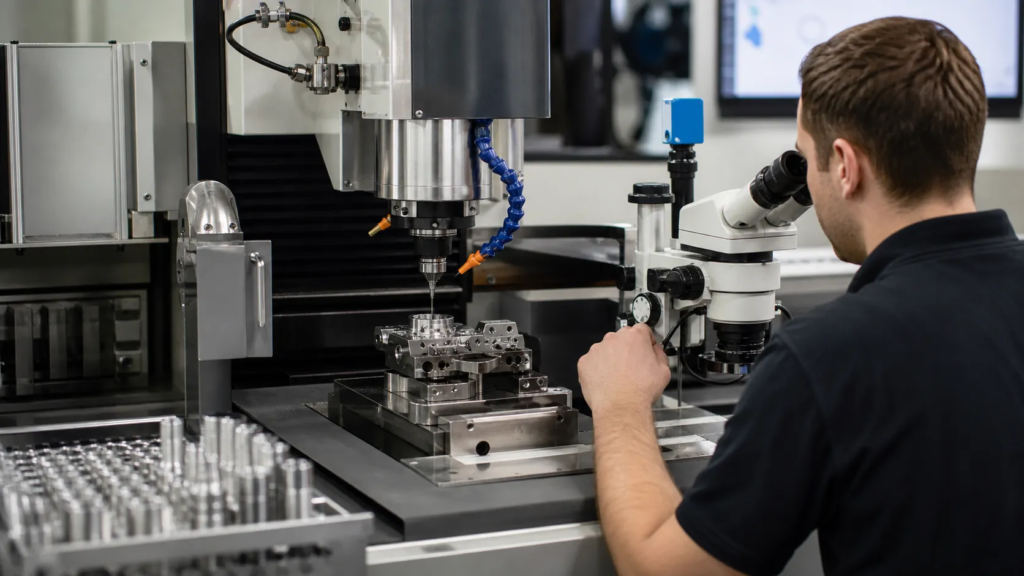
- Precision CNC Machining: Sand casting is not perfectly exact (standard tolerances are roughly ±0.030 inches per inch). For functional mating surfaces, threading, or bearing fits, machining raw cast iron is non-negotiable. We rely on CNC milling, turning, and facing to dial in those critical final dimensions.
Investment Casting vs. Sand Casting: A Comparative Guide
Depending on your part’s demands, you might be better off looking at a lost-wax (investment) casting alternative. Here is how the two methods stack up for OEM and industrial buyers:
| Feature | Sand Casting (Iron) | Investment Casting (Precision) |
| Ideal Part Weight | 1 lb to 10,000+ lbs | 0.1 oz to 150 lbs |
| Surface Finish (Ra) | 250 – 1000 µin (Rough) | 63 – 125 µin (Smooth) |
| Dimensional Tolerances | ± 0.030″ – 0.050″ per inch | ± 0.005″ per inch |
| Design Complexity | Moderate (Thick walls needed) | High (Intricate internal geometries) |
| Upfront Tooling Cost | Low to Moderate | Moderate to High (Metal dies) |
| Secondary Machining | High (Extensive milling needed) | Low (Near-net shape achieved) |
The Takeaway: Use sand casting for heavy, bulky parts where upfront tooling cost is the main concern. Choose investment casting when high precision, complex internal geometries, and minimal secondary machining are non-negotiable.
Precision Vast: Mastering Complex Metal Casting
While understanding how to sand cast iron makes sense for heavy, rough-finish components, modern US manufacturing often demands much tighter specs. When the inherent limitations of basic green sand molds hold your project back, Precision Vast steps in.
We move past the constraints of traditional iron foundry casting to deliver top-tier precision. Instead of standard raw cast iron, we focus our expertise on complex, high-performance materials like stainless steel, aluminum, titanium, and high-temperature alloys.
If your project requires intricate internal geometries or thin walls, our process serves as the ultimate lost-wax casting alternative. We utilize a highly controlled, 14-step precision investment casting method that produces near-net shapes with exceptional surface finishes, virtually eliminating the heavy fettling and grinding that sand castings require.
Casting Defect Simulation (CAE) & Quality Control
We don’t leave your project’s success to chance. We build quality into the process from day one:
- Predictive Engineering (CAE): We run advanced casting defect simulation software (CAE) before pouring a single ounce of metal. By modeling fluid flow and thermal cooling, we identify and prevent shrinkage, porosity, and cold shuts early, keeping your production timeline on track.
- In-House CMM Testing: We verify every critical dimension. Using advanced in-house Coordinate Measuring Machines (CMM), we guarantee your parts meet the exact metal casting dimensional tolerances you specified.
- Certified Excellence: Our manufacturing operations are backed by rigorous ISO 9001 certification, ensuring consistent, repeatable quality across every single production run.
Frequently Asked Questions (FAQ)
What is the minimum wall thickness for sand casting iron?
Because molten iron cools quickly, the minimum recommended wall thickness for sand casting is generally around 0.25 inches (6 mm). For walls thinner than this, investment casting or die casting is required.
How much does sand-cast iron shrink?
As it cools from a liquid to a solid, cast iron typically shrinks between 1% and 2% (about 1/8 to 1/4 inch per foot). Engineers must account for this by scaling up the initial wooden or metal pattern.
Can sand casting be fully automated?
Yes. While large, custom pieces are often hand-molded, modern foundries use automated highly-pressurized molding lines (like Disamatic machines) for high-volume automotive and industrial components, vastly increasing production speed.

 English
  German