

PrecisionVast industrial bearing catalog with ball and roller options detailed specs ABEC ratings and bearing interchange chart.
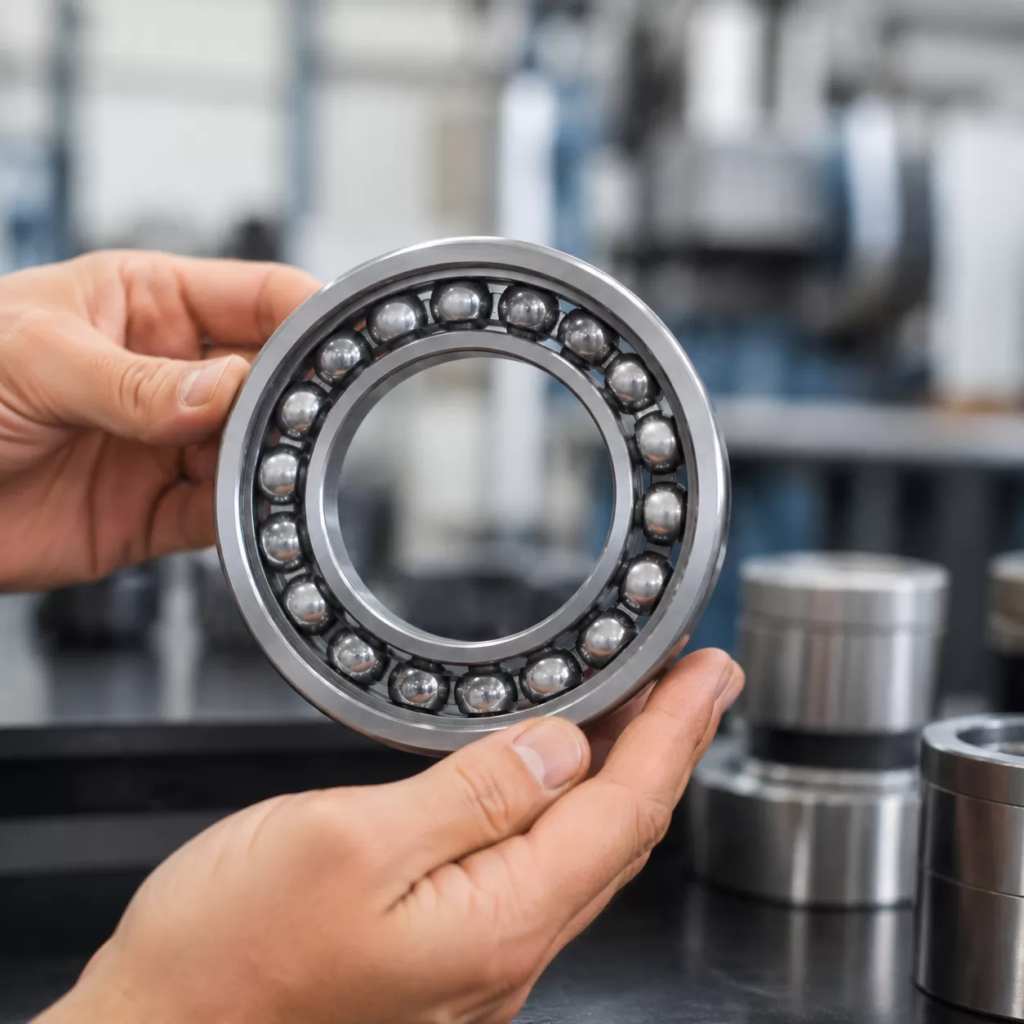
When your machinery starts grinding, overheating, or losing efficiency, the culprit is almost always unchecked rotational friction. In our industrial operations, we look at a mechanical bearing not just as a part, but as the critical baseline for smooth power transmission.
At its core, a bearing is a mechanical component designed to guide rotating shafts, handle heavy operational loads, and minimize metal-on-metal friction.
Mechanics of Anti-Friction Bearings
High-efficiency machinery relies heavily on anti-friction bearings. Instead of letting two flat metal surfaces slide past one another—which generates intense heat and rapid wear—these components place rolling elements between an inner and outer ring.
Our standard industrial configurations leverage this rolling motion to replace sliding friction, significantly lowering energy consumption and extending the service life of your equipment.
Deep Groove Ball Bearing Design
The deep groove ball bearing stands as the most widely used variety in the United States market due to its sheer versatility.
- Rotational Friction Reduction: By using perfectly spherical ball bearings held within deep, precision-engineered raceway grooves, the contact area is reduced to tiny points. Minimal surface contact equals minimal friction.
- Bi-directional Loading: The deep raceway walls provide the structural support needed to manage not only high-speed radial loads (forces pushing perpendicular to the shaft) but also light axial loads (forces pushing parallel to the shaft).
Choosing Ball Bearings vs Roller Bearings
Selecting the correct type of industrial bearings depends entirely on the nature of your mechanical load and speed requirements. The choice typically comes down to two major families:
| Bearing Type | Rolling Element | Contact Style | Best Used For |
|---|---|---|---|
| Ball Bearings | Spherical steel balls | Point contact | High-speed, lower-weight precision applications like electric motors. |
| Roller Bearings | Cylindrical or tapered rollers | Line contact | Heavy-duty, high-impact industrial machinery and automotive axles. |
Core Bearing Technical Specifications and Boundary Dimensions
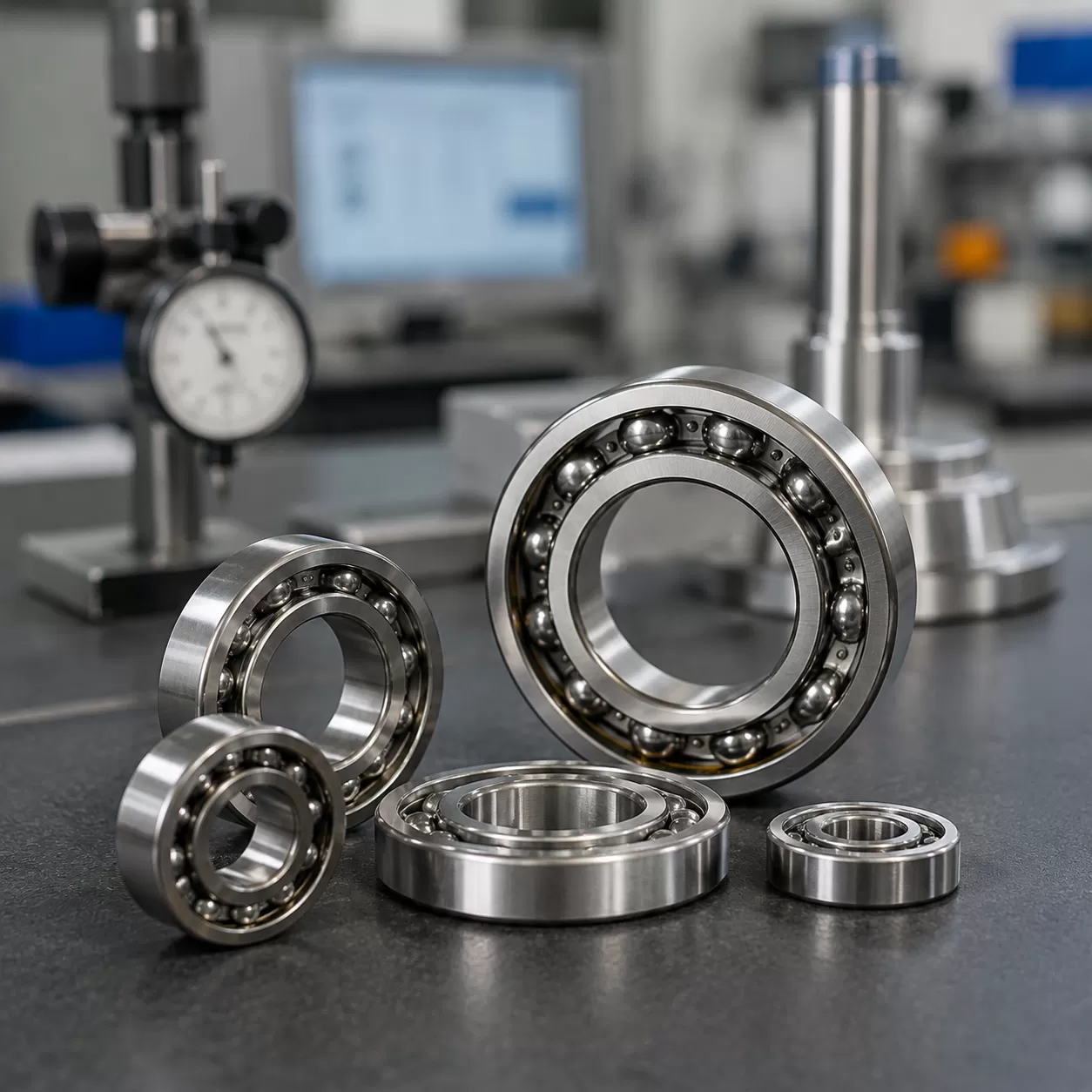
When selecting a mechanical bearing for any industrial or automotive application, dimensional accuracy is everything. Matching the exact boundary dimensions ensures proper component fit, prevents shaft misalignment, and eliminates premature equipment failure.
Boundary Dimension Standards
Every standard anti-friction bearing is defined by three primary boundary dimensions: the inner diameter (bore size), the outer diameter (OD), and the bearing width or thickness. In the United States, while many industrial applications rely on metric sizes established by the ISO, plenty of domestic machinery still utilizes inch-based dimensions.
- Inner Diameter (Bore Size): This is the critical measurement of the inner ring that fits directly onto the rotating shaft. Precise tolerances here prevent the bearing from slipping or spinning on the shaft under heavy loads.
- Outer Diameter (OD): The measurement of the outside ring that presses into the housing unit. Proper OD sizing ensures the assembly remains securely seated during high-RPM operations.
- Bearing Width/Thickness: The total axial width of the inner and outer rings. This dimension dictates how much physical space the bearing occupies along the shaft axis.
| Dimension Type | Metric Standard | Inch Standard | Critical Fit Role |
|---|---|---|---|
| Inner Diameter (Bore) | Millimeters (mm) | Decimals of an inch | Shaft mounting alignment |
| Outer Diameter (OD) | Millimeters (mm) | Decimals of an inch | Housing bore security |
| Width / Thickness | Millimeters (mm) | Decimals of an inch | Axial space management |
Understanding ABEC Tolerance Ratings and Precision Grades
The Annual Bearing Engineers’ Committee (ABEC) scale defines the standards for bearing manufacturing tolerances. This rating system grades the dimensional and runout accuracy of high-precision industrial bearings. ABEC ratings include odd numbers ranging from 1 to 9.
- ABEC 1: The standard industry baseline. Ideal for most general machinery, electric motors, and heavy-duty conveyor systems where extreme RPMs are not a factor.
- ABEC 3 to ABEC 5: Enhanced precision grades. These offer tighter tolerances for automotive axles, high-speed power transmission assemblies, and robust manufacturing equipment.
- ABEC 7 to ABEC 9: Ultra-high precision grades. Reserved for specialized applications like aerospace guidance systems, high-speed machine tool spindles, and medical instruments.
Higher ABEC numbers indicate tighter tolerances, smoother rotation, and increased efficiency at maximum speed thresholds. For rugged applications requiring specialized components, pairing these high-precision parts with durable structural aluminum castings ensures the entire housing assembly can withstand extreme mechanical stress without flexing or losing alignment.
Material Engineering and Component Construction in Premium Bearings
When we build high-performance machinery, the life of your bearing depends entirely on the materials we select for its construction. Choosing the right metal alloy or composite determines how well the component handles friction, heat, and corrosive environments.
Chrome Steel Bearings (52100) vs. Stainless Steel
For the vast majority of industrial applications, chrome steel bearings (SAE 52100) are our go-to standard. This high-carbon alloy offers incredible hardness and wear resistance, making it perfect for heavy radial loads. However, if your equipment operates in washdown environments or faces high moisture, we switch to stainless steel bearings (typically 440C). While stainless steel handles rust beautifully, it possesses slightly lower load capabilities than its chrome counterpart. For heavy-duty structural housings exposed to elements, matching these with rugged carbon steel casting components ensures the entire assembly survives harsh field conditions.
Ceramic Hybrid Bearings for High-Speed Performance
When standard steel hits its physical limits, ceramic hybrid configurations take over. These pieces combine traditional steel rings with silicon nitride ($Si_3N_4$) ceramic balls.
- Weight Reduction: Ceramic balls are 40% less dense than steel, radically lowering centrifugal force at high speeds.
- Heat Dissipation: They run significantly cooler, preventing thermal expansion from seizing the shaft.
- Electrical Insulation: Ceramic naturally stops stray electrical currents from pitting the bearing surfaces, a common lifesaver in electric motor maintenance.
Cage Designs: Pressed Steel, Nylon, or Machined Brass
The cage (or retainer) keeps the rolling elements spaced perfectly. We customize the cage material based on your specific operational goals:
- Pressed Steel: The reliable, cost-effective standard for everyday industrial use.
- Nylon / Polyamide: Lightweight and quiet. Excellent for high-speed applications, though limited to environments under 250°F.
- Machined Brass: Reserved for severe duty, massive shock loads, and extremely high temperatures. Brass provides natural lubricity and superior structural integrity.
Environmental Protection: Sealed vs Shielded Bearings
Choosing the right closure for your anti-friction bearings can make or break your machinery’s lifespan. The environment your equipment operates in dictates whether you need metal shields or contact rubber seals to protect the internal rolling elements and retain critical lubrication.
Metal Shields (Z/ZZ) for High Speeds
Metal shields, designated by the industry codes Z (single shield) or ZZ (double shield), offer excellent protection against larger debris without sacrificing performance.
- Low Friction: Because the metal shield does not physically touch the inner ring of the deep groove ball bearing, it creates zero added drag.
- High-Speed Thresholds: These are the go-to choice for high-precision industrial bearings operating at maximum RPMs where heat buildup must be minimized.
- Best For: Clean, dry environments like enclosed electric motors and high-speed power transmission assemblies.
Contact Rubber Seals (RS/2RS) for Maximum Exclusion
When your machinery faces harsh operating conditions, contact rubber seals—labeled as RS or 2RS—provide an absolute barrier against fine contaminants.
- Contaminant Exclusion: The rubber lip physically rides against the inner ring, blocking out moisture, fine dust, and washdown water.
- Lubrication Retention: Seals keep grease locked tightly inside the bearing cavity, significantly extending the time between maintenance cycles.
- Material Integrity: For extreme environments where corrosion is a threat, combining these seals with specialty components like high-temperature alloy castings or stainless components ensures the entire assembly survives.
Impact of Closures on Machinery Lifespan
| Feature | Metal Shields (Z/ZZ) | Rubber Seals (RS/2RS) |
|---|---|---|
| Contact Type | Non-contact (Gap) | Direct contact (Lip) |
| Friction & Heat | Extremely low | Moderate |
| Dust Protection | Fair (Good for large particles) | Excellent (Blocks fine dust) |
| Moisture Resistance | Poor | Excellent (Water-resistant) |
| Speed Capability | Maximum rating | Reduced due to drag |
Selecting the wrong closure type is a leading cause of premature bearing failure. If moisture penetrates a shielded bearing, the grease degrades rapidly, leading to micro-pitting. Conversely, running a sealed bearing at speeds beyond its limiting threshold causes the rubber lip to overheat and fail. Matching the closure to your specific environmental exposure ensures your equipment runs reliably without unexpected downtime.
Mechanical Load Capabilities and Speed Thresholds for Bearings
When choosing a bearing, understanding how it handles weight and rotational speed prevents early machinery failure. Every application demands a balance between structural load capacity and maximum RPM thresholds to keep your operations running smoothly.
Dynamic Load Rating (Cr) vs. Static Load Rating (Cor)
- Dynamic Load Rating (Cr): This figure represents the constant structural load a bearing can endure while spinning before fatigue sets in. We use this metric to calculate the overall operational lifespan of anti-friction bearings under continuous working conditions.
- Static Load Rating (Cor): This rating defines the maximum weight a bearing can handle when it is completely still or moving at incredibly slow speeds. Exceeding the Cor limit leads to permanent deformation of the rolling elements and raceways, causing immediate vibrations and noise.
Limiting Speeds: Grease vs. Oil Lubrication
The type of lubrication directly dictates how fast a bearing can safely spin. Friction creates heat, and your choice of lubricant determines the thermal threshold of the system.
| Lubrication Type | Speed Threshold Capacity | Best For |
|---|---|---|
| Grease Lubrication | Lower RPM limits (typically 70% to 80% of oil capacity) | Sealed environments, low maintenance, simplified designs |
| Oil Lubrication | Maximum RPM thresholds | High-speed performance, active heat dissipation, high-temperature applications |
Operating a deep groove ball bearing or roller bearings beyond these specified RPM thresholds breaks down the lubricant film. This leads to metal-on-metal contact, rapid heat buildup, and eventual catastrophic seizure. Always verify that your shaft speeds align with the delivery method of your lubricant.
Universal Industry Cross-Reference Guide
Finding the right replacement bearing doesn’t have to be a guessing game. Manufacturers worldwide use standard codes, but navigating a bearing interchange chart is the fastest way to match aftermarket options across global brands. When a machine goes down, you don’t always need the exact same brand; you just need the exact same specifications.
Decoding Part Number Nomenclature
Bearing part numbers look like a random string of letters and numbers, but they actually tell a complete story about the component’s size, type, and internal design.
- Prefixes: These letters usually identify special materials or unique applications, such as stainless steel or high-temperature configurations.
- Core Code (Base Number): This critical section dictates the bearing type and boundary dimensions, including the inner diameter (bore size), outer diameter (OD), and bearing width/thickness. For example, a standard 6204 indicates a deep groove ball bearing.
- Suffixes: These letters and numbers at the very end indicate the closure types (like ZZ for shields or 2RS for seals), internal clearance (like C3), and cage materials.
Using a Bearing Interchange Chart
When cross-referencing parts across different global manufacturers, a reliable interchange chart ensures you maintain the correct ABEC tolerance ratings and precision grades. While a premium cast component from our carbon steel casting page requires specific structural tolerances, anti-friction bearings rely on these standardized charts to guarantee a perfect drop-in fit.
| Original Manufacturer Code | Alternative Brand A | Alternative Brand B | Closure Type |
|---|---|---|---|
| 6203-2RS | 6203-LLU | 6203-DDU | Dual Rubber Seals |
| 6203-ZZ | 6203-2Z | 6203-ZZ | Dual Metal Shields |
| 7205-B-XL | 7205-A | 7205-BG | Angular Contact |
By matching the core dimensional data and suffix meanings, you can confidently source aftermarket alternatives that keep your machinery running without losing performance or alignment accuracy.
Industrial Applications and Machinery Fits
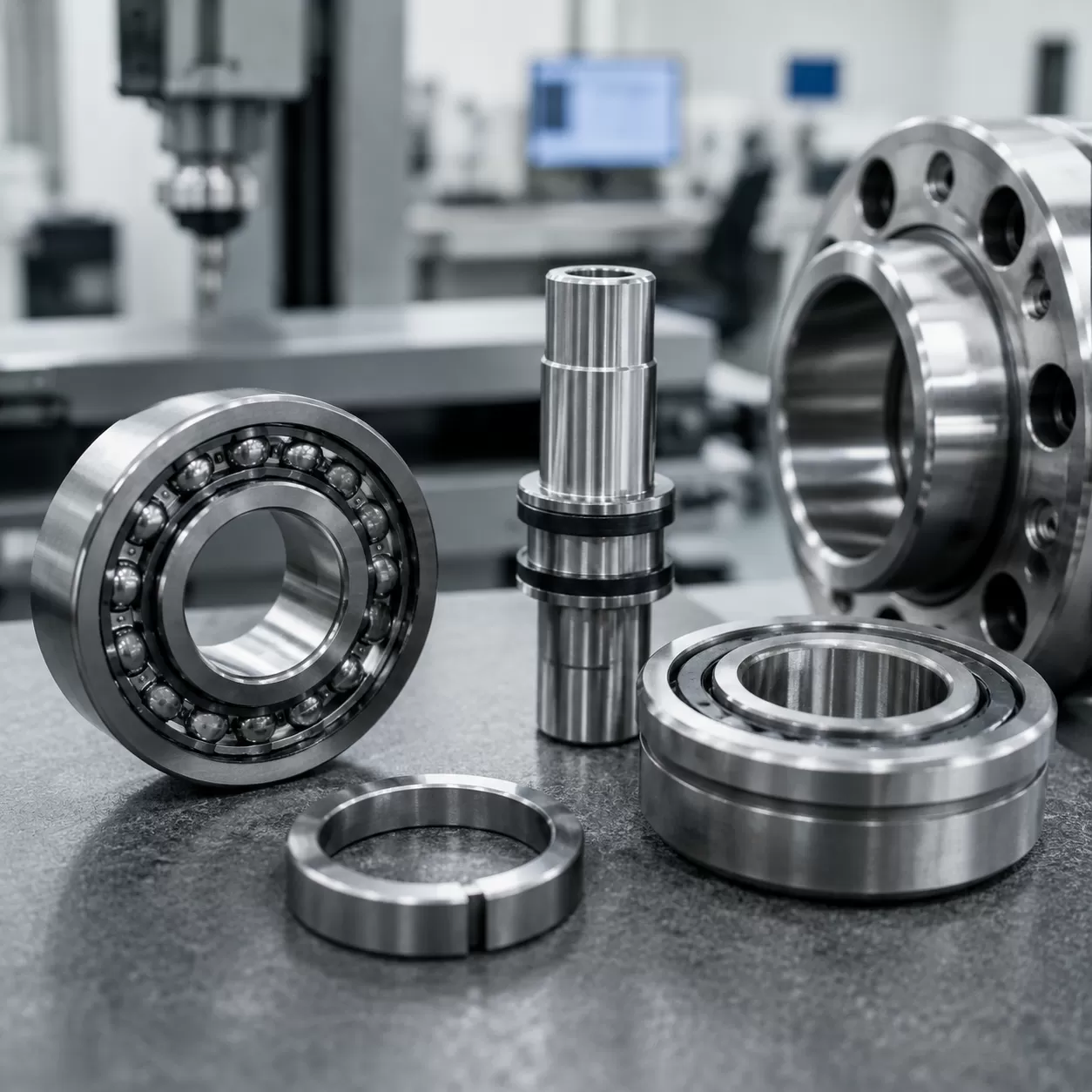
Every day, we supply high-performance anti-friction bearings to critical American infrastructure and manufacturing sectors. From heavy-duty automation to precision equipment, selecting the right bearing design and securing the perfect shaft and housing tolerance fits ensures long-term operational reliability.
Electric Motors and Power Transmission Assemblies
In electric motors, minimizing friction and vibration is everything. We rely heavily on a deep groove ball bearing configuration for these setups because they handle high speeds while keeping noise to an absolute minimum. In larger power transmission assemblies and gearboxes, roller bearings take over to manage heavier radial loads, ensuring smooth power transfer without shaft deflection.
Automotive Axle Systems and Conveyor Machinery
The demands of the automotive and material handling industries require extreme durability:
- Automotive Axles: Tapered roller bearings are the go-to choice here, effortlessly absorbing the combined radial and thrust loads experienced during vehicle cornering.
- Conveyor Systems: Industrial conveyors deal with dirt, debris, and continuous operation. For these harsh setups, we utilize heavy-duty ball bearings housed in pillow blocks, offering robust support and easy maintenance.
Shaft and Housing Tolerance Fits for Reliable Alignment
Even the highest-quality bearing will fail prematurely if the installation fit is off. Achieving the correct mechanical tolerance prevents the inner ring from slipping on the shaft and stops the outer ring from spinning inside the housing.
| Fit Type | Application | Purpose |
|---|---|---|
| Interference Fit (Tight) | Rotating Shafts | Prevents inner ring slippage under heavy loads. |
| Clearance Fit (Loose) | Linear/Axial Movement | Allows for thermal expansion and easier assembly. |
| Transition Fit | High-Precision Machinery | Provides exact alignment with minimal play. |
To dive deeper into the manufacturing precision behind these alignments, explore our guide on precision vast standards to see how micro-tolerances impact overall machinery lifespan. Proper alignment prevents vibration, reduces heat buildup, and keeps your production lines running smoothly.
Installation and Maintenance Best Practices for Your Bearing
Properly handling a mechanical bearing during setup and ongoing maintenance determines exactly how long your machinery stays up and running. Skipping steps here leads directly to unplanned downtime and expensive component damage.
Proper Mechanical and Induction Heating Mounting Protocols
Never strike a bearing directly with a hammer. For cold mounting smaller ball bearings or roller bearings, always use a fitting tool or sleeve that applies force evenly to the press-fitted ring. For heavy-duty industrial applications, induction heating is the standard.
- Temperature Limits: Heat the inner ring uniformly to around 110°C (230°F). Never exceed 120°C (250°F), or you risk altering the material properties of the chrome steel bearings (52100).
- Fit Check: The heated part slides smoothly onto the shaft. As it cools, it shrinks to form a tight, secure interference fit.
Lubrication Initializations and Re-Greasing Cycles
Correct lubrication reduces rotational friction and carries heat away from moving elements. Whether you utilize a standard deep groove ball bearing or a high-precision industrial bearing, the initial grease fill should typically occupy 30% to 50% of the internal free space.
- Over-Lubrication Danger: Packing a housing completely full causes churning, which spikes operating temperatures and degrades the grease.
- Maintenance Schedule: Establish strict re-greasing cycles based on operating RPMs, temperatures, and environmental dust levels.
Preventing Premature Machinery Failure Through Alignment Checkups
Perfect shaft and housing alignment keeps load distribution uniform across the rolling elements. Misalignment forces an angular contact bearing or standard ball bearing to handle unintended stress, accelerating wear on the cage and raceways. Use dial indicators or laser alignment tools during installation to verify tolerances, and perform routine vibration analysis checkups to catch minor shifts before they cause a catastrophic breakdown.
Frequently Asked Questions About Industrial Bearings
What is the difference between a sealed and shielded bearing?
The main difference comes down to contact and protection. A shielded bearing uses a non-contact metal shield (often designated as Z or ZZ) that sits close to the inner ring. It keeps large debris out and works great for high-speed, low-friction setups, but it won’t stop liquids. A sealed bearing uses a contact rubber seal (like RS or 2RS) that physically presses against the inner ring. This creates a solid barrier against moisture and fine dust, though it adds a bit more drag and lowers the maximum speed limit.
How do I find the part number using a bearing interchange chart?
To cross-reference an aftermarket option across global manufacturers, start by measuring the core boundary dimensions: the inner diameter (bore size), outer diameter (OD), and width. Once you have those dimensions, locate them on a universal bearing interchange chart. Look across the row to find your current brand’s part number, then match it to the corresponding column of the alternative manufacturer. Always double-check the prefixes and suffixes to make sure the closure types and clearance ratings match exactly.
Which material is best for high-speed high-precision industrial bearings?
For extreme high-speed and high-precision performance, ceramic hybrid bearings are the industry standard. They combine ultra-smooth silicon nitride ceramic balls with high-grade chrome steel bearings (52100) races. Ceramic balls are lighter, harder, and generate significantly less heat than standard steel, which prevents thermal expansion at high RPMs. For custom machinery components requiring specialized setups, using top low-volume casting prototyping solutions can help you perfect housing fits before launching full-scale production.
What causes a bearing to fail prematurely?
While anti-friction bearings are built to last, the vast majority of early failures stem from four common issues:
- Poor Lubrication: Either using the wrong grease, running dry, or over-greasing, which causes churning and overheating.
- Contamination: Dust, dirt, and moisture bypassing the closures and scoring the rolling elements.
- Improper Installation: Using brute force instead of induction heating or proper sleeve tools, which dents the raceways.
- Misalignment: Unaligned shafts that create uneven mechanical loads, spiking the dynamic load and destroying the cage assembly.
 English
  German