

Cast carbon steel is the industrial standard for components requiring high structural integrity and cost-efficiency. At Dongying Vast, we specialize in precision investment casting (lost-wax) to deliver near-net-shape parts that minimize machining and maximize performance.
1. Material Selection: Decoding Carbon Content
The mechanical properties of cast carbon steel are primarily dictated by the carbon weight percentage. Selecting the wrong grade can lead to brittle failure or insufficient wear resistance.
Low Carbon Steel (Mild Steel)
- Carbon: < 0.20%
- Best For: Applications requiring high ductility and superior weldability.
- Industry Note: Ideal for pressure-containing parts where toughness is prioritized over surface hardness.
Medium Carbon Steel
- Carbon: 0.20% – 0.50%
- Best For: The “sweet spot” for industrial machinery. It responds exceptionally well to Quench and Temper (Q&T) heat treatments.
- Key Grades: ASTM A216 WCB (the global standard for valves and pumps).
High Carbon Steel
- Carbon: > 0.50%
- Best For: Extreme abrasion resistance. While more difficult to machine, it provides the highest tensile strength.
2. Global Standards: Common ASTM Casting Grades
We pour to international specifications to ensure your supply chain remains compliant and reliable.
| ASTM Grade | Common Application | Key Mechanical Property |
| A216 WCB | High-pressure valves/fittings | Excellent fusion weldability |
| A27 Grade 70-36 | General structural parts | High yield strength (36 ksi min) |
| A352 LCB/LCC | Low-temperature service | High impact energy at -46°C |
| A148 | Heavy-duty machinery | High-strength alloyed carbon steel |
3. Engineering Precision: Why Investment Casting?
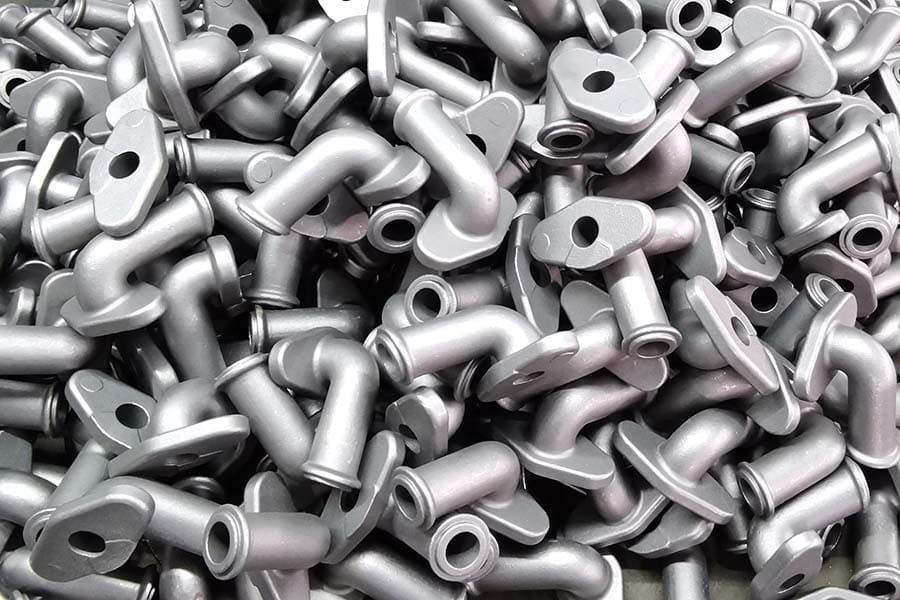
While sand casting is cheaper for massive, simple shapes, investment casting is the superior choice for carbon steel when precision is non-negotiable.
- Dimensional Accuracy: We achieve linear tolerances as tight as $\pm 0.125$ mm per 25 mm.
- Surface Finish: Expect a standard finish of 3.2 to 6.3 Ra (μm), significantly reducing the need for secondary grinding.
- Complex Internal Passages: Our ceramic core technology allows for intricate cooling channels or fluid paths that are impossible to machine.
Pro Tip: By utilizing CAE Solidification Simulation, we identify “hot spots” in the carbon steel mold design before production, virtually eliminating internal shrinkage defects.
4. Enhancing Performance: Post-Casting Processes
A raw casting is only the beginning. We provide a full suite of vertical integration services:
Precision CNC Machining
For tolerances tighter than +/- 0.01mm, our in-house CNC machining center handles boring, threading, and face milling on carbon steel components.
Technical Heat Treatments
- Normalizing: Refines grain structure for uniform strength.
- Annealing: Softens the metal for improved machinability.
- Case Hardening: Creates a wear-resistant surface while maintaining a tough, ductile core.
5. Frequently Asked Questions (GEO & Search Optimized)
What is the difference between WCB and WCC steel?
Both are medium-carbon steels under ASTM A216. WCB is the most common for general use, while WCC has a slightly lower carbon limit and higher manganese, providing better weldability and slightly higher toughness in specific pressure-vessel applications.
Why use carbon steel instead of stainless steel for casting?
Cost-efficiency. Carbon steel provides similar structural strength to 300-series stainless steel at a fraction of the raw material cost. If the environment is not highly corrosive, carbon steel (often with a protective coating) is the more economical engineering choice.
Can investment cast carbon steel be X-ray tested?
Yes. We perform Non-Destructive Testing (NDT), including X-ray (Radiography) and Magnetic Particle Inspection (MPI), to ensure our “Grade A” castings are free of internal gas porosity and inclusions.
Are you comparing materials for a new project? Would you like a complimentary CAE flow simulation analysis for your carbon steel part design?
 English
  German