

Advanced Mold Making for Superior Casting Integrity
Precision pattern making and complete lifecycle management from design to finishing
A flawless component begins with a flawless sand casting mold. At our facility, we don’t just pour metal; we engineer the entire tooling lifecycle to ensure your parts meet rigorous structural and dimensional demands. We bridge the gap between initial concept and final production, providing a seamless manufacturing solution that eliminates the headaches of multi-vendor sourcing.
Our approach to sand mold fabrication combines traditional foundry expertise with modern engineering technology:
- Optimized Gating Systems: We utilize advanced CAE simulation to analyze flow and solidification, optimizing the gating system design to prevent common defects like porosity before production begins.
- Precision Tooling: From durable match plate patterns for high-volume efficiency to complex core box tooling for intricate internal geometries, we manufacture patterns that ensure repeatability.
- Total Lifecycle Management: We handle everything from the initial pattern engineering to the final surface finishing, ensuring strict quality control at every step of the sand casting process.
By controlling the mold creation in-house, we guarantee that every sand casting mold is built to deliver superior surface finish and dimensional accuracy, tailored specifically to your project’s volume and alloy requirements.
Why Partner with PrecisionVast for Your Custom Foundry Needs? Choosing the right metal casting supplier goes beyond just pouring molten metal. We act as your strategic manufacturing partner. By integrating advanced CAE solidification simulation, rigorous ISO 9001 quality control, and decades of metallurgical expertise, we reduce scrap rates, shorten lead times, and deliver parts that pass strict non-destructive testing (NDT) on the first run.
Mold Specifications & Capabilities
Selecting the right sand casting mold is the deciding factor between a profitable run and a production headache. We don’t force a single method on your project; instead, we operate distinct molding lines tailored to your specific volume requirements, dimensional tolerances, and budget. Whether you are sourcing components from a reliable OEM carbon steel casting parts supplier or need complex alloy geometries, we align the molding process with your technical specs.
Our facility manages three primary sand casting variations to cover the full spectrum of industrial needs:
| Molding Process | Ideal Production Volume | Surface Finish Quality | Key Advantage |
|---|---|---|---|
| Green Sand Molding | High Volume | Standard (Ra 12.5–25 μm) | Most cost-effective route for small-to-medium parts; rapid cycle times. |
| Resin Sand Casting (No-Bake) | Low to Medium | Excellent (Ra 6.3–12.5 μm) | High-strength molds perfect for massive, heavy parts requiring tight tolerances. |
| Shell Molding Process | High Volume | Superior (Ra 3.2–6.3 μm) | Best for complex details and thin walls; significantly reduces machining needs. |
Tailored Molding Solutions
- Flask Size Flexibility: We utilize varied flask sizes to minimize sand waste and optimize the metal-to-sand ratio, keeping your material costs down.
- Surface Integrity: For parts requiring a finer aesthetic or sealing surface, our Resin sand casting (often called air-set or no-bake) utilizes a chemical binder that cures hard, providing exceptional dimensional stability compared to traditional clay-bonded sand.
- Production Scalability: From prototyping single units to running thousands of sand castings, our automated and manual lines ensure we meet your delivery schedule without compromising on the structural integrity of the final pour.
Core Making Capabilities
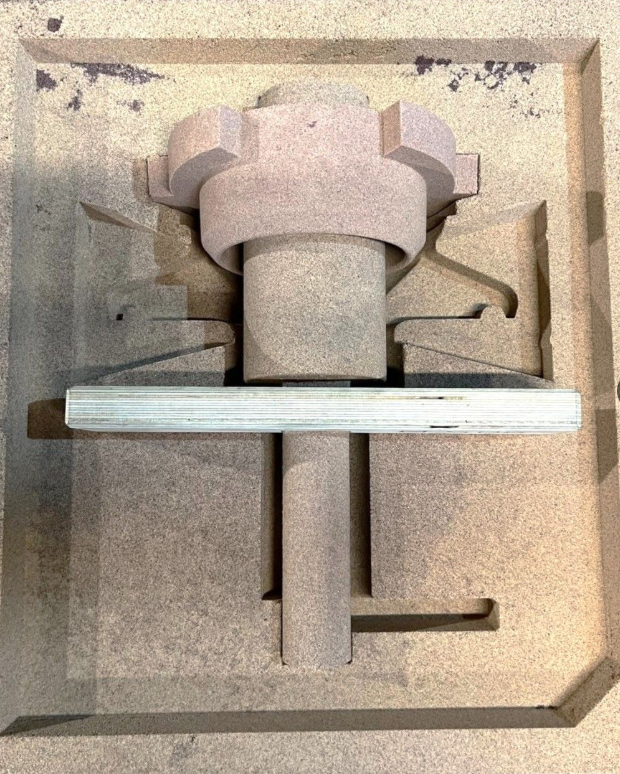
When your part design requires internal voids, undercuts, or cooling channels, a standard sand casting mold isn’t enough on its own—you need precision cores. We handle the entire core-making process in-house, ensuring that the internal geometry of your casting is just as precise as the exterior.
We utilize advanced binder systems to create cores that hold up against the pressure of molten metal but shake out easily during finishing. Our capabilities include:
- Resin Coated Sand (RCS) / Shell Cores: We use pre-coated sand cured in a heated core box. This method provides a smooth surface finish and high strength, which is essential for the intricate internal passageways often required in aluminum casting processes.
- Cold Box Processing: For higher volume projects, we use gas-cured cold box cores. This process eliminates thermal distortion, ensuring the core fits perfectly into the mold print for superior dimensional accuracy.
- Complex Core Assemblies: If a single core can’t achieve your geometry, we engineer and assemble multi-piece core packages to create highly complex sand castings without sacrificing structural integrity.
From Blueprint to Pour: Our Sand Mold Process
We don’t just pour metal; we engineer the entire production lifecycle to ensure repeatability and structural integrity. Our workflow is designed to minimize defects and maximize the lifespan of your tooling. Whether you need a single prototype or a high-volume run, we manage every step of creating a high-performance sand casting mold. For a deeper dive into the fundamentals, check out our guide on what is sand casting and how it works.
Here is how we transform your CAD data into finished sand castings:
- Pattern Engineering: We start by optimizing your digital design. Our engineers simulate metal flow to create an efficient gating system design that prevents turbulence. We then machine a precise match plate pattern—typically from aluminum or tool steel—ensuring the mold cavity matches your exact specifications.
- Sand Preparation: The quality of the surface finish depends heavily on the sand mix. We prepare a specific silica sand mixture tailored to the alloy being poured. For general applications, we utilize green sand molding, while high-precision parts often require resin sand casting (no-bake) for superior dimensional stability.
- Mold Assembly: We pack the prepared sand into the foundry flask, creating the mold halves known as the cope and drag. If your part requires internal hollows, we insert pre-made cores from our core box tooling before securely closing the mold.
- Pouring & Cooling: Once clamped, we proceed with molten metal pouring. We strictly control pour temperature and speed to minimize porosity. The metal is then allowed to cool and solidify completely inside the mold.
- Shakeout & Finishing: We vibrate the mold to break the sand away from the metal. The rough casting then moves to finishing, where we perform shot blasting, gate cutting, and grinding to deliver a clean, ready-to-use component.
Metals We Cast
Our foundry is equipped to handle a diverse spectrum of alloys, giving you the flexibility to choose the exact material properties your project demands. Because the sand casting mold process utilizes refractory silica sand mixtures, we can pour metals with extremely high melting points that would damage other types of permanent molds. We strictly monitor the molten metal pouring process to manage thermal shock and prevent common casting defects like porosity.
We specialize in both ferrous and non-ferrous categories:
- Ferrous Alloys:
- Gray Iron & Ductile Iron: The industry standard for heavy machinery bases, pump housings, and automotive components due to excellent vibration damping and machinability.
- Carbon & Alloy Steels: Ideal for parts requiring high tensile strength and wear resistance.
- Stainless Steel: We frequently cast grades like 304 and 316 for applications requiring superior corrosion resistance. You can learn more about exactly what materials are used in high-temperature casting to see how these alloys perform under stress.
- Non-Ferrous Alloys:
- Aluminum Alloys: Lightweight and corrosion-resistant, perfect for aerospace and transportation sectors.
- Copper-Based Alloys: We cast brass and bronze for marine hardware and valve bodies where friction resistance is critical.
Industries Relying on Our Sand Casting Molds
Our foundry delivers industrial-grade solutions across sectors where component durability is non-negotiable. We specialize in creating the robust sand casting mold tooling required for parts that face high stress, heavy loads, and extreme operating environments. By adapting our gating system designs to specific alloy requirements, we ensure consistent quality for both low-volume prototypes and mass production.
Key sectors we serve include:
- Automotive: We manufacture engine blocks, cylinder heads, and transmission cases. Our process ensures the dimensional stability required for these critical powertrain components.
- Heavy Machinery: From construction to agriculture, we produce large-scale brackets and structural parts. We encourage clients to use rigorous quality verification for carbon steel castings to guarantee these heavy-duty parts meet safety standards.
- Pumps & Valves: Our sand castings are ideal for complex pump housings, impellers, and valve bodies that demand pressure-tight integrity and smooth internal flow paths.
- Marine: We cast corrosion-resistant hardware, oversized anchors, and deck equipment capable of withstanding saltwater environments.
Ensuring Dimensional Accuracy in Sand Castings
Precision isn’t just for aerospace components; it is critical for every sand casting mold we engineer. While sand casting is often associated with rougher finishes compared to other methods, our modern foundry techniques allow us to hold tighter casting tolerances that meet strict industry standards. We operate under rigorous ISO 9001 guidelines, ensuring that every pour delivers consistent, repeatable results for your production line.
We employ a comprehensive quality control system that starts long before the metal melts. By strictly monitoring our silica sand mixtures for moisture, permeability, and strength, we prevent common issues like mold wall movement or gas defects. Once the part is cast, we validate the geometry using advanced metrology equipment. Our commitment to advanced manufacturing standards ensures that every component meets rigorous specifications.
Quality Assurance Protocols
- CMM Verification: We use Coordinate Measuring Machines to compare the final sand castings directly against your original CAD models, ensuring the parting line geometry and critical dimensions match the blueprint.
- Sand Property Testing: Daily lab tests on our green sand and resin sand mixtures ensure the mold maintains high stability during the pour.
- Non-Destructive Testing (NDT): We utilize X-ray and magnetic particle inspection to detect internal porosity or cracks without damaging the component.
- Material Certification: Every batch comes with detailed reports verifying the chemical composition and mechanical properties of the alloy.
Frequently Asked Questions About Sand Casting Molds
What is the difference between Green Sand and Resin Sand molding?
The main difference lies in the binder used to hold the silica sand mixture together. Green sand molding uses clay and water, making it cost-effective and ideal for high-volume runs due to its fast cycle times. Resin sand casting (also known as No-bake) uses chemical binders to create a rigid, hard mold. We typically recommend resin sand for larger, heavier components—such as complex steel casting projects—because it offers better dimensional stability and a superior surface finish compared to green sand.
Can you use 3D printed patterns for sand casting?
Yes. For rapid prototyping or low-volume production, we can utilize 3D printed patterns instead of traditional wood or metal tooling. This approach eliminates the high upfront cost of machining a metal match plate pattern and significantly accelerates the timeline. It allows you to validate your design and test physical aluminum castings or other alloy parts before committing to permanent, expensive tooling.
What are your typical tooling lead times?
Lead times vary based on the complexity of the part and the type of tooling required (e.g., simple cope and drag patterns vs. complex core box tooling).
- Rapid Prototyping: 1–2 weeks (using 3D printed patterns).
- Standard Production Tooling: 3–5 weeks for machined metal patterns.
- Complex Assemblies: 5+ weeks for multi-part molds requiring intricate gating system design.
How do you control casting tolerances?
We adhere strictly to ISO 8062 standards for casting tolerance. To ensure every sand casting mold produces a part that fits your specs, we verify pattern dimensions prior to molding and conduct CMM inspections on the final cast parts. We also carefully manage the parting line geometry and draft angles during the design phase to minimize variations during the pour.
Ready to Optimize Your Casting Production? Don’t let subpar tooling compromise your final product. At PrecisionVast, our engineers are ready to review your CAD files, recommend the optimal sand molding process, and deliver a tooling solution that maximizes your ROI.
Whether you need a rapid prototype using 3D printed patterns or full-scale production tooling for heavy machinery, we have the expertise to make it happen.
- Request a Custom Quote Today
- Speak with a Casting Engineer
- Contact us at [email protected] or call 0546-8781583 to discuss your project specifications.

 English
  German