

What is injection molding Learn the injection molding process materials tooling and DFM guidelines plus insert overmolding and high precision services by precisionvast.
What is Injection Molding? An Overview
When you look at the plastic products surrounding you—from your smartphone case to the dashboard in your car—you’re likely looking at the results of injection molding. At its core, this is a manufacturing powerhouse that allows us to produce complex plastic parts at a massive scale with incredible precision.
Definition of Plastic Injection Molding
Plastic injection molding is a process where we take raw thermoplastic pellets, melt them down until they become a liquid molten plastic resin, and then force them under immense pressure into a custom-designed mold cavity. Once the plastic cools and solidifies, it takes the exact shape of the mold. It is the go-to method for creating high-quality, repeatable parts.
Why Injection Molding is Critical for Modern Manufacturing
In today’s fast-paced market, efficiency is everything. We rely on this process because it solves the biggest challenges in production:
- Scalability: Once the tooling mold is created, the cost per unit drops significantly, making it the most cost-effective solution for high-volume runs.
- Precision and Detail: We can achieve incredibly tight tolerances and complex geometries that other methods simply can’t match.
- Material Variety: You aren’t limited to basic plastics; we use a wide range of engineering resins tailored for strength, flexibility, or heat resistance.
- Waste Reduction: Since we only use the exact amount of material needed for the part, and any excess can often be recycled, it’s a highly efficient system.
Injection molding is the backbone of the
How the Plastic Injection Molding Process Works
Turning raw plastic into a finished, high-precision part is a highly synchronized process. Inside our advanced facility, we utilize specialized injection molding machines to execute this five-step cycle with absolute consistency.
Step 1: Material Preparation & Melting
The process begins with thermoplastic pellets fed from a hopper into a heated barrel. Inside the barrel, a reciprocating screw shears and compresses the material. This mechanical action, combined with external heating bands, transforms the solid pellets into a uniform, flowing molten plastic resin.
Step 2: High-Pressure Injection
Once the correct volume of melt is accumulated, the screw acts as a ram. It forcefully drives the molten plastic through the machine nozzle, runner system, and gates, completely filling the custom mold cavity under immense pressure.
Step 3: Packing & Dwelling
To prevent internal voids and structural defects, the machine maintains a sustained clamping force and packing pressure. This step pushes additional material into the cavity to counteract mold shrinkage as the plastic begins to cool and contract.
Step 4: Cooling and Solidification
The plastic must solidify before it can safely exit the tooling mold. Internal cooling lines run through the mold, circulating water or specialized fluids to pull heat away from the part rapidly and uniformly. This is typically the longest stage of the cycle and is critical for ensuring part stability.
Step 5: Mold Opening & Part Ejection
When the cooling phase finishes, the moving platens of the injection molding machine separate. Mechanical ejector pins strike the back of the part, releasing it from the core side of the mold. The part drops into a collection bin, the mold clamps shut again, and the next cycle immediately begins.
Types of Injection Molding Services Offered by precisionvast
We deliver versatile custom plastic molding solutions tailored to meet the rigorous demands of US manufacturing. Our facility utilizes advanced injection molding machine setups to handle everything from rapid prototyping to high-volume production runs.
Thermoplastic Injection Molding
This is our core plastic injection molding service. We process a wide range of standard and high-grade thermoplastic pellets, melting them down to create highly repeatable, durable parts. This process offers excellent mold shrinkage control, ensuring your final high-precision components perfectly match your target dimensions every single time.
Insert Molding Services
Our specialized insert molding service allows us to place pre-formed parts—such as metal threaded inserts, electronic components, or bushings—directly into the mold cavity before the molten plastic resin is injected. This encapsulates the insert, creating a single, integrated component with superior structural integrity and eliminating secondary assembly costs.
Overmolding & Multi-Shot Molding
For parts requiring a soft-grip exterior or multiple colors, our overmolding process is the ideal choice. We inject a secondary layer of elastomer or plastic over a molded substrate. This multi-shot technique ensures a chemical or mechanical bond that won’t separate, which is perfect for consumer electronics, handheld tools, and medical devices.
Micro-Injection Molding & Thin-Wall Molding
When your project demands extreme precision, we deliver. Our micro-molding capabilities handle incredibly small parts with microscopic tolerances. Additionally, our thin-wall molding expertise allows us to produce lightweight, high-strength enclosures without risking part warping, keeping your production efficient and your material costs low.
Essential Injection Molding Materials & Engineering Resins
Choosing the right molten plastic resin is the most critical decision in the plastic injection molding process. The material you select directly impacts your part’s strength, flexibility, and overall performance. At precisionvast, we work with a massive selection of thermoplastic pellets to match your exact project specifications, whether you need high-volume consumer goods or specialized industrial components.
Commodity Plastics
Commodity plastics are the go-to choice for high-volume, cost-effective production. These materials are highly versatile, easy to process, and ideal for everyday consumer goods.
- Polypropylene (PP): Known for its excellent chemical resistance and elasticity. Frequently used for packaging, consumer products, and living hinges.
- Polyethylene (PE): Highly impact-resistant and flexible, making it perfect for household items and containers.
- Polystyrene (PS): A rigid, cost-effective plastic often utilized for lightweight housings and clear medical laboratory ware.
Engineering Resins
When your application demands superior mechanical properties, standard plastics won’t cut it. Engineering resins are modified to deliver enhanced strength, dimensional stability, and resistance to heat and wear.
- ABS (Acrylonitrile Butadiene Styrene): Combines toughness with rigidity. It delivers a great surface finish and high impact resistance, which is why it is the standard for electronic enclosures and automotive trim.
- Polycarbonate (PC): An incredibly strong, impact-resistant, and naturally transparent plastic. It is widely used for structural components and optical applications.
- Nylon (PA): Exceptional wear resistance and low friction. We frequently utilize nylon for gears, bearings, and heavy-duty industrial components.
High-Performance Polymers
For extreme environments where failure is not an option, high-performance polymers offer metal-replacement capabilities. These materials maintain their structural integrity under intense thermal, chemical, and mechanical stress.
- PEEK (Polyether Ether Ketone): Offers unmatched thermal stability and chemical resistance. It is heavily utilized in medical devices and healthcare applications where components must withstand repeated sterilization.
- PPS (Polyphenylene Sulfide): Provides superb dimensional stability and high-temperature performance, making it a staple for aerospace and under-the-hood automotive applications.
| Material Class | Key Characteristics | Common Applications |
|---|---|---|
| Commodity Plastics | Cost-effective, highly moldable, flexible | Packaging, toys, household goods |
| Engineering Resins | High tensile strength, impact-resistant, stable | Automotive parts, electronics, housings |
| High-Performance Polymers | Extreme heat and chemical resistance, ultra-durable | Aerospace, medical implants, oil & gas |
By optimizing material selection early in the tool design phase, we ensure minimal mold shrinkage and eliminate the risk of structural defects, delivering perfect custom plastic molding parts every single run.
Injection Mold Tooling: Design & Materials
The success of any plastic injection molding project hinges on the quality of your tooling mold. Choosing the right mold design and material determines your production speed, part quality, and overall project cost.
Rapid Prototyping Aluminum Molds vs. Production Steel Molds
When kickstarting a project, balancing speed against longevity is critical. We build our tooling mold options around your specific volume requirements and production goals.
- Rapid Prototyping Aluminum Molds: Ideal for low-volume production runs (typically 1,000 to 10,000 parts) and fast prototyping. Aluminum dissipates heat quickly, reducing cycle times. It allows you to get functional parts in hand fast to validate your design before committing to high-volume tooling.
- Production Steel Molds: Engineered for high-volume manufacturing (hundreds of thousands to millions of cycles). Steel molds offer extreme durability, wear resistance against abrasive engineering resins, and the ability to hold incredibly tight tolerances over long production lifetimes.
| Tooling Feature | Aluminum Molds (Prototypes) | Steel Molds (Production) |
|---|---|---|
| Typical Lifespan | 1,000 – 10,000 cycles | 100,000+ cycles |
| Lead Time | Fast (Days to Weeks) | Longer (Weeks to Months) |
| Initial Cost | Lower upfront investment | Higher upfront investment |
| Wear Resistance | Moderate | Excellent |
Mold Cavitation Strategies
Optimizing your mold cavity configuration is essential to balancing your piece-part cost with your upfront tooling budget.
- Single-Cavity Molds: Produces one part per injection molding process cycle. This is the most cost-effective option for low-volume production or exceptionally large parts.
- Multi-Cavity Molds: Features multiple identical mold cavities to produce several parts in a single cycle. While the initial tooling mold cost is higher, it drastically lowers your per-part cost and speeds up mass production.
- Family Molds: Contains different mold cavities to produce multiple distinct parts of an assembly (such as a top and bottom housing) in a single shot. This ensures the parts use the same batch of molten plastic resin, matching color and material properties perfectly.
To ensure your components are perfectly optimized for the tooling stage, we utilize precise advanced manufacturing methods. For example, our custom tooling and CNC machining capabilities allow us to cut highly precise mold gates and complex runners, preventing mold shrinkage and keeping your production running smoothly.
Critical DFM Guidelines for Plastic Injection Molding
Designing a part for high-quality plastic injection molding requires careful planning. By following strict Design for Manufacturing (DFM) guidelines, we ensure your custom parts roll off the injection molding machine without warping, cosmetic flaws, or structural failures.
Uniform Wall Thickness & Rib Design
Maintaining a consistent wall thickness throughout your part is the single most effective way to prevent mold shrinkage defects like sink marks and internal voids.
- Wall Thickness: Keep walls uniform. If thickness variations are necessary, use gradual transitions to allow the molten plastic resin to flow smoothly.
- Rib Design: To add structural strength without thickening the walls, use ribs. Design ribs to a thickness of 40% to 60% of the main wall to avoid sink marks on the cosmetic surface.
Draft Angles & Undercuts
Without the right geometry, a hardened piece can stick inside the mold cavity, ruining both the part and the tooling.
- Draft Angles: Apply a minimum draft angle of 1° to 2° on all vertical faces to allow easy part ejection. Textured surfaces require additional draft (typically 3° to 5°).
- Undercuts: Minimize or eliminate undercuts whenever possible. Undercuts require complex side-actions or lifters in the tooling mold, which increases your overall manufacturing costs.
Gating and Knit Line Optimization
The location of the gate—where the liquid plastic enters the cavity—determines the strength and appearance of the final product.
- Gate Placement: We strategically place gates in thicker sections of the part to ensure optimal packing and minimize cosmetic blemishes on visible faces.
- Knit Line Prevention: When plastic flows around obstacles like holes, the split flows meet to form knit lines (weld lines). Proper gate positioning ensures these lines occur in low-stress, non-cosmetic areas to prevent structural weak points.
While we focus on optimizing plastic tool designs to perfection, our manufacturing expertise also extends to heavy-duty industrial components, such as high-durability stainless steel casting for specialized hardware.
Global Industries & Applications of Injection Molding
At precisionvast, we deliver high-precision custom plastic molding solutions that power critical industries across the United States. Our advanced injection molding machine setups handle everything from high-volume production runs to specialized, low-tolerance components.
Automotive Components
The automotive sector relies heavily on lightweight, durable materials to improve fuel efficiency without sacrificing safety. We manufacture high-strength dashboards, interior trim panels, brackets, and under-the-hood components using robust engineering resins. Our processes ensure every part withstands intense thermal and mechanical stress.
Medical Devices & Healthcare
Medical manufacturing demands absolute purity and strict defect prevention. We produce medical-grade components, diagnostic equipment housings, syringe assemblies, and fluid delivery parts. Our facilities maintain the clean environments required to meet stringent healthcare standards. For specialized heavy machinery tools or structural components used in medical facility infrastructure, you can explore the benefits of precision casting for machinery parts to see how we handle high-strength metal components alongside our plastics division.
Consumer Electronics
Modern electronics require sleek aesthetics, thin walls, and complex internal geometries. We specialize in custom plastic molding for:
- Handheld device enclosures
- Laptop casings
- Connectors and internal structural frames
- Wearable tech components
Our precise overmolding process seamlessly integrates rigid shells with soft, shock-absorbing outer layers.
Industrial & Aerospace
For industrial and aerospace applications, parts must endure extreme environments. We utilize high-performance thermoplastic pellets to mold heavy-duty gears, seals, aircraft interior panels, and protective housings. By optimizing our tooling mold designs, we guarantee tight tolerances and minimal mold shrinkage for long-term reliability in the field.
Why Choose precisionvast for Custom Injection Molding?
We deliver high-precision custom plastic molding solutions tailored to the strict demands of the United States manufacturing sector. From local startups to Fortune 500 industrial leaders, our clients rely on us for speed, repeatability, and uncompromised part quality.
Advanced Tooling & CNC Machining Capabilities
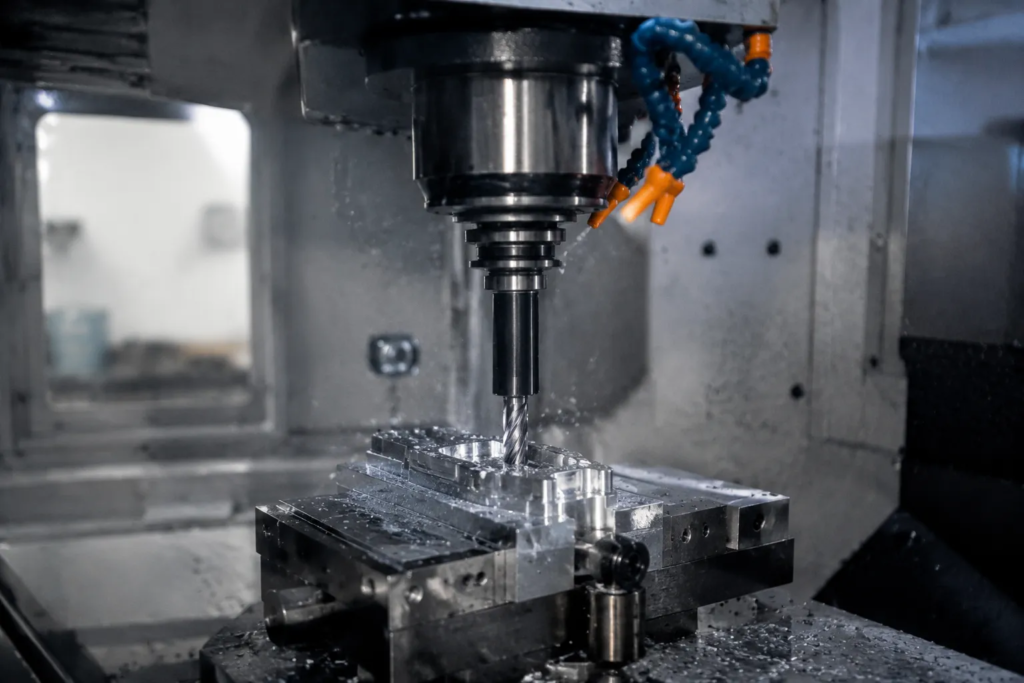
Our facility utilizes state-of-the-art CNC machining centers and EDM technology to cut your tooling mold with extreme accuracy. Whether you require a rapid prototype mold or a high-volume multi-cavity mold, our advanced manufacturing capabilities ensure tight tolerances and flawless surface finishes.
While we specialize in high-performance polymer molds, our cross-industry machining expertise also extends to alternative manufacturing methods like advanced aluminum casting processes for specialized industrial structural components.
Rigorous Inspection & Quality Control Standards
Defect prevention is built into every stage of our production run. We monitor critical parameters in real time to eliminate common molding issues before they happen.
| Quality Control Phase | Inspection Methods & Equipment | Target Defects Prevented |
|---|---|---|
| Tooling Validation | CMM Inspection & Blue Light Scanning | Dimensional variance, flash |
| In-Process Monitoring | Automated clamping force & pressure sensors | Short shots, burn marks, sink marks |
| Post-Production QA | Tensile testing & optical gaging | Mold shrinkage anomalies, warping |
End-to-End Solutions from Prototype to Mass Production
We handle your entire project lifecycle under one roof. Our turnkey service eliminates supply chain fragmentation, saving you time and reducing overall production costs.
- Design Optimization: Comprehensive DFM feedback on your initial CAD models.
- Prototyping: Rapid aluminum tooling to validate form, fit, and function.
- Mass Production: High-efficiency injection molding machines capable of scaling to millions of units.
- Secondary Operations: Post-molding assembly, ultrasonic welding, and custom packaging.
Frequently Asked Questions (FAQs) About What is Injection Molding
What is the typical lead time for an injection mold?
For standard custom plastic molding, prototype tooling molds usually take 2 to 4 weeks. Full-scale production steel molds with a multi-cavity mold design typically require 4 to 7 weeks depending on part complexity. We always optimize the tooling mold phase to compress your time-to-market without compromising precision.
How do you prevent defects like warping or flash?
Defect prevention starts in the design stage. We utilize advanced moldflow simulation to balance the injection molding machine parameters before cutting steel.
- Warping: Controlled by maintaining a uniform wall thickness and optimizing cooling line placement to avoid uneven mold shrinkage.
- Flash: Prevented by calculating the exact clamping force needed and maintaining ultra-tight tolerances on the tool parting lines.
- Sinks & Voids: Managed by fine-tuning the packing pressure and dwelling time as the molten plastic resin cools.
What is the minimum order quantity (MOQ) at precisionvast?
We offer highly flexible manufacturing solutions tailored to the United States market. Our minimum order quantities depend on your project phase:
| Project Phase | Typical Volume | Mold Material |
|---|---|---|
| Prototyping & Bridge Tooling | 100 – 1,000+ parts | Aluminum / Soft Steel |
| Full Production Runs | 10,000+ parts | Hardened Steel |
Whether you need a low-volume run for an insert molding service or high-volume automated overmolding, we scale our production to match your supply chain demands. For deeper insights into managing manufacturing timelines and scaling production, check out our updates on the precisionvast blog.

 German
  English