

Discover expandable casting expendable mold processes advantages materials and precision investment casting services by ISO9001 foundry PrecisionVast.
Are you struggling to manufacture highly intricate metal parts without breaking the bank on secondary machining?
Choosing the right manufacturing method can make a massive difference in your component’s performance and your bottom line.
You might already know that expandable casting (widely known in the industry as expendable mold casting) is the go-to solution for complex geometries and tight tolerances.
But how do you navigate the specific processes, alloys, and quality standards required to get it right?
Well, you’re in for a treat because I’ve put together the ultimate guide.
In this post, you’re going to learn exactly how to leverage the precision investment casting process to achieve near-net-shape perfection, step by step.
This is the exact approach we use to help engineers and OEM designers solve their absolute toughest manufacturing problems.
So if you’re looking to eliminate defects, scale your production, and master expandable casting, this guide is for you.
Let’s dive right in.
Are you hitting roadblocks when trying to manufacture metal components with severe undercuts or intricate internal cavities? When standard machining capabilities fall short, we turn to a more specialized, definitive solution.
What is Expandable Casting?
At its core, expandable casting (widely known as expendable mold casting) is a highly specialized manufacturing process that relies on temporary, non-reusable molds. Instead of machining a permanent two-part steel tool, we build a unique mold for every single part. Once the molten metal is poured and solidified, we completely destroy that mold to extract the final component.
This technique forms the backbone of near net shape manufacturing, ensuring that you get a highly accurate part straight out of the mold.
Expandable vs. Permanent Molds: The Geometry Advantage
Why would we intentionally rely on non-reusable mold casting? It comes down to absolute geometric freedom.
In permanent mold casting, the two halves of the die must physically separate to release the finished part. If your B2B project features intricate internal channels or deep undercuts, a rigid steel mold simply cannot open without damaging the component. By intentionally destroying the shell in expandable casting, we entirely eliminate tool-path restrictions, draft angle requirements, and ejection limits.
Key Advantages of Destroying the Mold:
- Complex Geometric Casting: We can successfully cast intricate internal cavities and hollow sections that traditional CNC machining simply cannot reach.
- Severe Undercuts: Features that would physically lock a part inside a permanent die are easily and accurately formed.
- Zero Draft Angles Required: You are never forced to taper your precision designs just to facilitate mold ejection.
| Feature | Expandable Casting | Permanent Mold Casting |
|---|---|---|
| Mold Lifespan | Destroyed after a single use | Reused for multiple production cycles |
| Undercut Capability | Unrestricted | Severely limited or impossible |
| Design Freedom | Unlimited geometric complexity | Constrained by part ejection limits |
Core Types of Expandable Casting Processes
When we tackle expandable casting projects, we rely on a few specialized methods to get the job done right. Here is a breakdown of the primary processes we use to meet strict US manufacturing demands:
- Precision Investment Casting (Lost-Wax): This is the gold standard for dimensional accuracy. We build a ceramic shell around a wax pattern, melt the wax out, and pour in the metal. It delivers incredibly tight tolerances without the need for extensive secondary machining. To see how we apply this to lightweight alloys, you can review what aluminum investment casting is and how it works.
- Expandable Pattern Casting (EPC) / Lost Foam: Often called evaporative-pattern casting, this method uses expanded polystyrene instead of wax. The molten metal instantly vaporizes the foam upon contact. It is a highly efficient route for near net shape manufacturing, eliminating the need to physically remove the pattern before pouring.
- Sand & Plaster Mold Casting: These classic non-reusable mold casting techniques still hold their ground in specific use cases. Sand casting is ideal for massive, heavy parts where surface finish is a secondary concern. Plaster molds provide a smoother finish but are limited to lower-melting-point metals. While both are cost-effective options, they typically cannot match the complex geometric casting capabilities found in the lost-wax process.
The 14-Step Precision Investment Casting Process for Expandable Casting
We break down our precision investment casting process into four distinct phases. This systematic approach ensures we turn your initial design into a flawless, ready-to-use metal component with maximum efficiency.
Phase 1: Pattern & Shell Creation
We start by building the foundation. This phase is all about creating the exact replica of your final part and the temporary mold that will hold the liquid metal.
- SLA Printing & Mold Design: We kick things off with precise mold tooling design. For rapid prototyping, we use SLA 3D printing to print the patterns directly.
- Wax Injection: We inject melted wax into the aluminum mold to create a perfect wax pattern of your part.
- Pattern Assembly: We take these wax patterns and weld them onto a central wax sprue. This creates a casting “tree.”
- Shell Building: We repeatedly dip the wax tree into a liquid ceramic slurry and coat it with fine sand. This dries to form a rock-hard ceramic shell around the wax.
Phase 2: Casting
This is the core of the lost-wax casting process. We remove the temporary pattern to make way for the actual metal.
- Dewax Operation: We place the ceramic shells into a high-pressure dewaxing kettle. The steam melts the wax out completely, leaving a highly detailed, hollow ceramic mold.
- Pouring Molten Metal: We pre-heat the ceramic shells and pour in the molten metal. We handle a massive variety of alloys during this step, catering to everything from rugged industrial pumps to innovative uses of titanium alloys in medical devices.
Phase 3: Finishing & Machining
Once the metal cools and solidifies, we break it out of the mold and start the refinement process to achieve near net shape manufacturing.
- Shell Removing: We mechanically vibrate and knock away the ceramic shell from the metal tree.
- Shot Blasting: We blast the parts with small metal beads to clean off any remaining ceramic dust and scale.
- Grinding Inlet & Pickling: We cut the individual parts off the central sprue, grind down the gate marks, and use a chemical pickling bath to clean the metal surfaces deeply.
- Polishing: We polish the parts to hit your exact surface finish requirements.
- CNC Machine Shop: While expandable casting gets us incredibly close to the final dimensions, we run the parts through our in-house CNC machining casting process to hit those ultra-tight tolerances.
Phase 4: Quality Assurance
We never ship parts without proving they meet the spec. Every batch goes through rigorous final checks.
- Coordinate Measuring Machine (CMM) Inspection: We use advanced CMM tools to map the physical geometry of the part against your 3D CAD files, ensuring perfect dimensional accuracy.
- Structural Inspection: We run comprehensive X-ray and structural tests to verify there are no internal defects. Whether we are testing lightweight aluminum enclosures or heavy-duty car parts made of high-carbon steel, our testing guarantees reliable performance in the field.
Engineering Advantages of Expandable Casting
Why do we rely on expandable casting for tough manufacturing jobs? It gives us engineering advantages that traditional methods simply cannot match.
- Unmatched Geometric Complexity: Traditional machining hits a wall when you need deep undercuts or intricate internal cavities. Because the mold is destroyed during the process, we can easily pull off complex geometric casting. It solves problem parts that are too difficult, slow, or expensive to mill from a solid block.
- Strict Tolerances & Dimensional Accuracy: You don’t want to pay for extra CNC machining if you don’t have to. Using methods like precision investment casting allows for near net shape manufacturing right out of the gate. We lock in high casting dimensional accuracy that meets strict US industry standards, keeping your secondary finishing costs and lead times low.
- Versatility in Scale: Expendable mold casting is highly adaptable. Whether you need fast rapid prototyping casting to test a new design or you are ready to scale up to full mass production, the process scales seamlessly. It is the perfect solution whether we are casting a handful of custom machinery parts or running high-volume, repeatable OEM batches without dropping quality.
Ideal Materials and Alloys for Expandable Casting
When we set up a production run at our custom metal foundry, material selection is the first detail we lock down. The beauty of expandable casting is its incredible versatility. Because the process uses a non-reusable mold, we can pour a massive variety of metals to meet strict US industry standards without worrying about permanent mold degradation.
Here are the core metals we rely on for precision investment casting:
- Carbon and Alloy Steels: These are our go-to metals for heavy-duty industrial components. They deliver the sheer structural strength and wear resistance required for rugged mechanical applications.
- Stainless & Duplex Stainless Steel: If your OEM parts face harsh, corrosive environments, this is the answer. We cast a lot of stainless steel for medical equipment, marine hardware, and food processing machinery where rust simply is not an option.
- Aluminum & Titanium Alloys: Manufacturers in the automotive and aerospace sectors are always looking to cut weight. These alloys offer incredible strength-to-weight ratios. While it is helpful to understand how sand casting aluminum works for simpler, bulkier items, the expandable casting route is absolutely essential for complex, thin-walled aluminum and titanium geometries.
- High-Temperature Alloys: These are critical for extreme environments like turbines, engine components, or high-stress aerospace fittings. Our expertise in high-temperature alloy casting allows us to manufacture components that hold their integrity under immense heat and pressure.
By matching the right alloy with the expandable casting process, we routinely deliver near net shape manufacturing results that save our clients serious time and money on secondary CNC machining.
Key Industrial Applications for Expandable Casting
As a custom metal foundry, we rely on expandable casting to solve tough manufacturing challenges across major US industries. By leveraging near net shape manufacturing, we deliver highly reliable parts designed for demanding, real-world environments.
Pumps, Valves & Fittings
High-pressure industrial systems demand flawless structural integrity. Expandable casting allows us to produce leak-proof, complex geometric casting designs that handle intense flow and heavy pressure without failing.
Medical Equipment
The healthcare sector requires strictly sanitary, high-precision components. We use the lost-wax casting process to produce detailed surgical tools and critical equipment parts. Because material selection is non-negotiable for sanitation, understanding stainless steels helps us deliver the exact medical-grade alloys required to meet strict industry standards.
Automotive & Marine Hardware
Constant exposure to moisture, salt, and harsh road chemicals destroys weak metals. Our precision investment casting delivers corrosion-resistant, structurally sound hardware built to survive extreme elements for the long haul.
Food Machinery
Processing food safely requires smooth, non-porous surfaces that prevent bacterial growth. Expandable pattern casting delivers durable food-grade metal components with exceptional surface finishes. This cuts down on secondary CNC machining casting work and ensures fast, easy cleaning on the production line.
Why Partner with PrecisionVast for Expandable Casting?
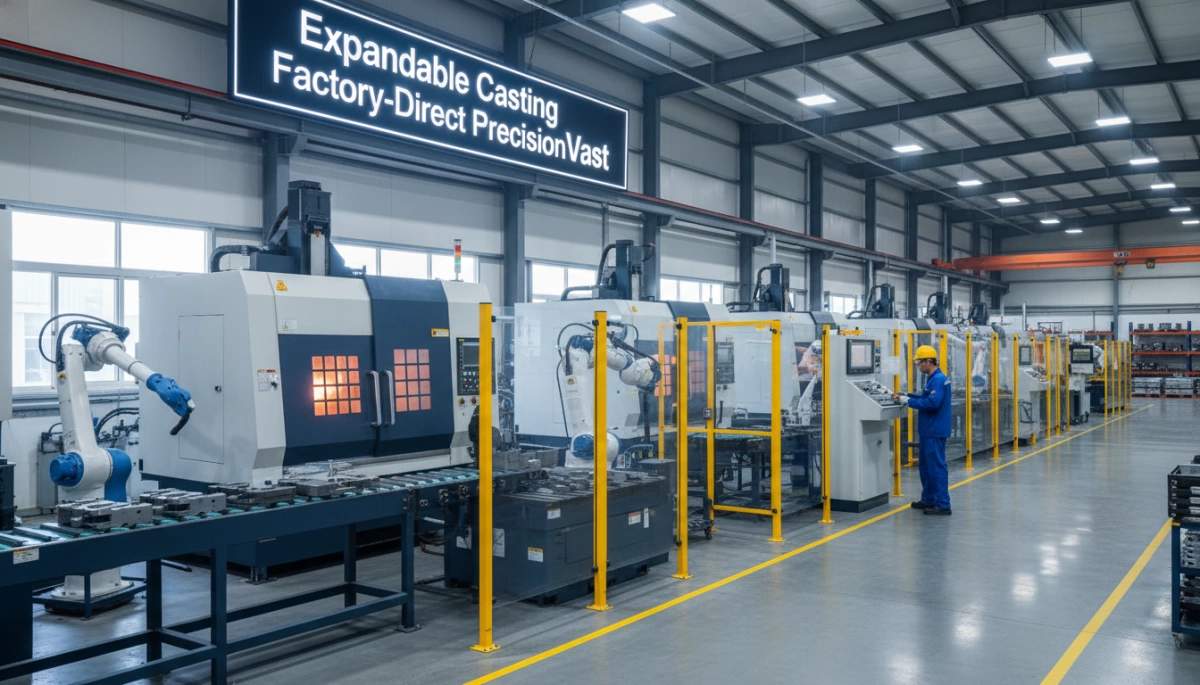
When sourcing parts for the US market, you need a custom metal foundry that delivers on its promises. At PrecisionVast, we manage your expandable casting projects directly, cutting out the middlemen to give you better quality control and faster lead times.
- Factory-Direct Capacity: Our facility is powered by over 200 skilled professionals, delivering a massive 700-ton annual output. We easily scale to meet your exact volume requirements.
- Advanced Engineering: We leverage CAE simulation and SLA 3D printing for rapid prototyping casting. This eliminates guesswork, ensuring a smooth, defect-free process before full production even begins.
- Certified Quality: We are strictly ISO9001 certified. Every order is backed by comprehensive material and X-ray testing reports. From specialized components to standard carbon steel castings for common industrial applications, our coordinate measuring machine (CMM) inspection guarantees strict compliance with your specifications.
- The PrecisionVast Guarantee: We know turnaround time is critical for your bottom line. We guarantee detailed, transparent quotes within just 8 hours to keep your supply chain moving without delays.
FAQs About Expandable Casting
What is the difference between expandable casting and expendable mold casting?
There is no practical difference. In the US manufacturing industry, expendable mold casting is the strict technical term, but we routinely use expandable casting interchangeably. Both describe a non-reusable mold casting process where the mold is intentionally destroyed to extract the final metal component.
How does expandable casting improve dimensional accuracy over traditional methods?
It all comes down to removing the need to split the mold. Because we destroy the shell to get the part out, we can achieve incredible casting dimensional accuracy.
- No parting lines: Eliminates the risk of mold halves shifting during the pour.
- Zero draft angles required: Allows for perfectly straight walls and complex internal cavities.
- Near net shape manufacturing: Produces parts so close to their final specs that heavy secondary CNC machining is often eliminated.
What are the limitations of using lost-foam vs. lost-wax casting for OEM parts?
While both are highly effective temporary mold techniques, they fit different project scopes:
- Lost-Foam (Expandable Pattern Casting – EPC): Excellent for scaling up large, bulky parts efficiently. However, it typically yields a rougher surface finish and can sometimes introduce minor surface porosity.
- Lost-Wax (Precision Investment Casting): The undisputed choice when your OEM parts demand strict tolerances, pristine surface finishes, and complex geometry. It is particularly vital for demanding applications, such as managing the properties of high-temperature alloys where structural integrity cannot be compromised.
 English
  German