

Explore industrial spring types with Precisionvast Compare compression extension torsion and specialty springs for custom engineering.
Introduction to Industrial Mechanical Springs
When you design, build, or maintain industrial machinery, you rely on components that manage energy flawlessly. Mechanical springs are the unsung heroes of modern hardware, acting as the primary components for storing, absorbing, and releasing mechanical energy. From simple consumer goods to complex aerospace actuators, these components keep the world moving.
Defining the Core Mechanics of Force & Elasticity
At its core, a mechanical spring operates on Hooke’s Law. When you apply a force to an elastic object, its displacement or change in shape is directly proportional to that force.
- Spring Rate: This is the measure of spring stiffness, defining how many pounds of force it takes to compress or extend the spring by an inch ($lb/in$).
- Elastic Deformation: High-quality springs deform under a load but return perfectly to their original shape once you remove that load.
- Energy Storage: Springs absorb kinetic energy from impact or movement, store it as potential energy, and release it precisely when needed.
The Role of Precision Springs in Modern Engineering
Modern manufacturing demands tight tolerances. A minor deviation in your spring rate can cause a valve to leak, a switch to fail, or a suspension system to wear out prematurely. High-performance engineering requires helical coil springs and custom components that can withstand millions of cycles without losing their tension or taking a permanent set. Reliability isn’t just a goal; it is a baseline requirement for reducing downtime and maintaining operational safety.
Precisionvast: Your Premier Custom Spring Manufacturing Partner
At Precisionvast, we don’t just manufacture standard catalog parts; we engineer custom solutions tailored to your exact mechanical specs. We understand the unique challenges of the United States industrial market—demanding fast turnarounds, absolute material traceability, and strict quality control.
| Why Partner with Precisionvast? | What It Means for Your Project |
|---|---|
| Advanced CNC Coiling | Perfect geometric consistency across micro-springs and heavy gauges. |
| Tailored Material Selection | Options ranging from high-carbon music wire to corrosion-resistant superalloys. |
| Precision Engineering Support | We assist with spring rate calculation and optimization right from the design phase. |
Whether you are troubleshooting a failing component or launching a brand-new product line, we provide the reliable, heavy-duty custom spring manufacturing your business needs to stay ahead.
Core Classifications of Mechanical Springs & Technical Parameters
Understanding the distinct types of mechanical springs and their technical parameters is essential for matching the right component to your application. Different designs handle forces uniquely based on their geometry and configuration.
Compression Springs (Helical Coil Springs)
Compression springs are open-coil helical coil springs designed to oppose compression along the axis of wind. When you apply an axial load to a compression spring, it stores energy by compressing, pushing back against the applied force to return to its original height.
| Technical Parameter | Description |
|---|---|
| Working Principle | Stores energy via axial compression resistance under an applied load. |
| Axial Load Dynamics | Manages linear force along the central axis; spring rate dictates force per inch of deflection. |
Geometric Variations of Compression Springs
Not all compression setups use a standard straight cylinder. Varying the shape helps manage tight spatial constraints or alters the spring rate performance.
- Cylindrical: The standard straight design with a constant diameter and linear spring rate.
- Conical compression springs: Tapered shape where the coils nest inside one another. This reduces solid height and provides a progressive spring rate.
- Barrel: Wider in the center and narrower at the ends, which helps reduce surging and saves space.
- Hourglass: Narrower in the center and wider at the ends, built to handle unique spatial limitations and minimize resonance.
End Configurations and Their Impact
The way we finish the ends of a compression spring determines how square it sits, how the load distributes, and how it interacts with mating components.
- Open Ends: Coils remain parallel without reducing pitch; requires a rod or shaft for alignment.
- Closed Ends: The final two coils touch, offering better squareness and alignment.
- Ground Ends: The ends are ground flat to provide a flat, stable bearing surface for uniform load distribution.
- Unground Ends: The wire maintains its natural round profile at the tips, which is highly cost-effective for non-critical assemblies.
When designing custom systems, balancing these geometric variations and end styles ensures your machinery achieves maximum fatigue life and stable performance. For additional technical resources on component manufacturing, check out our blog for deep dives into industrial hardware engineering.
Extension Springs (Tension Springs)
Extension springs, or tension springs, are designed to absorb and store energy by resisting a pulling force. Unlike compression variants, these mechanical springs operate with a stretching action. When components pull apart, the spring tries to bring them back together, maintaining tight control over relative movement.
Working Principle & Initial Tension Dynamics
The core mechanics relies on initial tension. During the manufacturing process, the wire is wound tightly against itself. This internal force holds the coils together securely.
Before the spring even begins to extend, the applied load must overcome this built-in initial tension. Once that threshold is crossed, the spring deflects linearly, following precise spring rate calculation models to handle demanding pulling forces reliably.
[Anchor Component] <— (Tight Coils / Initial Tension) —> [Moving Component]
End Hook Types
The reliability of an extension spring depends heavily on how it connects to your assembly. We offer several standard and custom end configurations to match your specific layout:
- Machine Loops: Standard, cost-effective loops where the last coil is set at a full 90-degree angle.
- Crossover Loops: The centerline of the loop aligns perfectly with the center of the spring body, reducing stress concentrations.
- Extended Hooks: Long straight sections before the hook curves, ideal for reaching distant attachment points.
- Threaded Inserts: Solid plugs threaded directly into the coils for heavy-duty setups requiring absolute security and high load capacities.
Choosing the right end configuration ensures smooth mechanical performance and maximizes the overall life cycle of the component.
Torsion Springs: Managing Rotational Force Components
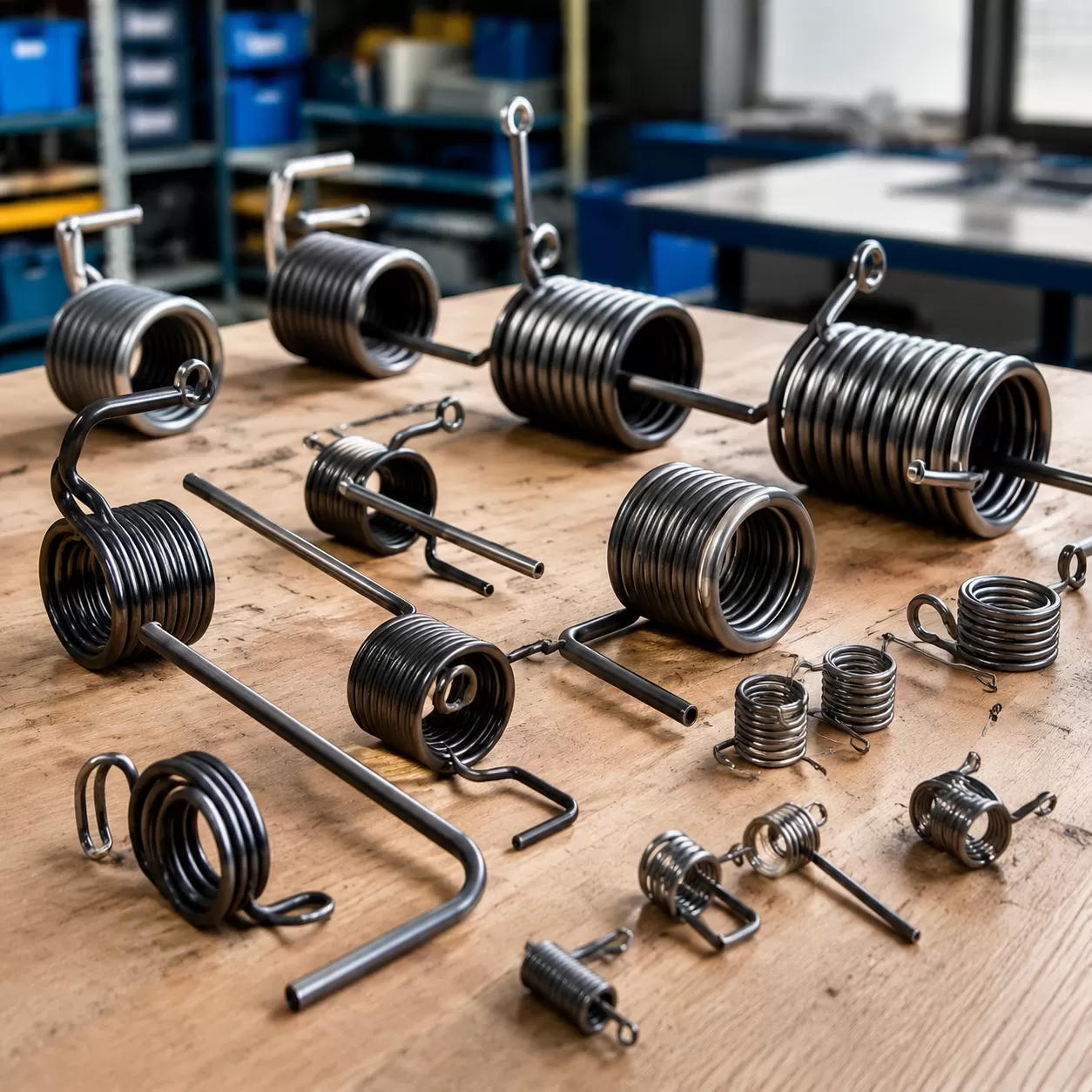
Torsion springs are specialized spring types designed to resist or transmit rotational force, commonly known as torque. Unlike compression springs that compress along an axis, these components work through angular deflection. When you twist the ends of a torsion spring, it exerts a proportional force in the opposite direction, pushing back to regain its original shape.
In our custom manufacturing setups, we ensure the internal diameter decreases and the body length increases slightly during operation. Accounting for these precise mechanical shifts keeps your machinery running without binding or unexpected friction.
Leg Configurations for Every Mechanical Setup
The versatility of torsion springs comes down to their torsion spring legs. How the ends are shaped determines how they attach to your assembly and transfer torque. We craft custom leg styles to drop right into your production lines:
- Straight Legs: The most common style, extending straight out from the coil at a specific angle for simple bracket or pin mounting.
- Hinged Legs: Feature a bend that allows the leg to act as a pivot point, ideal for tight clearances.
- Short Hooks: Specially bent ends that securely latch onto adjacent pins or holes without slipping.
- Custom Bends: Engineered configurations with multiple complex bends to fit unique spatial constraints in specialized equipment.
Whether you need standard configurations or custom bends, getting the leg geometry right prevents premature fatigue and ensures seamless integration with your hardware.
Specialty Industrial Springs
Standard helical coil springs are excellent for everyday applications, but unique mechanical challenges require engineered specialty industrial springs. When spatial constraints, extreme loads, or specific directional forces come into play, these specialized spring types deliver targeted performance.
Belleville Washers & Disc Springs (High Load, Minimal Deflection)
Belleville washers, or conical disc springs, handle incredibly high loads in tightly restricted spaces. By stacking these unique spring types in series or parallel, we can easily customize the spring rate and deflection to meet exact mechanical requirements.
Constant Force Springs (Clock Springs & Power Springs)
Unlike traditional tension springs, constant force springs offer smooth, even resistance throughout their entire extension. Often referred to as clock springs or power springs, they are ideal for counterbalancing mechanisms, seatbelt retractors, and window regulators where consistent force is mandatory.
Wave Springs (Space-Saving Axial Compression)
Industrial wave springs drop the required operating space by up to 50% compared to standard compression springs, without sacrificing force. Their unique wave-like design ensures predictable axial compression within compact, low-clearance assemblies.
Garter Springs (Continuous Radial Pressure Seals)
Garter springs are coiled extension or compression springs with connected ends, forming a perfect circle. They exert a continuous inward or outward radial pressure, making them critical for keeping oil seals, shaft seals, and protective boots tightly fitted.
Heavy-Duty Leaf Springs (Multi-Layered Shock Absorption)
Built from stacked, heat-treated steel flat bars, heavy duty leaf springs are the backbone of heavy vehicle suspension systems. They distribute extreme weights evenly and provide reliable, multi-layered shock absorption across rugged industrial applications.
| Specialty Spring Type | Primary Force Direction | Best Used For |
|---|---|---|
| Belleville Washers | Axial (High Load) | Heavy bolted joints, valves |
| Constant Force Springs | Linear (Uniform Tension) | Retractors, counterbalances |
| Wave Springs | Axial (Compact Space) | Bearings, aerospace valves |
| Garter Springs | Radial (Continuous Press) | Oil seals, piston rings |
| Leaf Springs | Bending (Shock Absorption) | Heavy trucks, trailers |
Industrial Metallurgy: Material Selection for Custom Springs
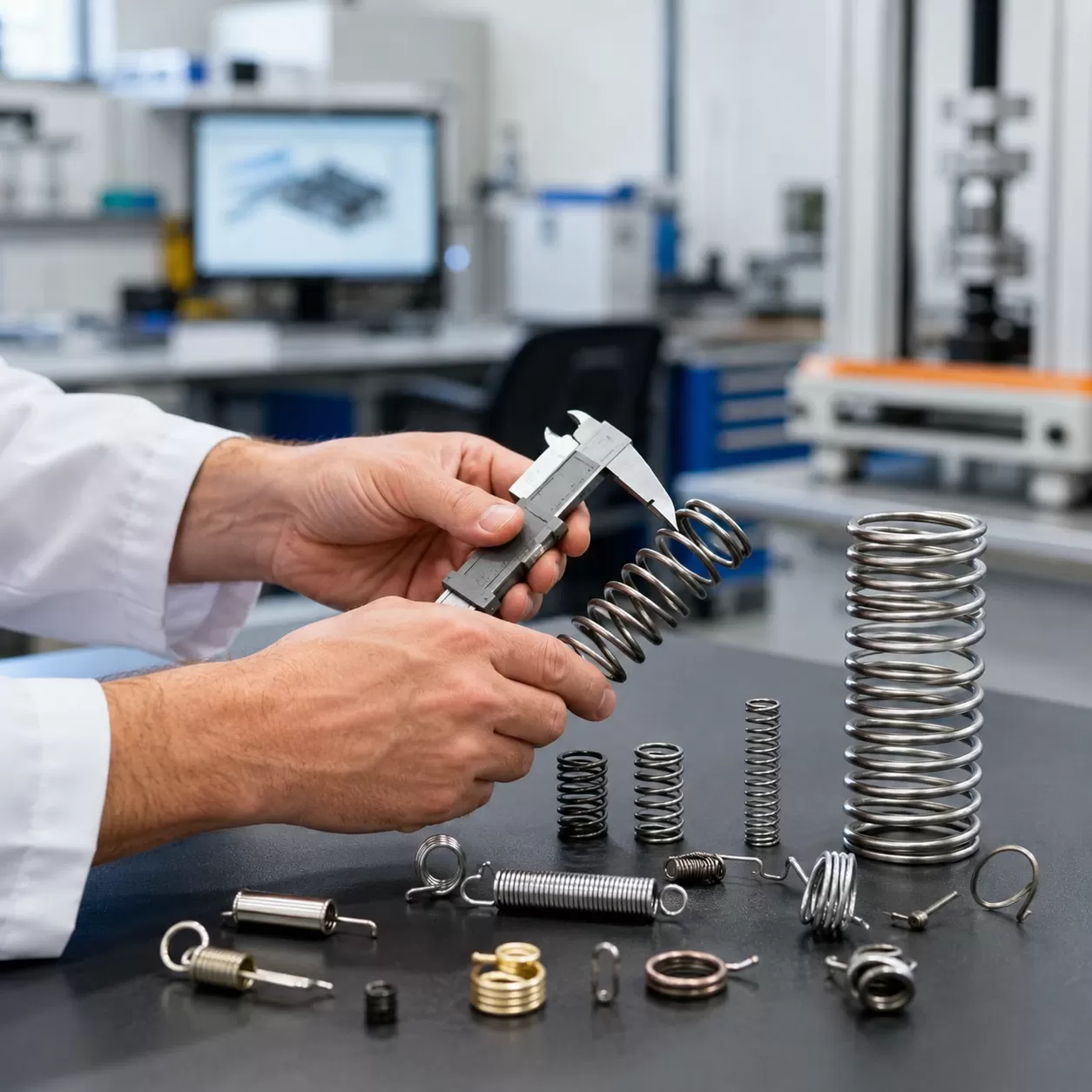
Choosing the right metal is the most critical decision in custom spring manufacturing. The raw material dictates how different spring types perform under pressure, how long they last, and whether they can survive harsh environments. We source and process a wide range of industrial alloys to match your exact performance specs.
High-Carbon Spring Steels
High-carbon steels are the workhorses of the mechanical springs industry, offering excellent tensile strength and affordability for everyday applications.
- Music Wire: High-tensile carbon steel perfect for small, high-stress helical coil springs. It handles repeated cycles beautifully but requires a protective coating to prevent rust.
- Hard Drawn Steel: A budget-friendly choice for low-stress, everyday compression and tension springs.
- Oil Tempered Wire: Pre-hardened material ideal for larger wire diameters and heavy-duty applications that require uniform shock absorption.
Stainless Steel Alloys for Corrosion Resistance
When your operating environment involves moisture, chemicals, or extreme cleanliness requirements, stainless steel coil springs are the industry standard.
| Alloy Type | Key Performance Features | Common Applications |
|---|---|---|
| SS302 | Excellent strength, basic corrosion resistance, non-magnetic when fully annealed. | General-purpose industrial springs, consumer electronics. |
| SS316 | High chloride resistance, superior pitting protection, non-magnetic. | Marine hardware, chemical processing, medical instruments. |
| 17-7 PH | Precipitation-hardened, extreme tensile strength, minimal distortion during heat treatment. | Aerospace components, high-stress valves. |
Alloy Steels for High-Stress Conditions
For heavy industrial machinery and automotive setups, standard carbon steel isn’t enough. We utilize specialized alloy steels that thrive under massive loads and high temperatures.
- Chrome Silicon: Exceptional fatigue life and resistance to load loss (sagging). This is our go-to material for high-performance automotive valve springs and racing suspensions.
- Chrome Vanadium: Known for its tough impact resistance, making it ideal for large-gauge shock absorbers and heavy machinery.
Superalloys & Non-Ferrous Metals
When standard metals fail under extreme heat, cryogenic temperatures, or intense chemical attack, we turn to premium non-ferrous metals and superalloys. Knowing why to choose proven high-temperature alloys for tough applications is vital when designing components for severe operating environments.
- Inconel & Hastelloy: Nickel-chromium superalloys that retain their structural integrity and spring rate at temperatures well above 1,000°F.
- Monel: Highly resistant to sea water and hydrofluoric acids, making it perfect for marine pumps and oil drilling equipment.
- Phosphor Bronze: Offers great electrical conductivity and low friction, which is essential for electrical contacts and rotary force components.
- Titanium: Extremely lightweight with an incredible strength-to-weight ratio, frequently utilized in advanced aerospace designs and biocompatible medical devices.
Engineering & Custom Manufacturing Capabilities by Precisionvast
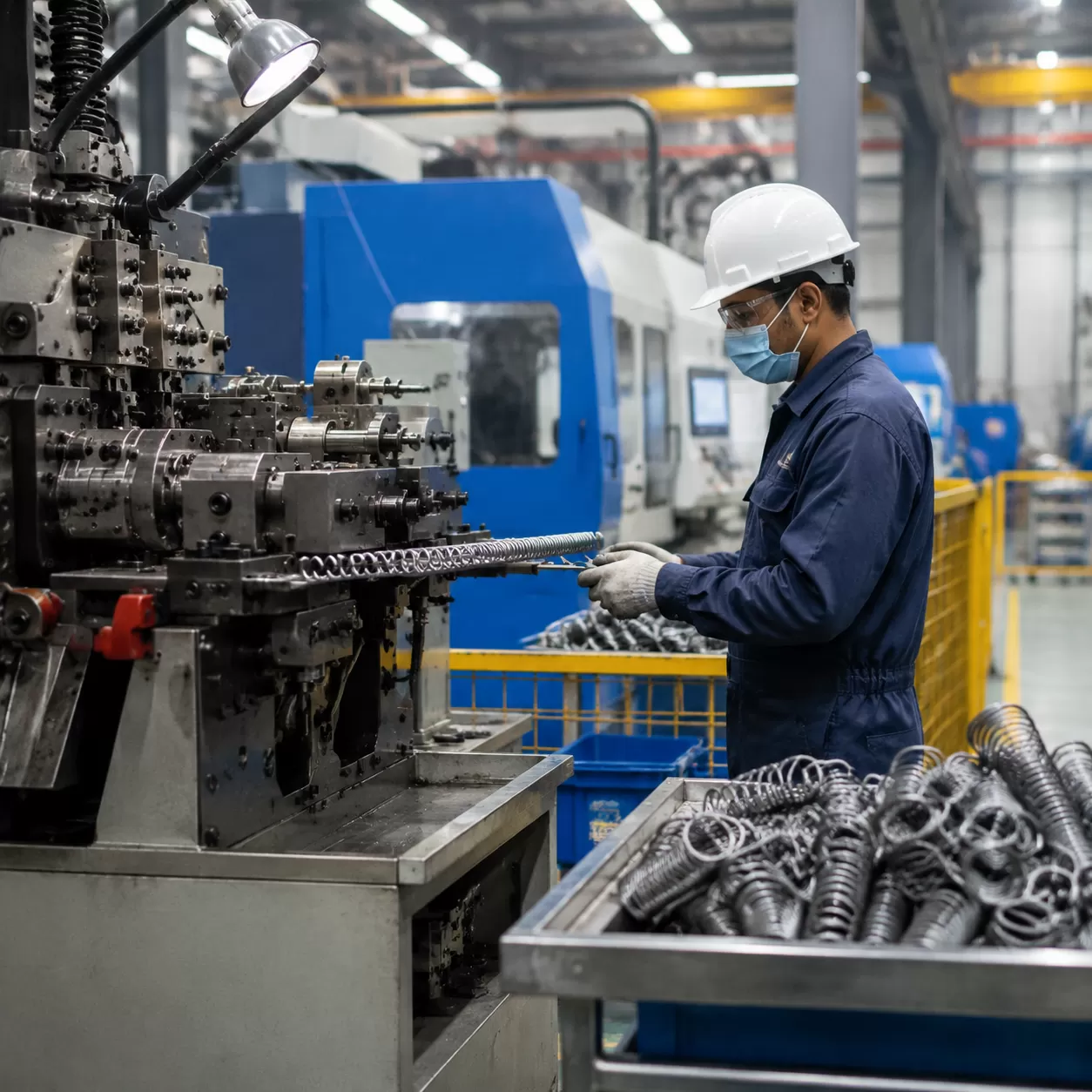
At Precisionvast, we turn complex engineering blueprints into high-performance mechanical springs. Our production facilities are optimized to handle custom spring manufacturing jobs that require strict adherence to tight tolerances, specialized geometries, and demanding performance metrics. We control every stage of the fabrication process to ensure your components perform flawlessly under pressure.
Wire Diameter Capabilities: From Micro-Springs to Heavy-Duty Gauges
Our machinery accommodates an extensive range of wire diameters to meet diverse industrial needs. We utilize advanced CNC multi-axis coilers to manufacture both ultra-fine micro-springs for delicate electronics and massive, heavy-duty gauges for industrial machinery.
- Micro-Wire Spectrum: Precision coiling for medical and electronic applications.
- Standard Industrial Gauges: Optimizing traditional helical coil springs for commercial use.
- Heavy-Duty Rods: Severe-duty hot and cold coiling for infrastructure and heavy equipment.
Precision Tolerances and Spring Rate Calibrations
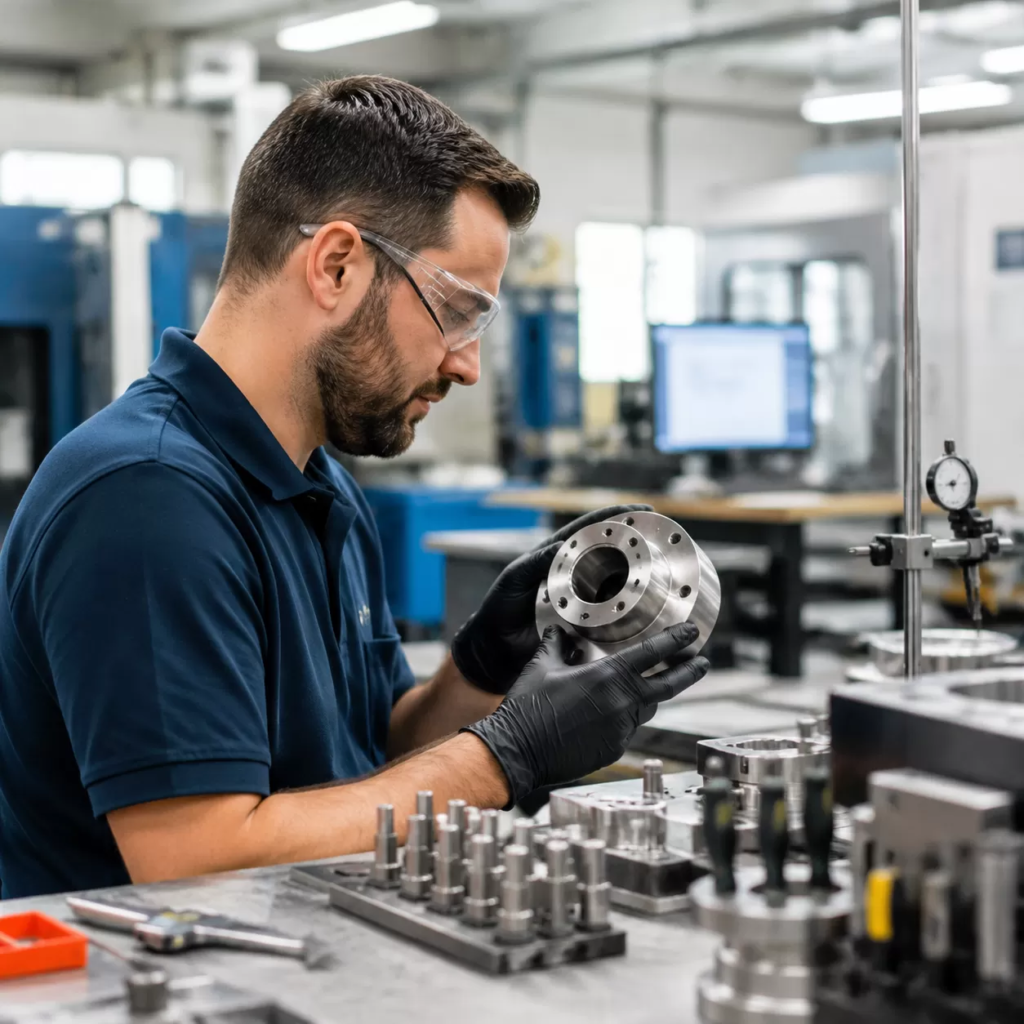
A reliable spring rate calculation is critical to preventing mechanical failure. We calibrate our equipment to deliver exceptionally tight dimensional and load tolerances. Every batch undergoes rigorous spring rate testing to guarantee that the force exerted per inch of deflection matches your exact design requirements. This precision eliminates variance and ensures uniform behavior across thousands of cycles.
Advanced Surface Finishing & Protective Coatings
The longevity of a spring depends heavily on its surface integrity. We offer a comprehensive suite of post-coiling treatments designed to fight corrosion, reduce friction, and eliminate hydrogen embrittlement. For components requiring enhanced wear resistance, our specialized finishing techniques mirror the strict standards used in investment casting surface treatments to ensure maximum durability.
- Zinc, Nickel, and Cadmium Plating: Delivers robust sacrificial and barrier corrosion protection for standard carbon steels.
- Passivation and Black Oxide Treatments: Essential for stainless steel coil springs to remove surface iron and create a sleek, non-reflective protective layer.
- Powder Coating: Provides a thick, impact-resistant physical barrier available in multiple color codes for easy part identification.
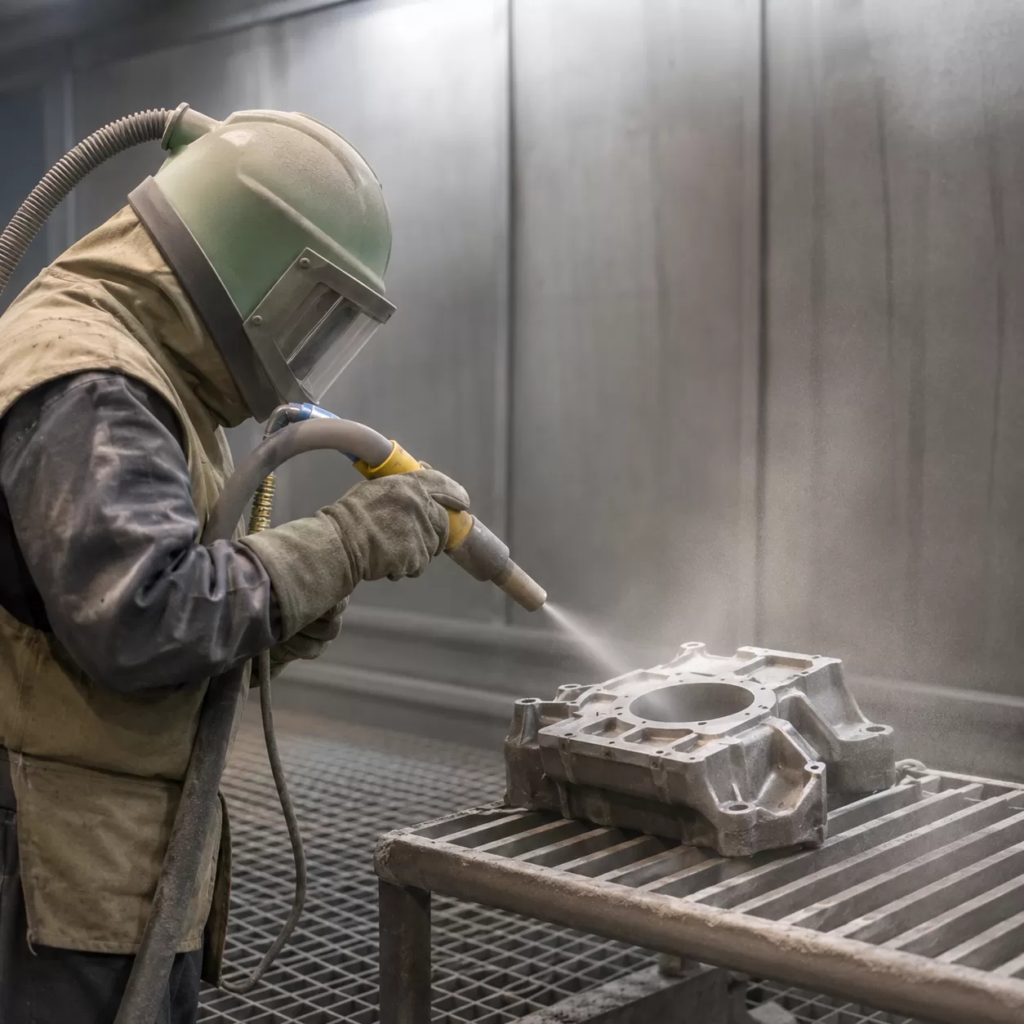
- Shot Peening: Bombards the spring surface with round metallic shot to introduce compressive residual stress, drastically extending fatigue life under cyclic loads.
- Electro-Polishing: Removes microscopic surface imperfections from stainless alloys, yielding a ultra-clean, biocompatible finish.
Critical Engineering Selection Criteria for Spring Types
Choosing the right mechanical springs for your project comes down to a few make-or-break engineering decisions. If you miss a detail here, the spring fails early, or it simply won’t fit your assembly. When designing for performance and longevity, you must calculate three core factors.
1. Determining Operating Environment
The environment dictates your material choice. Extreme heat, freezing temperatures, and corrosive chemicals will quickly degrade standard materials like music wire.
- Temperature Extremes: Standard carbon steels lose their tensile strength in high-heat environments. For extreme thermal applications, engineers must pivot to specialized superalloys. For instance, choosing the best high-temperature alloys for your applications ensures the spring retains its structural integrity and force-generation capabilities without succumbing to thermal relaxation.
- Chemical & Moisture Exposure: Marine, medical, and chemical processing applications require aggressive corrosion resistance. Utilizing stainless steel alloys (like SS316) or applying advanced protective coatings prevents rust and premature failure.
2. Load Profiles: Static vs. Dynamic
Understanding how your spring experiences force determines its fatigue life and total cycle count.
- Static Loads: The spring undergoes a constant, unchanging load or is rarely cycled. The main concern here is resistance to setting or creeping over time.
- Dynamic Loads: The spring undergoes continuous, cyclic deflections (e.g., automotive valves or heavy machinery). Dynamic applications require strict spring rate calculation and precision manufacturing to prevent fatigue cracking. Shot peening is frequently utilized here to increase cycle life.
3. Spatial Constraints & Dimensions
You cannot design a spring in a vacuum; it has to fit the physical envelope of your product.
| Spatial Constraint | Definition & Engineering Impact |
|---|---|
| Outer Diameter (OD) | The outermost limit of the coil. Critical when the spring must fit inside a hole or housing. |
| Inner Diameter (ID) | The interior clearance. Crucial when the spring guides over a rod or mandrel. |
| Solid Height | The total height of the spring when compressed tightly so all coils touch. The spring can never be compressed below this point. |
Cross-Industry Applications of Precisionvast Springs
At Precisionvast, we engineer custom spring types to meet the rigorous demands of various high-performance industries. Our manufacturing capabilities ensure that every spring delivers consistent reliability, whether it is handling massive mechanical loads or operating in highly sensitive environments.
Automotive & Aerospace Systems
Modern vehicles and aerospace configurations demand ultimate reliability under extreme stress. We manufacture high-grade helical coil springs, valve springs, and actuator components designed to withstand severe vibration, rapid cycling, and extreme temperature fluctuations. From suspension systems to critical aerospace controls, these components are engineered for maximum fatigue life.
Medical Devices & Surgical Instruments
Medical applications require absolute precision and strict material compliance. We produce micro-springs and specialized tension components using non-magnetic and biocompatible materials. These springs operate flawlessly in surgical instruments, drug delivery systems, and diagnostic equipment where cleanliness and exact spring rates are non-negotiable.
Industrial Machinery & Heavy Equipment
Heavy industrial environments rely on rugged components to keep production moving. Our facility delivers heavy-duty leaf springs, robust compression springs, and high-load Belleville washers built for harsh operating conditions. These parts provide essential shock absorption and counterbalancing forces in heavy machinery, manufacturing lines, and construction equipment.
Consumer Electronics & Precision Instruments
As devices become smaller and more advanced, spatial constraints become a critical engineering challenge. We supply ultra-compact wave springs, custom torsion spring configurations, and miniature clock springs for consumer electronics and precise calibration instruments. These components deliver the necessary force within tight enclosures without compromising the device’s footprint.
To ensure long-term reliability in these demanding environments, choosing materials that resist degradation is critical. For applications exposed to intense thermal environments, understanding the properties of heat-resistant metals helps ensure optimal material selection and component longevity.
| Industry | Common Spring Types Used | Key Performance Requirements |
|---|---|---|
| Automotive & Aerospace | Valve springs, suspension coils, actuators | High fatigue life, vibration resistance |
| Medical Devices | Biocompatible micro-springs, tension springs | Non-magnetic, precise tolerances, biocompatibility |
| Industrial Machinery | Heavy-duty leaf springs, compression springs | High load capacity, impact absorption |
| Consumer Electronics | Wave springs, miniature torsion springs | Space-saving design, consistent low-force delivery |
Quality Assurance, Testing, and Compliance for Custom Spring Types
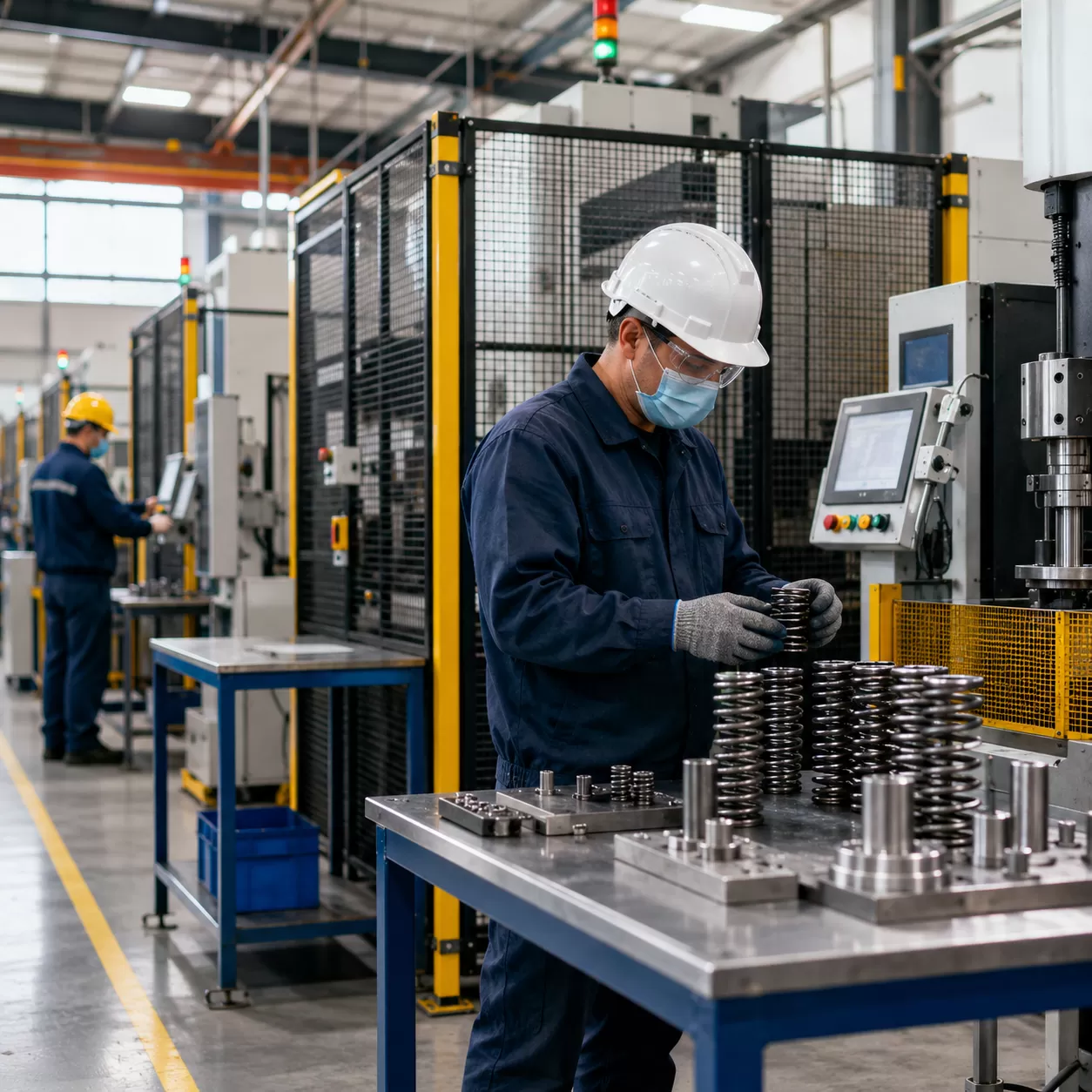
We build reliability into every spring we manufacture. Our commitment to quality ensures that every batch of custom spring types—from heavy-duty coil setups to micro-precision components—performs flawlessly under pressure.
ISO 9001 and IATF 16949 Manufacturing Frameworks
Our production facilities operate under strict ISO 9001 and IATF 16949 automotive-grade quality management systems. These rigorous international frameworks guarantee absolute consistency, process control, and continuous improvement from raw wire to finished product.
Rigorous Testing Protocols
To ensure your mechanical springs survive demanding operational environments, we subject them to a brutal battery of in-house tests:
- Load Testing: Verifies precise spring rate calculations and force tolerances at specific compression or extension heights.
- Cycle & Fatigue Testing: Simulates millions of operational cycles to predict and maximize the lifespan of your components.
- Salt Spray Analysis: Evaluates the durability of advanced surface coatings against harsh environments. Understanding corrosion resistance is critical, especially when evaluating how different metals hold up over time. For a deeper dive into material longevity, you can check out how we evaluate aluminum vs other metals a battle of corrosion resistance in corrosive environments.
Material Traceability & Certification
We maintain an unbroken chain of custody for all raw materials. Every order ships with comprehensive documentation to fulfill your compliance requirements:
| Certification Type | What It Covers | Target Applications |
|---|---|---|
| Material Test Reports (MTRs) | Chemical composition, tensile strength, and metallurgy origin. | Aerospace, Medical, Automotive |
| Certificate of Conformance (CoC) | Verification that parts meet all blueprint dimensions and tolerances. | Defense, Industrial Machinery |
FAQs
What are the most common spring types used in heavy machinery?
Heavy machinery relies on robust components that handle extreme loads and harsh conditions. The most common spring types deployed in these rugged environments include:
- Heavy-duty leaf springs: Essential for multi-layered shock absorption in suspension systems.
- Large helical coil springs: Used as high-capacity compression springs to absorb massive axial shocks.
- Belleville washers (disc springs): Ideal for high-load, minimal-deflection applications like heavy bolting systems.
How do I choose between stainless steel and carbon steel for custom springs?
Choosing the right material depends entirely on your operating environment and stress requirements:
- Carbon Steel (Music Wire, Oil Tempered): Best for high-stress applications requiring superior tensile strength and excellent fatigue life in dry environments.
- Stainless Steel (SS302, SS316, 17-7 PH): Crucial for corrosion resistance, moisture exposure, or high-temperature environments.
For extreme temperatures, choosing specialized heat-resistant metals prevents thermal relaxation and maintains exact spring rates over time.
What information do I need to provide for a custom spring RFQ?
To ensure accurate engineering and an efficient quoting process, your Request for Quote (RFQ) should include the following core details:
- Dimensions: Wire diameter, outer diameter (OD), inner diameter (ID), and free length.
- Performance Metrics: Required spring rate, working load, and maximum deflection limits.
- Material & Finish: Specific alloy type and any required surface coatings (e.g., zinc plating, powder coating).
- End Configurations: Specific styles like closed and ground ends for compression styles, or machine loops for extension styles.
What is the difference between linear and progressive spring rates?
The distinction lies in how the spring reacts to an applied load:
| Spring Rate Type | Performance Characteristic | Common Applications |
|---|---|---|
| Linear Spring Rate | Maintains a constant stiffness, compressing or deflecting at a uniform rate throughout its entire travel distance. | Precision instruments, valves, and standard industrial machinery. |
| Progressive Spring Rate | Features variable spacing or geometry, getting stiffer as the load increases to prevent bottoming out. | Automotive suspensions and high-impact shock absorption systems. |
 English
  German