

At its most fundamental level, the iron casting process involves melting ferrous metals into a liquid state and pouring them into a custom-designed mold to solidify into a specific shape. It is the backbone of heavy industry, allowing engineers to create complex geometries that would be impossible or too costly to achieve through machining alone.
However, not all casting methods deliver the same results. While traditional methods like sand casting are common for rougher components, Precisionvast takes a more sophisticated approach.
We specialize in investment casting (lost-wax casting) for ferrous alloys and steel. This technique offers distinct advantages over standard foundry methods:
- Superior Surface Finish: We achieve smoother surfaces that often eliminate the need for secondary polishing.
- Complex Geometries: Our process handles intricate internal structures and thin walls that other methods cannot support.
- Unmatched Dimensional Accuracy: By using precision wax patterns and ceramic shells, we hold tighter tolerances, ensuring your parts fit perfectly right out of the mold.
Whether you require carbon steel, alloy steel, or specialized ferrous metal casting solutions, our approach bridges the gap between raw durability and engineering precision.
Our Precision Investment Casting Process: Step-by-Step
When it comes to the iron casting process, precision is everything. We rely on the proven lost-wax casting process to deliver consistent, high-quality results. Here is a breakdown of our exact cast iron manufacturing steps:
Phase 1: Mold & Wax Preparation
- Wax Injection: We inject molten wax into an aluminum die to create an exact replica of the final part.
- Pattern Assembly: These wax patterns are attached to a central wax sprue, creating a “tree” ready for the next phase.
Phase 2: Shell Creation & Dewaxing
- Shell Building: We repeatedly dip the wax tree into a ceramic slurry and coat it with fine sand, building a strong, heat-resistant shell around the pattern.
- Dewax Operation & Kettle: The coated assembly is placed into a high-pressure dewaxing kettle. Hot steam melts the wax out of the shell, leaving a perfect hollow cavity.
Phase 3: Pouring & Shaping
- Precision Casting: This is the core of the industrial foundry pouring process. We pour the molten iron or steel into the pre-heated ceramic shells.
- Shell Removing: Once the metal cools and solidifies, we break away the ceramic shell through vibration and mechanical knockout to reveal the solid metal tree.
Phase 4: Finishing & Machining
- Shot Blasting & Grinding: We separate the individual parts from the sprue and use shot blasting to remove any remaining ceramic and smooth the surface.
- Pickling & Polishing: Chemical and mechanical treatments further clean and refine the surface finish of the metal.
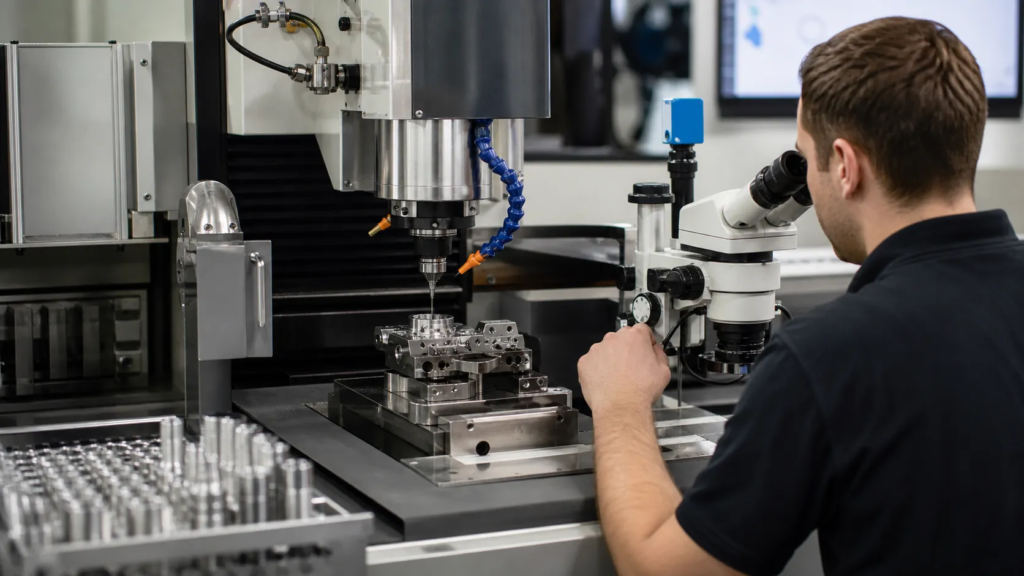
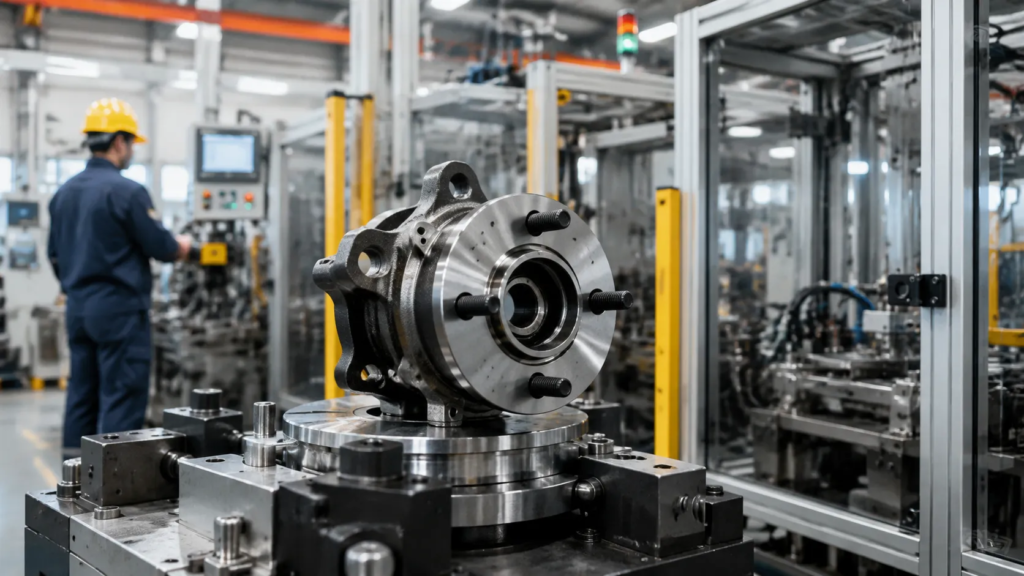
- CNC Machine Shop Integration: For components requiring strict tolerances, we run them through our CNC machining centers. If you are looking into how to import carbon steel precision castings from China, finding a partner with in-house CNC machining is vital to ensure parts arrive assembly-ready.
Phase 5: Quality Assurance
- Comprehensive Inspection: Every component undergoes strict visual and dimensional checks to weed out surface defects.
- CMM Verification: We utilize Coordinate Measuring Machines (CMM) for top-tier foundry quality assurance. This guarantees that your high-precision cast iron parts match your exact engineering blueprints.
Advanced Technology: Why Engineers Choose Precisionvast
Modern manufacturing requires predictive engineering and rigorous validation. At Precisionvast, we integrate advanced technology directly into our iron casting process to ensure structural integrity before production begins.
CAE Simulation for Defect Prevention
We utilize Computer-Aided Engineering (CAE) simulation to visualize the casting process digitally. This allows our engineers to predict exactly how molten metal will flow and cool within the mold. By identifying potential issues like shrinkage, porosity, or cold shuts in the design phase, we eliminate defects before a single drop of metal is poured.
Comprehensive Testing & Validation
Quality isn’t an afterthought; it’s verified at every stage. Our facility is equipped with a full suite of in-house testing equipment to guarantee every batch meets strict ISO9001 standards.
| Testing Method | Purpose |
| X-Ray Inspection | Detects internal voids and cracks invisible to the naked eye. |
| Magnetic Particle Inspection | Identifies surface and near-surface discontinuities in ferromagnetic materials. |
| Hardness Testing | Verifies the material’s resistance to deformation and wear. |
| Spectral Analysis | Confirms the exact chemical composition of the alloy. |
| CMM Verification | Ensures precise dimensional accuracy against the original CAD model. |
Versatile Materials and Industrial Applications
At Precisionvast, we adapt the iron casting process to handle a wide spectrum of ferrous and non-ferrous metals. Our facility is equipped to pour and heat-treat complex chemical compositions to strict metallurgical standards.
Materials We Handle
- Carbon Steel & Alloy Steel: The standard for heavy-duty industrial machinery and structural components.
- Stainless Steel & Duplex Stainless Steel: Critical for applications requiring high corrosion resistance.
- High-Temperature Alloys: Engineered to withstand extreme thermal stress.
- Titanium & Aluminum Alloys: Lightweight, high-strength options for specialized engineering needs.
Industries Served
- Automotive & Aerospace: We manufacture critical engine components and structural parts. For high-stress applications, understanding material science in airfoil construction allows us to optimize alloy selection.
- Pumps, Valves & Fittings: Our castings provide leak-proof integrity and pressure resistance for fluid handling systems.
- Medical Equipment: From surgical instruments to implants, we adhere to exacting tolerances, frequently utilizing titanium alloys for orthopedic devices to ensure biocompatibility.
- Food Machinery & Marine Hardware: We produce parts with smooth surface finishes and rust-resistant alloys, essential for hygiene-critical and saltwater environments.
Frequently Asked Questions (FAQ)
Sand Casting vs. Investment Casting: What’s the Difference?
While sand casting is used for massive, less detailed components, it results in a rougher surface finish and wider dimensional variations. At Precisionvast, we focus on the investment casting process (lost-wax casting). This method creates parts with complex geometries, thinner walls, and superior surface finishes. If your project requires high-performance materials, our process is ideal for working with durable investment casting alloys.
What Standard Tolerances Can We Achieve?
Investment casting naturally offers tighter tolerances than other foundry methods, reducing the need for secondary machining. However, for parts requiring extreme exactness, we integrate our in-house CNC machine shop capabilities. We verify all critical dimensions using CMM (Coordinate Measuring Machine) technology to ensure every batch meets your specific blueprints.
Do You Offer Rapid Prototyping Before Production?
Yes. We know that moving straight to hard tooling is a significant commitment. To mitigate risk, we offer rapid prototyping services, including SLA printing. This allows you to physically validate your design and test form, fit, and function before we begin the full-scale manufacturing run, saving you time and money.

 English
  German