

Titanium melting point 1668C 3034F with precisionvast titanium products specs grades and high temperature applications.
What is Titanium’s Melting Point?
When engineering components for extreme environments, knowing exactly what is titanium’s melting point is critical to preventing catastrophic material failure. As a material supplier, I constantly work with procurement and engineering teams who need precise thermal data for high-stakes applications.
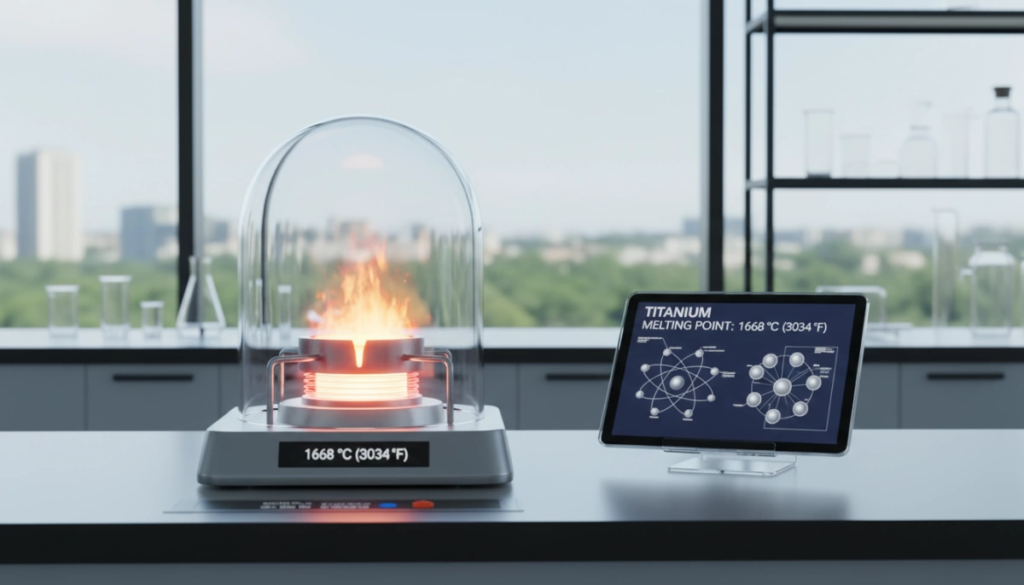
The exact titanium melting temperature for Commercially Pure (CP) Titanium is 1,668°C (3,034°F).
Understanding the Ti melting point Celsius and Titanium melting point Fahrenheit specifications is just the baseline. To see why aerospace and industrial sectors rely on this metal, we have to look at how it performs against other common structural materials. Titanium maintains exceptional structural integrity and an unmatched strength-to-weight ratio even as temperatures rise.
Thermal Comparison: Titanium vs. Other Metals
Here is how commercially pure titanium products compare to other standard industrial metals in extreme heat:
| Material | Melting Point (°C) | Melting Point (°F) | Thermal Performance Profile |
|---|---|---|---|
| Commercially Pure Titanium | 1,668°C | 3,034°F | Superior strength-to-weight ratio at high heat |
| Aluminum | 660°C | 1,220°F | Rapid loss of strength at elevated temperatures |
| Carbon Steel | 1,425°C – 1,540°C | 2,600°F – 2,800°F | Heavy weight penalty for high-heat resistance |
| Inconel 625 (Superalloy) | 1,290°C – 1,350°C | 2,350°F – 2,460°F | Excellent heat resistance but significantly heavier |
By leveraging these thermal properties, engineers can confidently specify titanium for environments where aluminum would melt and steel would add unnecessary weight.
Precisionvast Titanium Product Forms & Inventory

Knowing exactly what is titanium’s melting point is only the first step in engineering for extreme environments; selecting the right material form is what actually brings your project to life. At Precisionvast, we maintain a robust inventory of heat-resistant metal supply designed to meet strict US manufacturing standards. Our precisionvast titanium materials are available in multiple configurations to suit your specific high-heat applications.
Titanium Sheet & Plate
We stock aerospace grade titanium sheet and plate with tight thickness tolerances. These flat rolled products are the go-to choice for high-heat shielding applications, firewall construction, and specialized exhaust components where maintaining structural integrity under thermal stress is non-negotiable.
Titanium Bar & Billet
Our titanium bar stock and billet inventory covers a wide range of diameters tailored for heavy-duty CNC machining and hot forging. Because the titanium forging temperature requires precise control to maintain the metal’s mechanical properties, starting with premium, defect-free billet ensures your final machined components perform flawlessly under pressure.
Titanium Tubing
For high-temperature fluid transfer, we supply both seamless and welded titanium tubing and piping. These tubes offer exceptional corrosion resistance and handle extreme thermal cycling without cracking or degrading, making them ideal for chemical processing and aerospace hydraulic lines.
Custom Forgings & Machined Parts
We provide tailored solutions for specific thermal environments. Whether you need complex geometries or heavy-duty structural components, our custom machining and forging capabilities deliver exact specifications. Just as we focus on how precision casting improves the quality of carbon steel parts for heavy machinery, our custom titanium manufacturing guarantees that every piece of commercially pure titanium products or alloy we produce stands up to the harshest conditions without losing its dimensional stability.
Thermal Properties & High-Temperature Performance

At Precisionvast, we know that while figuring out exactly what is titanium’s melting point is crucial for manufacturing, understanding how the metal behaves as it heats up is just as important. The thermal properties of titanium make it a top choice for extreme environments, but it requires precise engineering to maximize its potential.
Titanium Phase Transition Temperature
Before titanium even gets close to its melting point, it goes through a significant structural shift.
- Alpha to Beta Phase: At approximately 882°C (1,620°F), titanium transitions from an alpha phase (hexagonal close-packed crystal structure) to a beta phase (body-centered cubic).
- Structural Impact: This phase transition alters the metal’s mechanical properties. It becomes more ductile and easier to form, which is great for forging, but engineers must carefully account for this shift when designing load-bearing parts for high-heat applications to maintain structural integrity.
Thermal Conductivity & Expansion
When evaluating the properties of heat-resistant metals, titanium consistently stands out for its reliable dimensional stability.
- Low Expansion Rate: The titanium thermal expansion coefficient is significantly lower than that of aluminum, copper, or stainless steel.
- Dimensional Stability: Because it does not expand drastically when heated, titanium parts maintain their precise shape and tight tolerances even under extreme thermal stress.
Oxidation Resistance
Titanium does not just survive high heat; it actively protects itself from the elements.
- Protective Oxide Layer: As temperatures rise, the surface of the titanium reacts with oxygen to instantly form a hard, protective oxide film.
- Built-in Shield: This naturally occurring barrier prevents further degradation, scaling, and oxidation, ensuring the metal retains its core strength during prolonged exposure to elevated temperatures.
Popular Titanium Grades and Their Temperature Limits
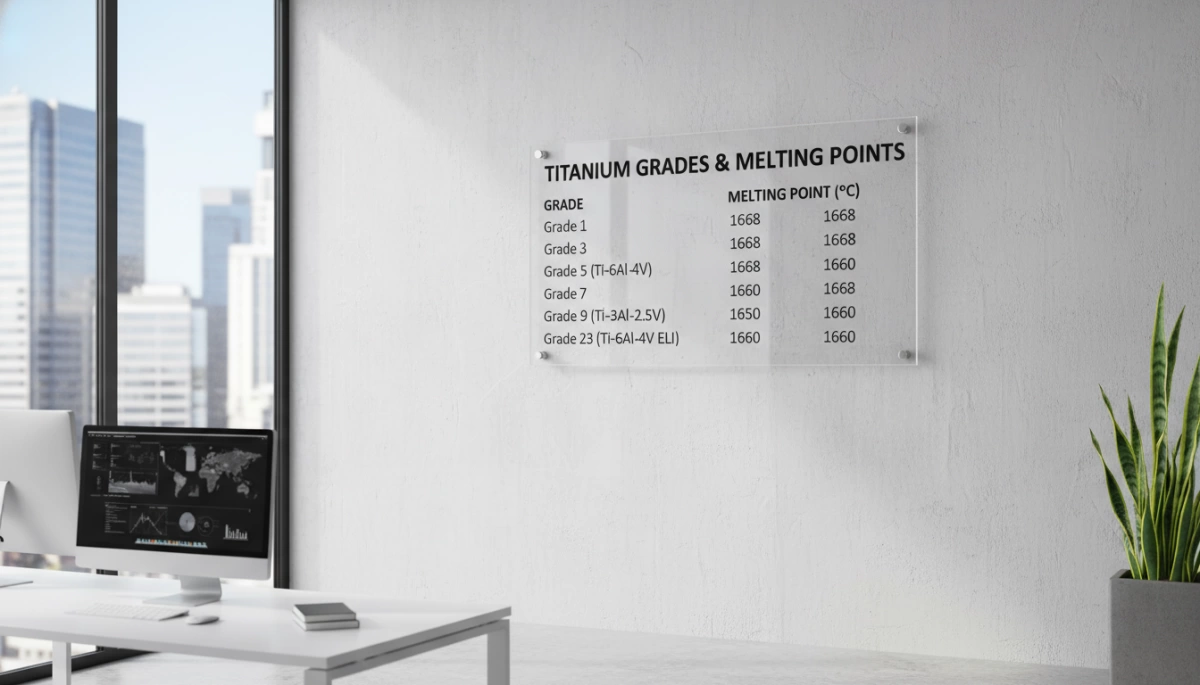
When clients ask me exactly what is titanium’s melting point, I always clarify that the precise number depends heavily on the specific grade. While the base metal handles extreme heat naturally, adding alloying elements shifts the overall titanium melting temperature and dictates how the material performs under continuous thermal stress.
Grade 2: Commercially Pure Titanium Products
Grade 2 is our go-to for unalloyed, corrosion-resistant applications.
- Melting Point: Sits at a highly stable 1,668°C (3,034°F).
- Operating Limit: Even though it takes massive heat to melt, commercially pure titanium products are typically limited to continuous operating temperatures of about 425°C (800°F) to prevent the metal from losing its structural integrity.
Grade 5 (Ti-6Al-4V): The Workhorse Alloy
This is the most widely used titanium grade in the United States, dominating both aerospace and heavy industrial manufacturing.
- Melting Range: The melting point of Ti-6Al-4V is slightly lower than pure titanium, falling between 1,604°C and 1,660°C (2,920°F – 3,020°F).
- Performance: It retains exceptional strength up to 400°C (750°F). When engineers evaluate the key benefits of alloy vs steel castings for demanding environments, Grade 5 frequently wins out due to its reliable strength retention during high-heat exposure.
High-Temperature Titanium Alloys (Ti-6242)
For projects where standard grades fall short, we supply specialized high-temperature titanium alloys engineered specifically for extreme thermal endurance.
- Extreme Heat Resistance: Grades like Ti-6242 are formulated to resist creep and fatigue under prolonged exposure to severe heat.
- Operating Limit: These advanced alloys comfortably handle continuous operating temperatures well over 500°C (930°F), making them non-negotiable for jet engine components and high-performance motorsport exhausts.
Industrial Applications Requiring High Melting Point Metals

Understanding exactly what is titanium’s melting point is critical for industries that push materials to their absolute limits. Because it can handle extreme temperatures without failing, engineers rely on this metal for applications where standard steel or aluminum would simply melt or warp. When sourcing a reliable heat resistant metal supply, these high-stakes sectors demand uncompromising performance and dimensional stability.
Here is how major industries utilize titanium’s extreme heat resistance:
- Aerospace & Defense: Jet engine components, exhaust systems, and spacecraft structures rely heavily on aerospace grade titanium sheet and forged parts to survive intense atmospheric friction and core combustion temperatures.
- Chemical Processing: Heat exchangers and industrial reactors require materials that withstand both high heat and aggressive corrosion. Titanium maintains its structural integrity and safety in these volatile environments.
- Motorsport & Automotive: High-performance exhaust systems and engine valves use titanium to shave off massive amounts of weight while surviving the blistering heat of the race track.
- Medical Manufacturing: Sterilizable surgical instruments and medical implants benefit from this high melting threshold, easily enduring repeated high-temperature autoclave cycles without losing their shape or strength.
Technical FAQs on Titanium’s Heat Resistance
When evaluating what is titanium’s melting point for industrial applications, specific technical questions frequently arise regarding its behavior under extreme thermal stress. Here are the direct answers to the most common concerns regarding titanium’s heat resistance.
Does Titanium Weaken Before It Melts?
Yes. Like all metals, titanium experiences a reduction in structural integrity long before reaching the actual titanium melting temperature. While it boasts an exceptional strength-to-weight ratio, standard commercially pure titanium and common alloys begin to lose significant tensile strength when continuous operating temperatures exceed 400°C (750°F).
Extreme Heat Effects on Titanium
Heating titanium to extreme temperatures triggers specific physical and chemical reactions. We monitor these changes closely during manufacturing and application design:
- Phase Shift: At approximately 882°C (1,620°F), titanium undergoes a critical phase transition, altering its internal crystalline structure.
- Embrittlement: If heated above 427°C (800°F) in an open atmosphere, titanium rapidly absorbs oxygen, nitrogen, and hydrogen, causing the metal to become brittle and prone to cracking.
- Oxidation: A thick, protective oxide layer forms rapidly, which can discolor the metal and alter surface dimensions.
Welding and Titanium’s Melting Point
Because the Ti melting point Celsius sits at a staggering 1,668°C, fabrication requires intense, highly focused heat input. This high melting threshold directly dictates our welding and manufacturing protocols. The extreme heat required to melt the metal, combined with its high reactivity at elevated temperatures, means we must use strict TIG welding procedures with 100% argon trailing shields. Understanding these thermal dynamics is also crucial when we utilize high-heat manufacturing processes like investment casting to produce complex, defect-free components.
Titanium Thermal Behavior Quick Reference
| Thermal Event | Temperature Threshold | Primary Effect |
|---|---|---|
| Strength Reduction | > 400°C (750°F) | Gradual loss of tensile strength |
| Atmospheric Reactivity | > 427°C (800°F) | Embrittlement without shielding gas |
| Phase Transition | ~ 882°C (1,620°F) | Structural shift (Alpha to Beta phase) |
| Complete Melting | 1,668°C (3,034°F) | Transition to liquid state |


 German
  English