

High precision CNC machine precision solutions with tight tolerances thermal stability and reliable machining for automotive industrial parts.
Technical Pillars of CNC Machine Precision
Achieving micron-level machining requires more than just high-quality software; it demands a mechanical foundation where every component minimizes error. At Precisionvast, we build our machines on four technical pillars that ensure CNC machine precision remains consistent under heavy workloads.
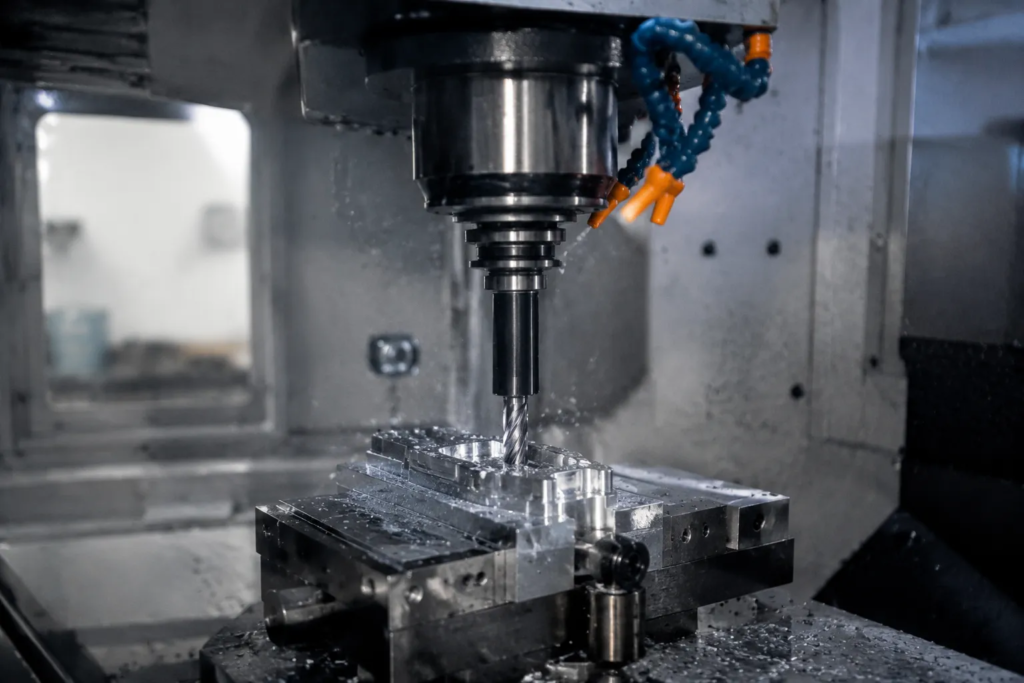
The Spindle Assembly: Stability at High RPMs
The spindle is the heart of the machine. To prevent spindle runout and maintain positioning accuracy, we focus on thermal management and rotational balance. High-speed milling generates heat that can cause tool deflection; our systems use liquid cooling to stabilize temperatures.
| Feature | Technical Benefit |
|---|---|
| Runout Control | Limits deviation to <0.002mm for superior tool life. |
| Thermal Stabilization | Active cooling prevents Z-axis growth during long cycles. |
| High RPM Balance | Eliminates centrifugal vibration for smoother finishes. |
Linear Motion Systems and Structural Rigidity
To eliminate ball screw backlash, we utilize pre-loaded, double-nut ball screws. These are paired with roller-type linear guides, which offer higher contact surface area than ball-type guides, resulting in superior dimensional tolerance and load capacity.
The “skeleton” of our equipment is crafted from Meehanite cast iron. This high-density material is renowned for its vibration-dampening properties. By using a rigid, heavy base, we effectively eliminate “chatter”—the harmonic vibrations that ruin sub-micron finishes.
- Pre-loaded Ball Screws: Ensures zero-play movement during direction changes.
- Roller-type Guides: Increases rigidity by up to 30% over standard guides.
- Meehanite Bases: Absorbs kinetic energy to protect part geometry.
Feedback Loops: Real-Time Correction
Even the best mechanical parts experience minute deviations. We integrate linear scale feedback to create a closed-loop control system. Unlike “open-loop” systems that only trust the motor’s position, our optical scales measure the actual physical location of the machine table.
- Closed-Loop Control: Detects and corrects errors in milliseconds.
- Optical Scales: Provide 0.1-micron resolution for tight tolerance components.
- Thermal Compensation: Software algorithms adjust for environmental shifts in real-time.
Precision Specifications and Tolerances
When we talk about CNC machine precision, we aren’t just chasing small numbers; we are ensuring that every single part coming off the line is identical to the first. In the United States manufacturing landscape, meeting tight dimensional tolerances is the baseline for staying competitive in high-stakes industries.
Geometric Accuracy: Standard vs. Ultra-Precision
Geometric accuracy defines the machine’s ability to move exactly where it is told. While standard machines handle general industrial work, our ultra-precision setups are designed for micron-level machining.
| Feature | Standard Range | Ultra-Precision Range |
|---|---|---|
| Positioning Accuracy | ±0.005 mm | ±0.001 mm or less |
| Spindle Runout | < 0.003 mm | < 0.001 mm |
| Typical Application | General hardware | Medical/Optics |
Repeatability and Process Capability
Consistency is the soul of mass production. We don’t just hit the mark once; we hit it every time. By maintaining a Cpk of 1.67, we ensure that our processes are statistically capable of producing zero-defect parts even during long-duration runs. High repeatability means your assembly line never slows down due to out-of-spec components.
Surface Finish Excellence
Precision isn’t just about size—it’s about the feel and the look. For automotive mirror finishes or specialized valves, we achieve sub-micron Ra values. Using high-speed milling and vibration-dampening tech, we eliminate tool marks to provide a flawless surface right off the machine.
- Ra 0.1 – 0.4 µm: Ideal for high-end automotive and decorative parts.
- Reduced Friction: Essential for understanding high-temperature alloys for critical applications where surface integrity affects part longevity.
- Zero Post-Processing: Our accuracy often eliminates the need for secondary polishing or grinding.
Why Precision Matters: Industry-Specific Applications
In our world, CNC machine precision isn’t just a metric—it’s the difference between a successful launch and a catastrophic failure. We specialize in delivering tight tolerance components that meet the rigorous demands of the U.S. industrial sector. When your project involves high-stakes environments, “close enough” is never an option.
Automotive and EV Innovation
The shift toward Electric Vehicles (EVs) has pushed requirements for dimensional tolerance to new extremes. We focus on:
- Battery Housings: Ensuring perfect seals to prevent thermal runaway.
- Motor Shafts: High-speed rotation requires near-zero spindle runout to prevent vibration.
- Transmission Components: Smooth power transfer depends on micron-level gear mesh.
Aerospace Excellence
Aerospace parts often involve complex geometries carved from high-temp alloys that are notoriously difficult to machine. We utilize multi-axis CNC equipment to maintain accuracy across 5-axis tool paths, ensuring structural integrity in turbine blades and fuel system manifolds. To ensure the highest quality in these builds, we often integrate x-ray testing for investment casting to verify internal soundness before the final precision machining stage.
Medical Device Reliability
For medical professionals, there is no margin for error. We produce biocompatible implants and surgical tools that require zero-defect reliability.
- Sub-micron finishes are mandatory to prevent bacterial growth on implant surfaces.
- Precise positioning accuracy ensures that robotic surgical components respond with absolute fluidity.
of Industry Requirements
| Industry | Primary Focus | Typical Tolerance Requirement |
|---|---|---|
| Automotive/EV | Thermal Management & NVH | $pm 0.01mm$ |
| Aerospace | Strength-to-Weight & Heat Resistance | $pm 0.005mm$ |
| Medical | Biocompatibility & Surface Integrity | $< 0.5 mu m Ra$ |
By maintaining a strict closed-loop control system, we ensure that every part—whether it’s a titanium bone screw or an aluminum EV housing—meets the exact specs required by your industry. If you are looking for high-quality base materials for these components, we offer specialized aluminum investment casting that serves as a perfect foundation for high-precision finishing.
Precisionvast’s Integrated Manufacturing Advantage
At Precisionvast, we don’t just assemble parts; we control the entire lifecycle of a component to ensure CNC machine precision remains unmatched. By managing everything in-house, we eliminate the “tolerance stack-up” that occurs when a part moves between multiple vendors.
From Casting to Finishing: The One-Stop Edge
Most machine shops outsource their raw blanks, but we start at the foundational level. By integrating the basics of iron casting directly into our workflow, we ensure the structural integrity of the base material before it ever hits the spindle. This “One-Stop” approach reduces cumulative errors and guarantees that tight tolerance components meet your exact specs every single time.
- Reduced Handling: Fewer transfers between facilities mean less risk of physical damage or misalignment.
- Thermal Consistency: Internal control over heat treatment prevents material warping during high-speed milling.
- Accountability: One team manages the transition from raw mold to micron-level machining.
ISO-Certified Quality Protocols
Precision isn’t an accident—it’s a governed process. Our facility operates under strict ISO 9001:2015 and 14001:2015 protocols to maintain a professional, reliable output for the U.S. market.
| Certification | Focus Area | Benefit to Customer |
|---|---|---|
| ISO 9001:2015 | Quality Management | Guaranteed positioning accuracy and repeatable results. |
| ISO 14001:2015 | Environmental Impact | Lean, sustainable manufacturing that lowers long-term costs. |
We also specialize in high-performance materials, providing a complete guide to high manganese steel castings for clients dealing with extreme wear environments. Our integrated system ensures that even the toughest alloys are machined with the sub-micron finish your high-stakes projects demand.
Maintaining CNC Machine Precision Over Time
Buying a high-end machine is only half the battle; keeping it accurate requires a disciplined maintenance strategy. At Precisionvast, we treat CNC machine precision as a moving target that requires constant monitoring to offset mechanical wear and environmental shifts.
Calibration Protocols
We don’t guess when it comes to accuracy—we measure. To ensure every Vertical Machining Center (VMC) in our fleet performs to spec, we utilize industry-standard diagnostic tools:
- Renishaw Ballbar Testing: This allows us to check for circularity and servo tracking errors, identifying backlash or leveling issues before they ruin a part.
- Laser Interferometer: We use this for ultra-precise linear calibration, measuring positioning accuracy down to the micron level across the entire travel of the machine.
Environmental Control and Thermal Drift
Even the best hardware fails if the room is too hot. Thermal compensation software helps, but it can’t replace a stable environment. Our shop floors are climate-controlled to minimize “thermal drift”—the expansion or contraction of machine castings due to temperature swings.
When working with sensitive materials, such as heat-resistant metals, even a $2^{circ}text{C}$ change in ambient air can push a tight-tolerance part out of spec. By stabilizing the air, we ensure our tight tolerance components remain consistent from the first shift to the last.
Frequently Asked Questions (FAQ)
We know that CNC machine precision can be a complex topic. Here are the straight answers to the most common questions we hear from our partners across the United States.
What is the difference between CNC accuracy and repeatability?
While people often use these terms interchangeably, they mean very different things in a machine shop:
- Accuracy: This is the machine’s ability to hit a specific target coordinate. If you program a cut at 5.000mm, accuracy is how close the tool actually gets to that mark.
- Repeatability: This is consistency. It measures how closely the machine can return to the same position over and over again. High repeatability is what allows us to maintain Cpk 1.67 consistency during massive production runs.
How does material hardness affect machining precision?
Harder materials, like those found in our guide on heat-resistant metals for high-temperature use, create more tool pressure and heat. This can lead to tool deflection or “chatter,” which compromises dimensional tolerance. We counter this by using ultra-rigid Meehanite bases and specialized coating tools to ensure micron-level machining regardless of the alloy’s toughness.
How often should a high-precision CNC machine be calibrated?
For standard operations, a full calibration every 6 to 12 months is typical. However, for tight tolerance components used in aerospace or medical fields, we perform more frequent checks. We utilize:
- Renishaw Ballbar testing for circularity and geometric health.
- Laser interferometers to verify linear positioning accuracy.
- Daily warm-up cycles to stabilize the spindle before any chips fly.
What role does thermal compensation play in daily operations?
Metal expands when it gets hot. As a Vertical Machining Center (VMC) runs, the spindle and ball screws generate heat, which can cause “thermal drift.” Thermal compensation uses sensors and software to shift the machine’s coordinates in real-time, offsetting this expansion. This ensures that the part you cut at 8:00 AM is identical to the one you cut at 4:00 PM, maintaining a sub-micron finish throughout the shift.
Get a Quote for Your High-Tolerance Project
Ready to turn your complex designs into reality? We specialize in CNC machine precision that meets the most demanding American industrial standards. Whether you are dealing with exotic alloys or intricate geometries, our team is ready to provide the technical backbone your project requires.
Consulting with Our Engineering Experts
We don’t just take orders; we solve problems. When you consult with our engineers, you gain access to decades of expertise in micron-level machining and material science. We dive deep into your custom requirements to ensure every tight tolerance component is optimized for both performance and manufacturability.
- Custom Design Review: We analyze your CAD files for potential precision bottlenecks.
- Material Guidance: Specialist advice on how titanium alloy casting or high-temp superalloys affect final tolerances.
- Strategic Optimization: Streamlining workflows to maintain positioning accuracy while reducing lead times.
Technical Feasibility Studies
For high-stakes projects, guesswork isn’t an option. We offer comprehensive feasibility studies for parts requiring sub-micron finishes or extreme geometric accuracy. We evaluate your specs against our multi-axis CNC equipment capabilities to guarantee 100% compliance before the first chip is even cut.
| Service Feature | Benefit to You |
|---|---|
| Feasibility Analysis | Identifies risks in tight-tolerance designs early. |
| Rapid Quoting | Fast turnaround to keep your production timeline on track. |
| Validation Protocols | Ensuring every part hits the required Cpk 1.67 consistency. |
Contact us today to request your technical study and secure a quote for your high-tolerance manufacturing needs. We provide the reliability and “one-stop” integrated advantage your business deserves.

 English
  German